
Hello, Space Rangers! Are you ready to blast off on an adventure to the coldest, most distant parts of our solar system? We're going to answer a really big question: what is the Kuiper Belt?
Imagine our solar system is a giant spinning disc. Now, picture a huge, frosty doughnut floating way out at the very edge, far beyond the orbit of Neptune. That's the Kuiper Belt! It's a cosmic treasure chest packed with billions of icy, rocky leftovers from when the planets were first forming, all those years ago.
Preparing for Your Kuiper Belt Mission

Get your explorer gear ready, because this is one of the most mysterious places in our entire cosmic neighbourhood. The Kuiper Belt isn't just empty space; it’s a bustling region full of secrets just waiting for us to discover.
This chilly frontier holds clues about how our solar system was born. By studying it, scientists can learn how everything—including our own planet Earth—came to be. It’s like being a space detective, piecing together a puzzle that’s billions of years old!
Before we zoom off, let's get a quick mission briefing with some top-secret facts.
Kuiper Belt Quick Facts for Space Rangers
| Fact | What It Means |
|---|---|
| Location | Beyond Neptune's orbit, from 30 to 55 AU from the Sun. |
| Discovery | Predicted in 1951, but first object confirmed in 1992. |
| Composition | Icy bodies made of frozen methane, ammonia, and water. |
| Famous Residents | Dwarf planets like Pluto, Eris, Makemake, and Haumea. |
| Known Objects | Over 2,000 confirmed, but scientists think there are trillions! |
Now you've got the basics, let's dive in deeper.
A Cosmic Time Capsule
The Kuiper Belt is an enormous ring of cosmic leftovers from 4.6 billion years ago. It’s not only home to famous dwarf planets but it's also the starting point for lots of comets we see from Earth. An astronomer named Gerard Kuiper guessed it existed way back in 1951, but it took until 1992 for scientists to actually prove he was right!
Since then, we've found more than 100,000 objects out there that are over 100 km wide. And that's just the big stuff!
Imagine the Kuiper Belt is the solar system’s attic. It's filled with old, forgotten treasures that haven't been touched for billions of years, giving us a perfect snapshot of what things were like at the very beginning.
Getting to a place so incredibly far away isn't easy. We have to send amazing robotic explorers on missions that last for years. These incredible machines are our eyes and ears in the deepest, darkest parts of space. You can find out all about these awesome journeys by reading our guide on what is a space probe.
In this guide, we'll navigate this mysterious region and meet its most famous residents, like Pluto. Get ready to map its location and even try some hands-on explorer activities.
Your mission starts now!
Mapping the Solar System's Outer Edge
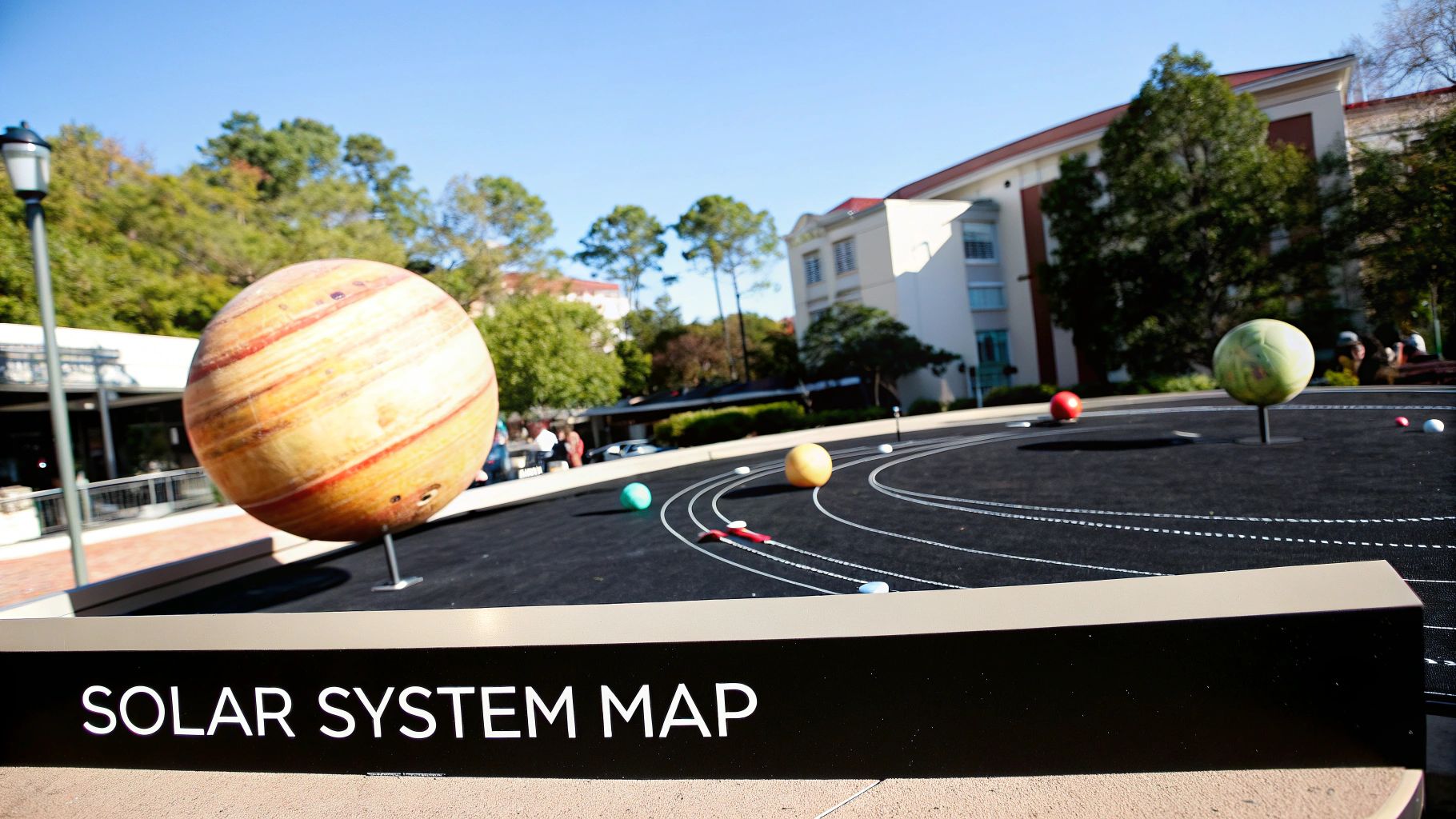
Alright, Space Rangers, every good explorer needs a map! To get our heads around the Kuiper Belt, we first need to figure out where on earth (or in space!) it is. Let's chart a course to the very edge of our solar system, using the giant, icy planet Neptune as our main landmark.
Space is mind-bogglingly big, so scientists came up with a clever way to measure it without using silly-long numbers. They use something called an Astronomical Unit, or AU for short.
One Astronomical Unit (1 AU) is the distance from our home planet, Earth, to the Sun. That’s about 150 million kilometres!
Using this cosmic ruler makes hopping around the solar system much simpler. For instance, Jupiter is about 5 AU from the Sun, while Neptune is a whopping 30 AU away. That's thirty times further from the Sun than we are!
Finding the Kuiper Belt
The Kuiper Belt kicks off just past Neptune’s orbit, which makes the planet a kind of gatekeeper to this mysterious region. Picture Space Ranger Fred zooming past Neptune on a wild adventure into a giant doughnut of icy rocks. This belt stretches from 30 AU all the way out to about 50 AU from the Sun – that’s between 4.5 billion and 7.5 billion kilometres away!
Astronomers were over the moon when they spotted the first Kuiper Belt Object back in 1992, sparking a huge discovery boom. You can read more about the discovery of the Kuiper Belt here.
To get a real feel for just how far that is, let's look at one of our most famous robotic explorers.
The Epic Voyage of New Horizons
NASA's New Horizons space probe is a true hero of exploration. Its mission was to fly all the way to Pluto, the most famous resident of the Kuiper Belt. Any guesses how long it took?
- Launch Date: January 2006
- Arrival at Pluto: July 2015
That’s a journey of more than nine years! Imagine starting primary school and not getting there until you were almost ready for secondary school. That’s how long it took New Horizons, travelling faster than a speeding bullet, just to reach the inner edge of the Kuiper Belt.
This incredible voyage really helps us grasp the true scale of our solar system. The Kuiper Belt isn't a place we can just pop over to for a quick visit; it’s a vast, distant frontier that pushes our exploration skills to the absolute limit. Now, let’s get ready to meet some of its amazing residents.
Meeting the Residents of the Kuiper Belt
Alright, now that we know where we're going, let's say a big hello to the amazing objects that call the Kuiper Belt home. Imagine Space Ranger Fred waving to his cosmic friends—this isn't just a quiet ring of rocks; it's more like a bustling neighbourhood packed with incredible characters!
So, who's the biggest star of the show? You guessed it: Pluto. For decades, we all knew Pluto as the ninth planet from the Sun. But as our telescopes got better, astronomers started spotting more and more objects way out there. They soon realised Pluto wasn't alone at all. It had loads of neighbours, many of a similar size.
This discovery kicked off a huge discussion, and in 2006, scientists came up with a brand-new category just for worlds like Pluto: the dwarf planet.
What Makes a Dwarf Planet?
A dwarf planet is a round object that orbits the Sun, just like a regular planet. The main difference is that it hasn't "cleared its neighbourhood." Think of it this way: Earth's gravity is strong enough to pull in or fling away any space rocks that cross its path, but Pluto shares its orbit with countless other icy bodies in the Kuiper Belt.
Don't feel too bad for Pluto, though! It's still an incredible world with towering mountains made of solid water ice, a wispy-thin atmosphere, and even a giant heart shape etched across its surface!
But Pluto is just one of many. Let's meet some of its fascinating friends!
- Eris: This is the one that really started the whole Pluto debate! Eris is a little smaller than Pluto but actually more massive, which means its stuff is packed together more tightly. Finding Eris made scientists realise the Kuiper Belt was far more crowded than anyone had ever imagined.
- Haumea: Now here’s a weird one. Haumea spins so ridiculously fast—a whole day lasts just four hours!—that it's stretched itself into the shape of a rugby ball. As if that wasn't cool enough, it also has two little moons and a faint ring.
- Makemake: Named after the creator god of the Rapa Nui people of Easter Island, Makemake is a bright, reddish-coloured world. It was one of the first major discoveries in the Kuiper Belt after Pluto.
Imagine these icy worlds as cosmic fossils. Because they're so far from the Sun’s warmth, they're perfectly preserved, holding secrets about how our solar system got started 4.6 billion years ago.
The Comet Nursery
Besides dwarf planets, the Kuiper Belt is basically a giant nursery for comets. These Kuiper Belt Objects (KBOs) are mostly made of rock and ice—kind of like giant, dirty snowballs floating through space. Every now and then, a gravitational nudge from a planet like Neptune can send one of these icy wanderers hurtling towards the Sun.
As it gets closer, the Sun’s heat warms it up, causing the ice to turn straight into gas. This creates the beautiful, glowing tail we sometimes see from Earth. In fact, many of the comets that streak across our night sky began their epic journey right here. Want to know more about these celestial visitors? Check out our guide on what are comets made of.
Now, let's see how this icy realm stacks up against another famous belt in our solar system.
Kuiper Belt vs Asteroid Belt: A Cosmic Comparison
It’s easy to mix up our solar system’s two famous belts of space rocks, but they are incredibly different places! Let's pop on our Space Ranger helmets and compare them side-by-side to see what makes each one so special.
Think of the Asteroid Belt, tucked away between Mars and Jupiter, as a rocky garden fairly close to the Sun. The Kuiper Belt, on the other hand, is more like a vast, icy wilderness at the very edge of our solar system. One of the biggest differences is what they’re made of.
Rock vs Ice
Objects in the Asteroid Belt are much closer to the Sun's warmth. This means any ice they once had has long since evaporated, leaving behind mostly rock and metal. It’s why we call its residents asteroids. You can learn more about these fascinating space rocks in our special guide on what are asteroids.
Now, let's journey far, far out to the Kuiper Belt. It’s so distant and chilly that its objects are mostly made of frozen materials like water, methane, and ammonia, all mixed with a bit of rock. These are the giant, dirty snowballs we call Kuiper Belt Objects, or KBOs for short.
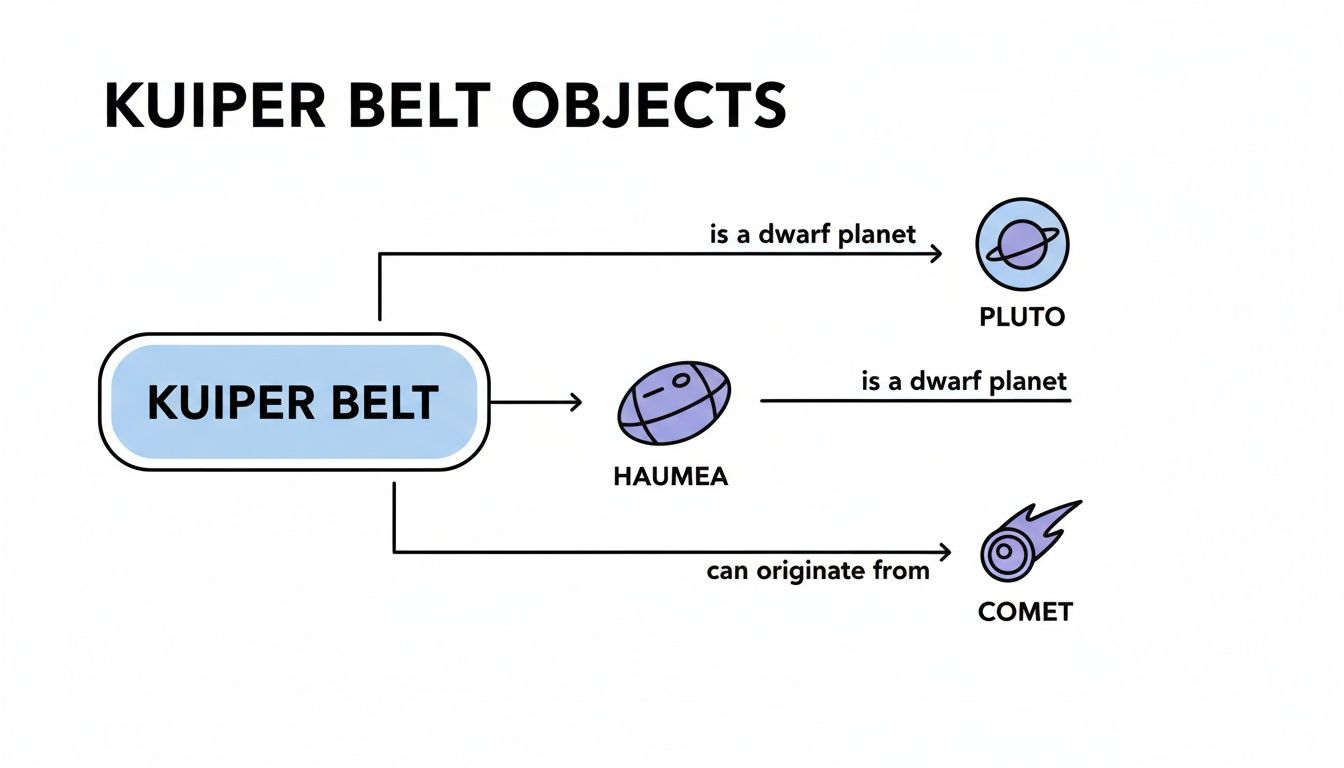
From dwarf planets like Pluto to the strange, egg-shaped Haumea, you can see the variety of fascinating worlds hiding out in this distant neighbourhood.
A Tale of Two Sizes
Another massive difference is just how big they are. The Kuiper Belt is absolutely enormous! It’s roughly 20 times wider than the Asteroid Belt and more than 200 times as massive. We’re talking about a doughnut of icy bodies stretching for billions of kilometres.
For a little perspective, Pluto is probably the most famous resident of the Kuiper Belt. When the New Horizons spacecraft flew past in 2015, it showed us a world with a huge, heart-shaped glacier on its surface. Pluto might be small for a planet, but at nearly 2,400 kilometres across, it's one of the kings of the Kuiper Belt.
Cosmic Belts: A Ranger's Comparison
To make it even clearer, let's look at the two belts next to each other. It’s like comparing your back garden to the whole of the Amazon rainforest!
| Feature | Asteroid Belt | Kuiper Belt |
|---|---|---|
| Location | Between Mars and Jupiter | Beyond Neptune's orbit |
| Main Ingredients | Rock and metal | Ice (water, methane, ammonia) and rock |
| Famous Residents | Ceres, Vesta, Pallas | Pluto, Eris, Haumea, Makemake |
| Size (Width) | About 1 AU wide | About 20 AU wide |
| Total Mass | Roughly 4% of our Moon's mass | 200-300 times the mass of the Asteroid Belt |
As you can see, while both are belts of celestial objects orbiting our Sun, they are truly worlds apart in almost every way.
Understanding these differences helps us build a much clearer map of our amazing solar system in our minds. Now, let’s get ready to become explorers ourselves with some fun, hands-on activities!
Your Guide to Becoming a Kuiper Belt Explorer
Reading about the Kuiper Belt is one thing, but getting hands-on is where the real fun begins! Let’s get creative and bring this distant, icy part of our solar system right into your home or classroom.
These simple, playful activities are a brilliant way to understand what the Kuiper Belt is all about. Ready to start your mission, Space Ranger? Let’s go!

Activity 1: Craft Your Own Kuiper Belt
First up, let's make a mini version of this giant cosmic doughnut. It’s a fantastic way to picture its shape and what it’s made of.
You will need:
- A paper plate
- Some glue
- Glitter (silver or white looks extra frosty!)
- Tiny pebbles, beads, or even lentils
Your mission steps:
- Draw the Orbit: Grab a pen and draw a large circle around the inside rim of your paper plate. This represents the huge, looping path of the Kuiper Belt.
- Add the Ice: Spread glue along your circle. Now for the fun bit—sprinkle lots of glitter over the glue! This is for the billions of icy comets and frozen bits that make up most of the Kuiper Belt Objects.
- Place the Rocks: Carefully stick your small pebbles or beads onto the glittery glue. These are your rocky KBOs and famous dwarf planets like Pluto and Eris.
And there you have it! You’ve just built a model of our solar system's icy frontier, showing how it’s a mix of frozen gases (glitter) and rocky chunks (pebbles).
Activity 2: Build a Comet on a Stick
Did you know many of the comets we see from Earth start their long journey in the Kuiper Belt? Let's build one to see how they get those amazing tails.
You will need:
- A small piece of aluminium foil
- A lollipop stick or a twig from the garden
- Colourful ribbons or strips of crepe paper
- Sticky tape
Your mission steps:
- Make the Nucleus: Scrunch the foil into a tight ball. This is the comet’s nucleus—its solid, icy, and rocky centre.
- Attach the Stick: Push the stick into the foil ball so it’s easy to hold.
- Add the Tails: Tape your colourful ribbons to the foil ball. These are the comet’s beautiful tails, which only appear when the Sun’s heat turns its ice into gas.
Now, run around with your comet! See how the ribbons flow behind you? That’s exactly what happens when a comet zooms through space.
By making things with our hands, we can get our heads around big ideas like what is the Kuiper Belt in a fun and memorable way. Each craft you make is like a mini science experiment!
Activity 3: Spot the Gatekeeper Planets
The Kuiper Belt starts just beyond Neptune’s orbit. While we can’t see Neptune without a big telescope, you can often spot Jupiter and Saturn, the giant planets that act like guards for the inner solar system.
On a clear night, grab a grown-up and use a stargazing app. See if you can find the bright light of Jupiter or the steady glow of Saturn. Finding these giants helps you imagine just how far you’d have to travel past them to reach the Kuiper Belt.
For more brilliant projects and cosmic colouring sheets, make sure to visit our freebies and activities page. Happy exploring!
Why the Kuiper Belt Is a Cosmic Time Capsule
So, why is this distant, icy belt so important for us to explore? Because it’s a perfectly preserved time capsule, holding clues from the very beginning of our solar system, all the way back some 4.6 billion years ago.
Imagine finding an old, dusty box in your nan's attic that hadn't been opened for hundreds of years. The things inside would tell you a fascinating story about the past, right? Well, the Kuiper Belt is our solar system's attic!
Frozen in Time
Because this region is so incredibly far from the Sun’s warmth, it’s one of the coldest places you can imagine. The objects floating out there are deep-frozen, which means they've barely changed since they were first formed.
By studying these pristine, icy worlds, scientists can piece together the story of how everything around us—including our own planet Earth—came to be. They’re like cosmic fossils holding the original recipe for our solar system.
Did the Kuiper Belt Bring Life to Earth?
Now, here’s an even more exciting idea that scientists are looking into. What if the most important ingredients for life on our planet were delivered by a special delivery all the way from the Kuiper Belt?
One amazing theory is that comets, knocked from their orbits in the Kuiper Belt, may have crashed into a young Earth billions of years ago. These cosmic snowballs could have brought with them two vital things: water to fill our oceans and the special building blocks of life itself.
This incredible idea just goes to show that science is a never-ending adventure, with countless secrets still waiting to be uncovered in this frozen frontier. It's a mystery that Space Ranger Fred himself would love to solve! You can join him on a similar quest in the book, Space Ranger Fred and the Shoelace Adventure.
Thinking about how planets are made is a huge and exciting topic. To continue your journey and find out more about how our cosmic neighbourhood was built, check out our guide on how planets are formed.
Right then, Space Rangers, you've fired off some absolutely brilliant questions on our journey! Before we dock back at the command centre, let’s go through a few of your biggest curiosities.
How Did the Kuiper Belt Get Its Name?
It’s named after a Dutch-American astronomer called Gerard Kuiper. Way back in 1951, he had this fantastic idea that there must be a huge belt of icy objects out past Neptune—a kind of cosmic junkyard full of leftovers from when our solar system was just getting started.
It took a while, but when astronomers finally spotted the first object in the belt in 1992, they named it in his honour. A brilliant prediction deserves a brilliant tribute!
Could a Human Ever Travel to the Kuiper Belt?
What a thought! It would be an incredibly long and very, very chilly trip, that’s for sure. It took the robotic New Horizons spacecraft more than nine years just to get to Pluto, which is right at the inner edge of the belt.
For now, we have to rely on amazing robotic explorers to be our eyes and ears out there. But who knows? Maybe future Space Rangers like you will be the ones to make that journey one day!
Are the Objects in the Kuiper Belt Close Together?
Not at all! This is a great question, because films often show spaceships weaving through crowded asteroid fields. In reality, space is mostly just… well, space.
The objects in the Kuiper Belt are actually millions of kilometres apart from each other. You could fly a ship right through the middle and you’d have to be incredibly lucky to even spot one KBO up close.
Your cosmic adventure doesn't have to end here! The Space Ranger Fred universe is packed with stories, activities, and mind-boggling facts to discover. Keep exploring, keep asking questions, and blast off on your next learning mission with us.