
Fred once asked Zando a very big question while staring at the morning sky through the ship window. “Does the Sun get old?” Zando beeped, flashed, and replied, “Oh yes. It has a whole life story.”
That's why the life cycle of the Sun is such a brilliant thing to learn as a family or in class. It turns one bright ball in the sky into a story with a beginning, a middle, and a far-future ending.
Our Sun's Secret Story
Commander Zando tapped the ship window and pointed at the Sun. “Fred, today's puzzle is a sneaky one. Are we talking about the Sun changing over billions of years, or its shorter repeating pattern?”
That question matters because the Sun has two different stories, and they are not the same story at all.
The first is the Sun's life cycle. That is the long tale of how a star begins, spends ages shining steadily, and eventually grows old. The second is the solar cycle, a much shorter pattern in the Sun's magnetic activity that rises and falls again and again. NASA Space Place explains the solar cycle for children, and it is a handy guide when those two ideas get muddled.
A simple way to say it is this. A person has a whole life from baby to grandparent, but they also have birthdays every year. Birthdays repeat. A whole life keeps moving forward. The Sun works a bit like that. Its solar cycle repeats. Its life cycle does not.
Mission note: If your child can say, “The solar cycle is a short repeating pattern, but the Sun's life cycle is its whole lifespan,” they've understood something big.
Our Sun is currently in its long, steady middle age as a star. It has been shining for a very long time, and it still has a long way to go. That makes it a brilliant star to study, because we can learn about both a star's full life story and its shorter changes in the present day.
If your young explorer wants a helpful side mission before the next part, this guide to how stars are born in space gives useful background for the Sun's earliest chapter.
How Our Sun Was Born
Space Ranger Fred, here is the part of the mission where we travel so far back in time that there was no Earth, no Moon, and no one asking for biscuits yet. Our Sun began inside a huge, cold cloud of gas and dust called a nebula.
A nebula works a bit like flour floating in a kitchen after a very enthusiastic baking disaster. The material starts spread out, but gravity keeps tugging it inward. Over a very long time, more and more gas gathered in the middle. The growing clump became tighter, denser, and hotter.
That hot, squashed centre was the young Sun, still only a protostar, which means a baby star that has not fully started shining in the way our Sun does now.
The engine that makes a star shine
At the centre, the heat and pressure became fierce enough for nuclear fusion to begin. Fusion is the process that joins tiny bits of hydrogen together to make helium and release energy. That energy is the Sun's light and warmth.
A simple family version goes like this. A torch uses batteries. A car uses fuel. A star uses fusion.
Children often mix this up with the Sun's 11-year solar cycle, but they are very different clocks. The solar cycle is a repeating pattern in the Sun's activity. The Sun being born happened once, at the beginning of its much longer life story.
For a child-friendly look at this earliest stage, this guide to how stars are born in space matches neatly with the Sun's first chapter.
What happened next
Once fusion began, the Sun became the brightest object in our young Solar System. Leftover dust and gas kept circling around it, rather like crumbs whirling round a mixing bowl. Those swirling leftovers gradually helped form the planets, moons, asteroids, and comets.
So the Sun did not pop into a finished Solar System like a lamp in a ready-made bedroom. It formed first, then the rest of the neighbourhood grew around it. That is why the Sun sits at the centre of our Solar System today, holding everything in its gravitational grip while the planets continue their long journey around it.
The Main Sequence Our Star's Happy Place
Space Ranger Fred checks the Sun on his mission screen and says, “So this is it? The Sun just stays like this for ages?” Yes. This is the long middle chapter of the Sun's life, the calm, hardworking stretch where our star shines in a steady way day after day.
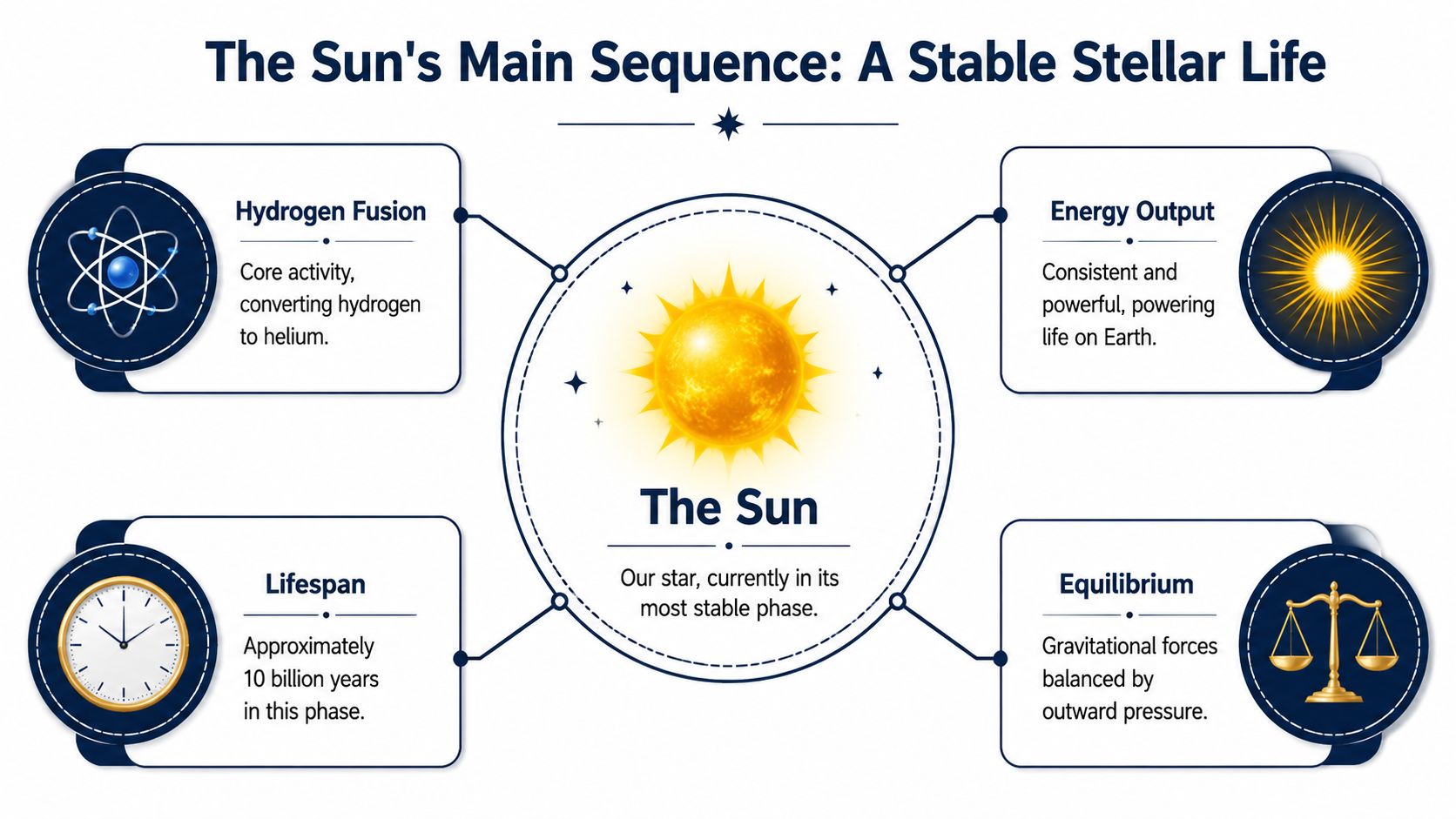
Astronomers call this stage the main sequence. NASA describes the Sun as a G2 V yellow dwarf and notes that it sits about 93 million miles (150 million kilometres) from Earth, with a visible surface temperature of about 5,500°C and an outer atmosphere that can become far hotter, on NASA's Sun facts page.
A star with a very steady job
During the main sequence, the Sun's core keeps turning hydrogen into helium through fusion. It works a bit like a giant cosmic power station, except no one has to refill it with coal or plug it into a wall. The fuel is already there inside the star.
A child can easily mix this up with the Sun's 11-year solar cycle, because both use the word “cycle”. They are different clocks. The 11-year solar cycle is a repeating pattern in sunspots and solar activity. The life cycle is the Sun's whole story across billions of years, and the main sequence is the longest chapter in that story.
That difference matters because the Sun can have busy and quiet years during the solar cycle while still staying in the same life stage overall.
The balancing act that keeps the Sun stable
Two big forces are at work inside the Sun. Gravity pulls everything inward. Pressure from the hot gas and energy made by fusion pushes outward.
Those forces balance each other, rather like a perfectly timed tug-of-war where neither side lets go. That balance is why the Sun does not collapse into a smaller ball, and it is also why it does not puff up into a giant just yet.
If your young explorer wants to know what is going on in that glowing engine room, how the Sun produces energy through fusion gives a closer look.
Why this stage is called the Sun's happy place
The main sequence is the Sun's most settled phase. It is where the Sun spends most of its life shining steadily enough for Earth to have long stretches of time in which oceans, weather, plants, dinosaurs, and eventually people can exist.
That does not mean the Sun is boring. Inside, it is very busy. Outside, from our safe distance, it is steady enough to be the dependable centre of our Solar System.
So when Fred looks up and sees the same Sun rising again, he is seeing a star in its long-lasting, reliable middle age. That is a pretty amazing thing to spot before breakfast.
When Our Sun Becomes a Red Giant
Fred checks the mission clock and gasps. The number is so huge it barely fits in his space log. We are talking about billions of years in the future, which is a very different clock from the Sun's 11-year solar cycle of busy sunspots and quieter spells. Those shorter ups and downs happen while the Sun is still in the same life stage. The red giant phase is a later chapter in the Sun's full life story.
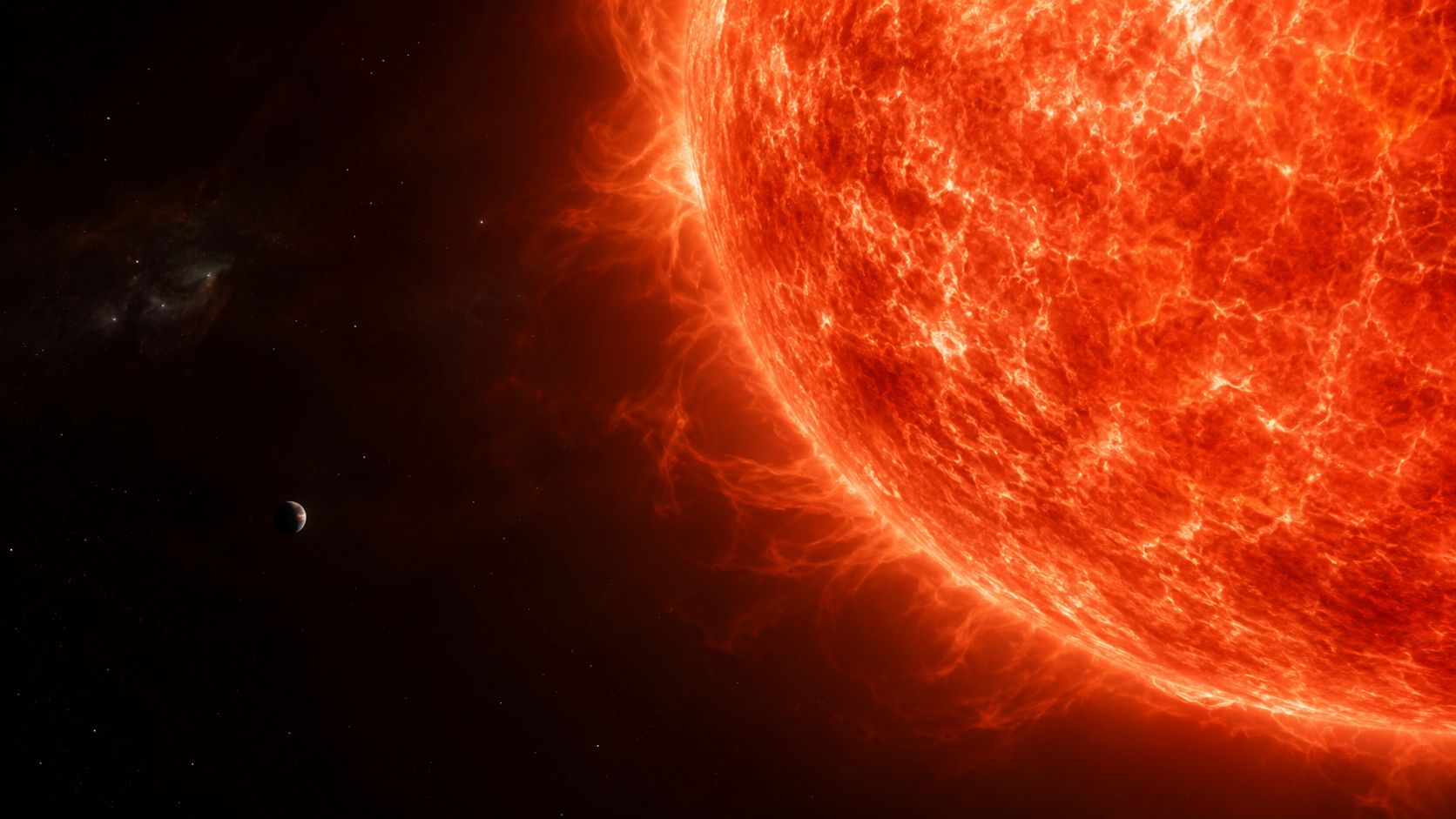
Much later on, the Sun will run low on the hydrogen fuel in its centre. Then the middle squeezes tighter and heats up, while the outer layers swell far out into space. Our familiar yellow star will grow into a huge, cooler-looking red giant.
The great puffing up
A red giant works a bit like a toasting marshmallow that puffs up as the heat changes it. The Sun's outside will stretch enormously, and the whole star will shine much more strongly than it does today. Inner planets will have a very bad day.
Mercury and Venus are expected to be swallowed by the expanding Sun. Earth's fate is less cheerful than any Space Ranger would like, and it may also be lost as the Sun grows and changes.
That sounds dramatic because it is.
If Fred and Zando could watch from a safe spacecraft far away, they would see the Sun become a giant red lantern in space, far bigger than the star we know now.
Here's a visual if your young explorer likes seeing ideas in motion.
A strange but natural change
“Red giant” can sound like the Sun has broken. It has not. This is a normal stage for a star like ours.
The steps are easier to follow if you picture the Sun as a giant space cooker:
- The centre runs short of its usual fuel. The Sun cannot keep fusing hydrogen in its core forever.
- The core squeezes inward and gets hotter. That extra heat changes what happens in the layers around it.
- The outer layers spread outward. The surface becomes cooler than before, so the Sun looks redder even while the whole star grows far larger.
Quick check for learners: A red giant is still the same Sun, just much older and in a very different stage of life.
If your child wants a helpful next picture for what stars throw out into space later on, this guide to what a nebula is makes a good follow-up.
A Planetary Nebula and a White Dwarf
Commander Fred here with an easy way to keep one big idea straight. The Sun's life cycle is its full story across billions of years. A solar cycle is the shorter 11-year pattern of magnetic activity. By the time the Sun reaches this late chapter, we are talking about star ageing, not the solar cycle at all.
At this stage, the Sun lets go of its outer layers. Those layers drift out into space and glow as gas around the small, hot core left behind. Astronomers call that glowing cloud a planetary nebula.
The name trips up plenty of young explorers. No planets are being built here. Long ago, early sky-watchers thought these round, fuzzy shapes looked a bit like planets through small telescopes, so the name stuck.
The dandelion stage
A planetary nebula works a bit like a dandelion clock after a puff of air. The soft outer parts spread away, while the middle stays behind. The comparison is not perfect, of course. Dandelions do not shine in space. But it gives children a helpful picture for what happens next.
What stays behind is a white dwarf. It is the Sun's hot, dense core, left after the outer gas has floated away. The glowing nebula lasts for a relatively short time in space terms, then thins out and fades, while the white dwarf keeps cooling for an extremely long time.
If your child wants a clearer picture of those glowing gas clouds, this guide to what a nebula is makes a good next read.
The Sun's life in a nutshell
| Stage Name | What Happens | How Long It Lasts |
|---|---|---|
| Birth in a nebula | Gas and dust gather until fusion begins | A formative early stage |
| Main sequence | The Sun steadily shines while fusion powers it | Billions of years |
| Red giant | The outer layers expand enormously | Shorter than the main sequence stage |
| Planetary nebula | Outer gas drifts away and glows | A brief final cloud stage |
| White dwarf | The hot core remains and cools over time | Longer than humans can easily picture |
The Sun's ending is calm and gradual, more like a glowing coal cooling in the dark than a firework bursting in the sky.
Your Mission to Explore the Sun's Story
By now, you can probably spot the biggest classroom mix-up. The life cycle of the Sun is the whole star story across billions of years. The solar cycle is a repeating pattern of magnetic activity.
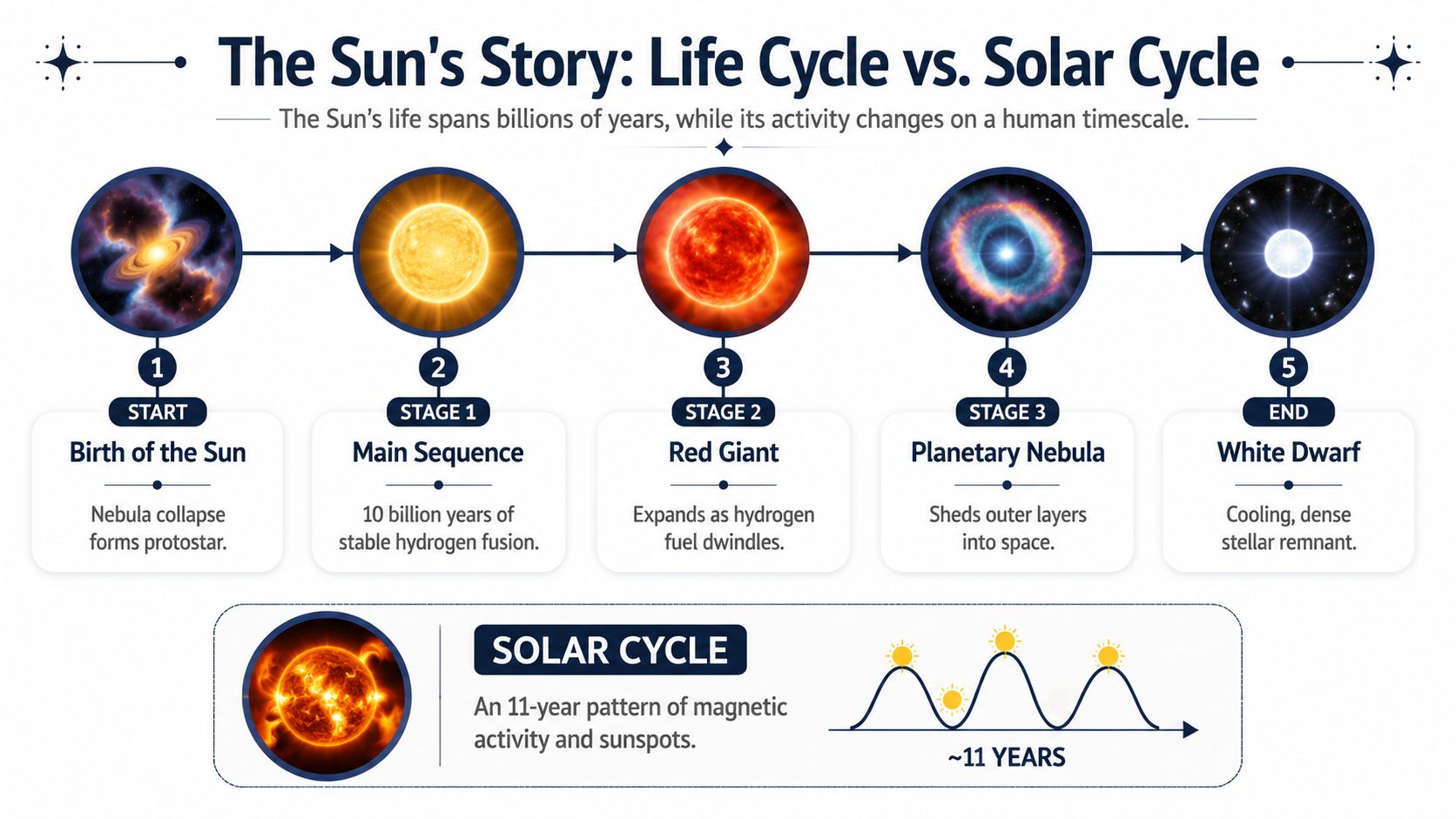
The Sun's solar cycle lasts about 11 years, and during that cycle its magnetic field reverses completely, as explained by NOAA's page on the solar cycle. That is very different from the Sun ageing from birth to white dwarf.
A simple mission for home or school
Try this poster activity with your child or class:
- Draw the five big stages: nebula, young Sun, main sequence, red giant, white dwarf.
- Add one fact to each stage: use words and arrows, not just labels.
- Finish with the learner sentence: “I think, I try, I can, I can explain.”
A hands-on follow-up helps children keep the ideas straight. For printable tasks and family-friendly projects, visit the free activities page. If you'd like more story-led reading, the book page offers another way to explore space through narrative, and you can also browse more space learning articles on the blog.
For one factual option among those resources, Space Ranger Fred is a children's edutainment brand that uses storytelling, humour, books, animation, and interactive learning to make STEM more approachable for children aged 6 to 12.
Mission debrief: If a child can explain the difference between the Sun changing over 11 years and over billions of years, they've understood something genuinely big.
A CTA for Space Ranger Fred. Explore the books for story-led space learning at home, try the activities for classroom or library sessions, and if you're a teacher or organiser, look into school visits that use interactive storytelling to support reading, confidence, communication, and curiosity. Learning should be experienced, not just delivered.