Let’s be honest—it’s gut-wrenching to watch your child treat a book like it's a plate of Brussels sprouts. If you’re wondering how to make reading fun again, you’re not alone. The secret isn't about forcing them to turn one more page; it’s about reframing reading as an adventure by tapping into their natural curiosity.
From Chore to Choice: Unlocking a Love for Reading
Remember when they’d beg for just one more bedtime story? For so many kids, that initial spark dims when reading gets tangled up with school reports and assigned texts. Suddenly, the pressure to perform turns a magical escape into just another task on the to-do list.
But what if reading could feel less like homework and more like a secret mission? The key is to stop focusing on performance and start chasing the fun. This means going beyond the usual advice and plugging into what truly captivates your child's imagination—and for a lot of kids, that’s the world of science, technology, engineering, and maths (STEM).
Linking Stories to Their World
A story about a mission to Mars doesn't have to end when you close the book. When you read something like Space Ranger Fred and the Tick Tock Tale, it’s an invitation to explore the science of time. You could build a simple sundial in the garden or chat about how astronauts keep track of days in space. Just like that, passive reading becomes an active, hands-on experience.
The goal is to transform reading from a solitary activity into a shared adventure. By connecting books to real-world curiosity, you show your child that stories are the starting point for discovery, not the end.
This approach also hands a powerful tool back to your child: choice. Letting kids pick their own books is a total game-changer. One report on UK children's reading habits found that when pupils choose their own books, their engagement and comprehension go through the roof.
Year 5 pupils’ favourite books were often nearly two years above their average reading level, yet their quiz accuracy hit an impressive 94%. You can learn more about these findings on what kids are reading in 2025. When you empower them to choose, you're not just finding them a book; you're helping them find their book.
Before we dive deeper, let's look at a few practical ideas you can try tonight.
Here are five simple, actionable strategies you can use right away to change your child's perspective on reading.
Five Quick Wins to Spark Reading Joy Today
| Strategy | Why It Works | Quick Tip |
|---|---|---|
| "Book Tasting" Night | It’s low-pressure and turns book selection into a fun event. | Set out a "menu" of different genres (comics, fantasy, non-fiction) and let them "sample" a chapter from each. |
| Read the Film, Watch the Book | Connects a familiar, loved story to its source material. | Pick a film they adore and grab the book. Talk about the differences between the two. |
| Go on a "Story Hunt" | Turns reading into an active, real-world adventure. | Read a book set in a park or a museum, then visit a similar place and look for things from the story. |
| Start a Parent-Child Book Club | Creates a shared experience and makes reading social. | Just the two of you is enough! Pick a book, read it separately, and schedule a "meeting" over milkshakes to discuss. |
| Create a "Cosy Reading Nook" | Makes reading feel like a special treat, not a chore. | Pile up some cushions, add a soft blanket and a good lamp in a quiet corner. Make it their exclusive spot. |
These small shifts can make a huge difference, showing your child that reading is an invitation to explore, not just an obligation to fulfil.
Connect Books to Hands-On STEM Experiments

This is where the real magic happens—when a story leaps off the page and lands right in your child’s hands. One of my favourite ways to get kids fired up about reading is to show them that books aren't just words; they’re launchpads for discovery and real-world action.
Forget dusty old book reports. We’re talking about building, creating, and experimenting.
When you do this, you’re turning reading from a passive activity into a memorable, hands-on adventure. It creates these brilliant little connections between the story and actual scientific principles, sneakily reinforcing both their reading skills and STEM concepts without ever feeling like a lesson.
From Story Time to Lab Time
Imagine you've just finished reading Space Ranger Fred and the Umbrella Rescue, where our hero Fred gets caught in a sudden downpour. The story doesn't have to end when you close the book. In fact, that's the perfect moment to start exploring the science of weather and materials.
You can instantly transform your kitchen table into a pop-up science lab. Grab a few simple things from around the house and challenge your child to become an engineer, just like Fred.
Your Umbrella Rescue Mission:
- The Challenge: Design and test a tiny umbrella to find the best waterproof material.
- Materials You'll Need: Small squares of different materials (tin foil, plastic wrap, a paper towel, a scrap of fabric), a little toy figure to keep dry, and a spray bottle filled with water.
- The Experiment: Drape each material over the toy and give it a good spray. Which one keeps the figure dry? Why do they think some worked better than others?
This little activity hooks directly into the book's plot, making Fred’s problem something your child can physically touch and solve. It’s a fantastically fun way to get them thinking about concepts like absorption and water resistance.
By linking a story to a hands-on activity, you're not just reading a book; you're living it. Reading becomes a collaborative, problem-solving adventure that makes learning feel like pure play.
Keep the Experiments Coming
You can adapt this idea for almost any book that has a hint of a problem to solve. A story about building a treehouse? That could easily inspire an afternoon of tinkering with simple levers and pulleys using rulers, pencils, and string. Reading about a character who gets lost? That's a great excuse to make a DIY compass or learn how to read a map together.
The trick is to listen for those "what if…?" or "how does that work?" questions hiding inside the story. If you need a bit more inspiration, you can check out these 10 mind-blowing science experiments for kids that are perfect for curious young minds.
When you tie these kinds of activities to what they're reading, you cement the idea that books are bursting with incredible ideas just waiting to be explored.
Launch a Themed Family Reading Mission

One of the best ways to get your child excited about reading is to turn it into a shared family experience. Instead of just telling them to read, invite them on an adventure. Let's create a ‘Family Reading Mission’ together—a proper space-themed quest that makes reading feel like a game, not a chore.
This is about more than just finishing a book; it’s about building an entire world around it. Sadly, daily reading for pleasure is at an all-time low. Recent figures show that only 18.7% of UK children aged 8 to 18 read daily in their free time. You can discover more insights from the National Literacy Trust report, which really highlights why making reading a shared, fun experience is so vital.
A family mission completely flips this challenge on its head.
Designing Your Mission Control
Every great mission needs a command centre, starting with a logbook. But forget boring reading journals—this is your official ‘Mission Log’. Just grab a simple notebook and let your child go wild decorating it with stars, planets, and rockets.
Inside, each book they finish becomes a ‘Planet Explored’. For every entry, they can:
- Log the Planet: Write down the book’s title and author.
- Rate the Atmosphere: Give it a star rating (1-5 is perfect).
- Record Alien Life: Draw their favourite character or a memorable scene.
- File a Mission Report: Write a sentence or two about what they loved.
This isn’t about writing a stuffy book report. It’s about creating a personal, fun record of their reading voyage. It’s a bit like project-based learning, which makes education tangible and exciting. If that sounds interesting, you can read our guide on what project-based learning is and see how to bring it home.
The goal is to celebrate progress, not just performance. A Mission Log and star chart make reading a visible, exciting, and collaborative family achievement.
Making Reading a Family Event
Next, set up themed reading nights to make the mission feel like a real event. How about ‘Sci-Fi Saturdays’? You could all settle in to read a chapter of a book like Space Ranger Fred and the Shoelace Adventure, which sneakily weaves STEM concepts into a brilliant story.
After reading, you could spend half an hour learning and trying out different useful knots—a practical skill lifted right from the adventure! Get everyone involved, from younger siblings to grandparents. When the whole family is on board, reading shifts from a solo task to a much-loved family ritual.
And when the mission is complete (say, after exploring five or ten ‘planets’), plan a reward that’s an experience. A family trip to a local science museum or an observatory is the perfect way to wrap up your space adventure, showing your kids that the worlds they discover in books are all around them.
Find the Right Books to Spark Their Curiosity
The right book at the right time can be a complete game-changer. If you want to know how to make reading fun, the real secret often lies in handing over the reins and letting your child take the lead. It’s about venturing beyond the required school reading list to help them find books they genuinely want to get lost in.
When a child gets to choose, reading stops feeling like a chore and starts feeling like an adventure they're in control of. That sense of ownership is incredibly powerful. Instead of pushing what you think they should be reading, try tapping into what they're already obsessed with. Is it dinosaurs? Robots? The deepest parts of the ocean? Trust me, there’s a book for that.
Go Beyond Traditional Stories
Don't get stuck on the idea that only traditional novels "count" as reading. Graphic novels, for instance, are a fantastic gateway for visual learners. They blend compelling plots with incredible artwork, which can be a massive confidence booster for kids who feel overwhelmed by a solid wall of text.
In the same way, a magazine about coding or gaming can be just as valuable as a classic story. It meets your child right where their interests are, proving that reading is a practical tool for learning more about the things they already love. It's all about finding the right format to light that initial spark.
To help you get started, here’s a handy comparison to match different kinds of reading materials to your child's unique personality.
Matching Book Types to Your Child's Personality
| If Your Child Loves… | Try This Book Type… | Why It Works |
|---|---|---|
| Video Games & Films | Graphic Novels | The visual storytelling and fast-paced action feel familiar and exciting. |
| Building & Tinkering | How-To & DIY Books | They offer practical, step-by-step projects that lead to a real-world reward. |
| Asking "Why?" | Non-Fiction & Encyclopaedias | These books are packed with fascinating facts that directly answer their endless questions. |
| Daydreaming & Fantasy | Fantasy & Sci-Fi Novels | They open up entire new worlds to explore, feeding their boundless imagination. |
| Jokes & Giggles | Joke Books & Humorous Poetry | Short, snappy, and guaranteed to make them laugh—it's reading for pure fun. |
Finding the right match can make all the difference, transforming reading from a task into a treat.
Host a "Book Tasting" at Home
A brilliant, pressure-free way to introduce new genres is to host a 'book tasting' right in your living room. It's really simple:
- Gather Your Menu: Pop to the library and grab a diverse selection of books. Think a sci-fi adventure like Space Ranger Fred and the Shoelace Adventure, a cool graphic novel, a non-fiction book about space, and a twisty mystery.
- Set the Scene: Arrange the books on a table like a special menu, making it feel like a fun event.
- Time to Sample: Give your child 10-15 minutes to 'sample' each book. They can read the first chapter, flick through the pages, or just look at the pictures.
- Review: Afterwards, have a chat about which 'flavours' they liked best and why.
This little game turns book selection into a fun activity instead of a daunting decision. For more ideas to add to your tasting menu, check out this brilliant list of the best space books for kids.
Of course, reading doesn't always have to be a solo mission. Shared experiences, like listening to audiobooks or reading aloud together, are just as important. The chart below compares some key engagement data between audiobooks and traditional read-aloud sessions.
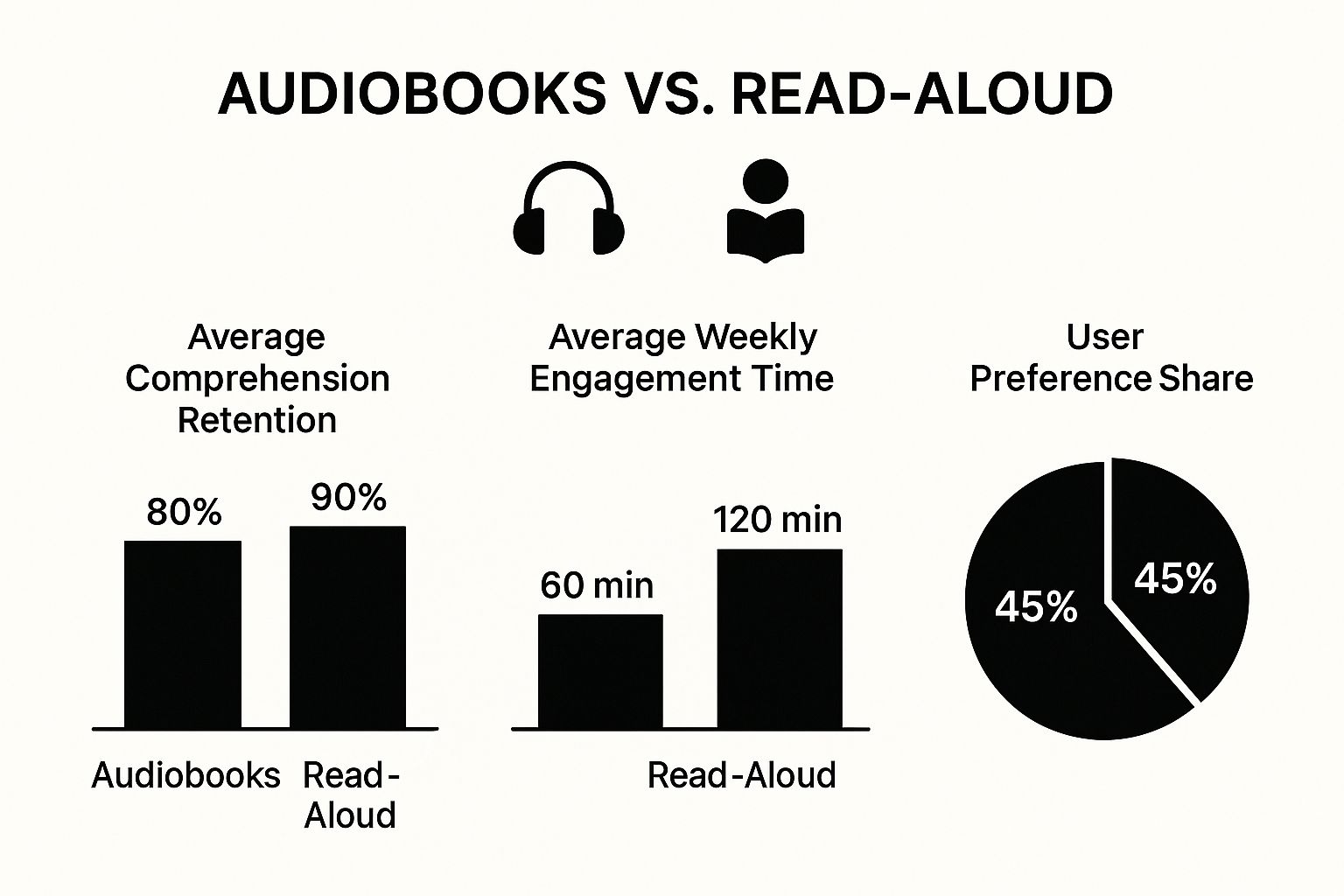
As you can see, while both are great options, reading aloud together often leads to deeper comprehension and more dedicated engagement time each week. Finding the right book is just the first step; sharing the experience is what makes it truly stick.
Build an Irresistible Reading Nook
Where a child reads is sometimes just as important as what they’re reading. A special, dedicated spot sends a powerful message: reading isn't a chore; it’s a treat, an escape to look forward to. If you’re wondering how to make reading fun, creating a cosy reading nook is one of the most effective things you can do. It turns the simple act of opening a book into a little bit of magic.
This doesn’t have to be a grand, expensive project. Forget about a simple bookshelf wedged into a busy playroom. The real goal is to create a personal, comfy, and distraction-free zone that your child connects with pure relaxation and adventure.
Designing Their Personal Escape Pod
Let your child take the lead on this. When they have a say in creating the space, it becomes truly theirs. A good reading nook should be a reflection of their personality. Got a budding astronaut on your hands? A simple pop-up tent decorated with a few glow-in-the-dark stars can instantly become a ‘spacecraft cockpit’ for exploring new literary worlds.
Here are a few simple ideas to get you going, no big budget required:
- Cushion Corner: Gather up every pillow, cushion, and soft blanket you can find and build a cosy nest in a quiet corner of a room.
- Tent Hideaway: A small play tent works wonders. So does a bedsheet draped over a couple of chairs to create an instant, secret hideout.
- Beanbag Base: Sometimes, all it takes is a single comfy beanbag and a small, kid-safe reading lamp to mark out a special zone.
The trick is to make it exclusive to reading. This shouldn't be a place for homework, tablets, or noisy toys. Think of it as a sanctuary, reserved only for getting lost in a good story.
Stocking the Spacecraft
Once the pod is built, it's time to add mission-critical supplies. Keep a small, tempting collection of books right within arm's reach. It's great to have a mix of their current favourites, library books they’ve picked out themselves, and maybe one or two exciting new titles to spark their curiosity.
A reading nook is more than just a comfortable chair; it’s a physical invitation to read. By creating a special, kid-designed space, you remove distractions and build a positive, lasting association between books and comfort.
To really make it feel special, add a few personal touches. A little pot for their bookmarks, a small torch for those 'under the covers' reading adventures, or a special shelf just for their copy of Space Ranger Fred and the Umbrella Rescue can make all the difference. This little corner of the house becomes their personal launchpad for countless journeys, proving that the right setting can make reading an absolute joy.
So, What’s the Big Secret to Raising a Lifelong Reader?
We’ve covered a lot of ground, haven’t we? From turning stories into science experiments to launching family-wide reading missions, we've explored all sorts of ways to tackle that one big question: how to make reading fun.
If there’s one thing to take away from all this, it’s that the secret ingredient is connection. It’s about shifting reading from a lonely task on a to-do list into a shared adventure you can have together.
The real win isn’t just ticking another book off the list. It’s about building a world where your child sees books as a doorway to discovery, a source of laughter, and a brilliant way to spend time with you. This happens when all those little moments of fun become part of your normal routine.
Turning These Ideas into Your Reality
Think of all the strategies we’ve talked about as your personal toolkit, not a strict instruction manual. You know your child best, so mix and match what works for your family.
- Don’t try to do it all at once. Just pick one thing that sounds fun. Maybe you decide to build a cosy reading corner this weekend. Start there, and see what happens.
- Let them be the guide. If they get really into a book like Space Ranger Fred and the Shoelace Adventure, ride that wave! Use their excitement to jump into a related craft or find another book by the same author.
- Praise the effort, not just the result. Celebrate their curiosity and the fact they’re giving it a go. How they feel about the experience is so much more important than how many pages they turn.
The most powerful tool you have is your own excitement. When you treat reading like a gift—an amazing chance to explore new worlds together—your child will catch on.
Getting this right has never been more important. It’s a bit of a shock, but a recent YouGov survey found that 40% of Brits hadn't picked up a single book in the last year. By making reading a fun, shared part of your life now, you’re giving your child something that will last forever. You can read more about these UK reading habit findings to see just how much of a difference you can make.
Right then, your reading adventure starts now. You’ve got the ideas—go and build something wonderful together.
Common Questions About Making Reading Fun
Even with the best intentions, it's easy to hit a few roadblocks. Let's tackle some of the common hurdles parents face when trying to figure out how to make reading fun for their children.
My Child Says Reading Is Boring What Should I Do First
First things first, you need to gently break that negative association. Shift the whole focus away from the act of reading and onto the adventure of the story.
Try listening to an audiobook together on a car journey. Or maybe find a graphic novel about a topic they’re already obsessed with, like robotics or dinosaurs. The key is to connect the story to a fun, real-world activity. For instance, read a chapter of Space Ranger Fred and the Tick Tock Tale and then head into the garden to build a simple sundial together. This makes the story's world tangible and shows that reading is a springboard for doing exciting things, not just sitting still.
How Much Should I Be Involved in My Child's Reading
Think of yourself as a co-adventurer, not a drill sergeant. For kids aged 6–12, this means showing genuine, authentic interest. You could ask open-ended questions like, 'If you were the main character, what would you have done differently?' or 'Which gadget from that book do you wish was real?'
Your enthusiasm is contagious. If you treat reading as a fun and valuable activity to share, they are much more likely to see it that way too.
Honestly, one of the most powerful things you can do is simply sit and read your own book while they read theirs. It models the behaviour you want to see, framing reading as a normal, enjoyable part of daily life for everyone. For younger kids, reading aloud is still pure magic and creates a brilliant bonding experience.
What If My Child Only Wants to Read the Same Book Over and Over
This is completely normal and, believe it or not, it’s actually brilliant for them! Rereading helps children build fluency, supercharges their confidence, and gives them a much deeper understanding of the story and its vocabulary.
Instead of fighting it, lean into it. Use their favourite book as a launchpad for new adventures. If they adore a book about space, like Space Ranger Fred and the Shoelace Adventure, use that passion to introduce a non-fiction book about planets or another story featuring a different kind of spaceship. You could say, 'Since you love that book so much, I found another one I think you'll find just as exciting!' This validates their choice while gently expanding their horizons.
Ready to launch your own reading mission? The Space Ranger Fred book series is designed to blend exciting stories with real STEM concepts, making learning an adventure.