
Ever looked up at the night sky and wondered, “Is the space station really that high?” It is widely understood to be “in space”, but that answer doesn't help much, does it?
Children usually want an accurate picture. Is it aeroplane-high? Moon-high? So high you'd need a giant ladder and a packed lunch? Let's make how high is iss easy to picture, easy to explain, and a lot more fun.
So How High Does the Space Station Fly
The short answer is this. The International Space Station flies about 250 miles above Earth, or 400 kilometres, and it races along at 17,500 miles per hour, going around Earth once every 90 to 93 minutes according to Georgia Tech's explanation of ISS orbit.
That means the ISS isn't floating somewhere far beyond the Solar System. It's much closer to Earth than many children imagine. It's our giant space lab, circling overhead again and again while astronauts eat, sleep, work, and do science.
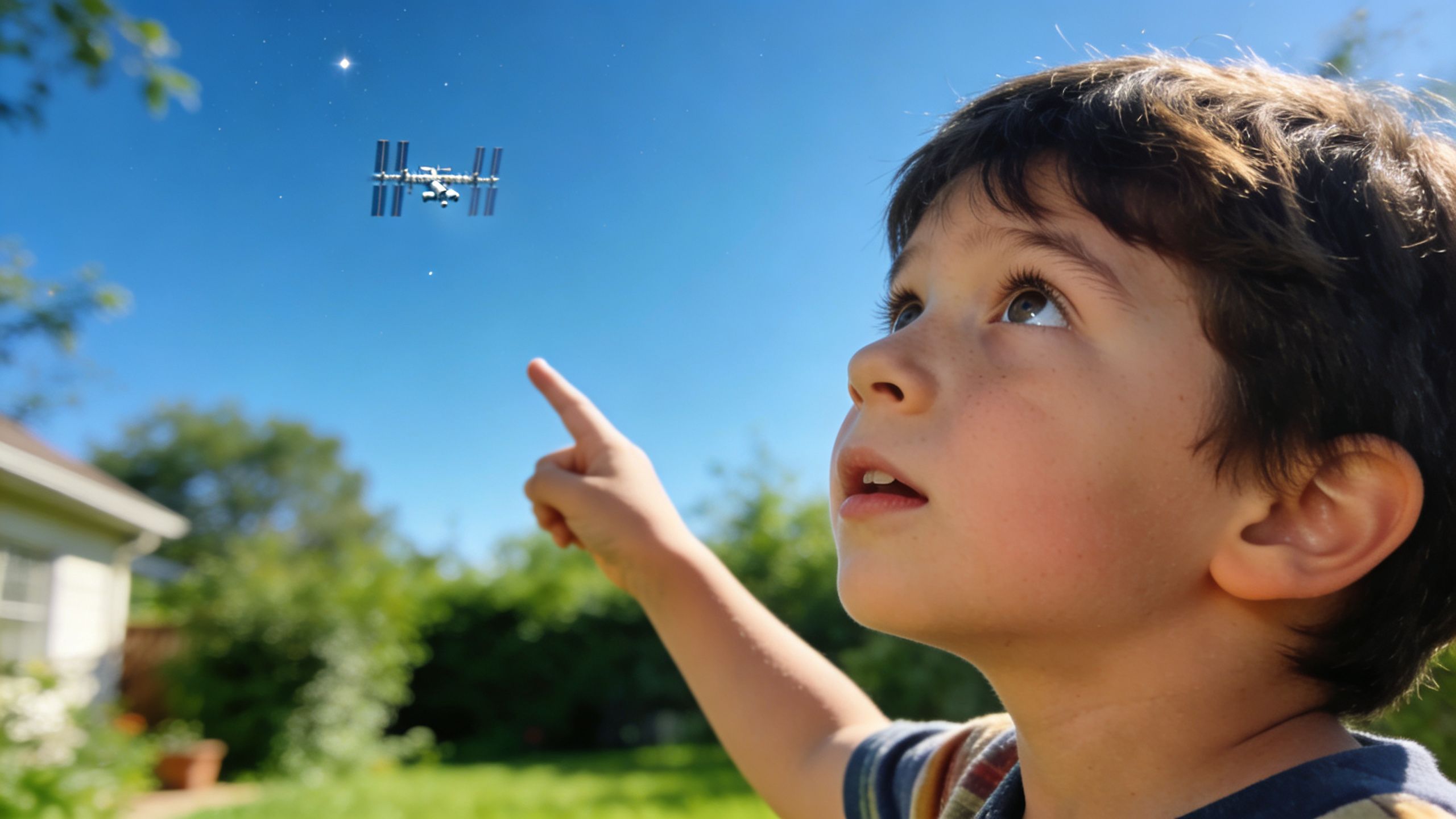
A real space lab above your head
The ISS is not a star and it's not a tiny toy in the sky. It's a real place where people live and work. If you want a simple family-friendly introduction, this guide to what the International Space Station is is a helpful next step.
Big idea: The ISS is high enough to be in space, but close enough that people on Earth can sometimes spot it.
That's what makes the number exciting. It isn't just “250 miles”. It's a human-made home and laboratory, zooming above us while most of us are brushing our teeth or finding lost PE kits.
What 250 Miles Up Really Means
A number like 250 miles can feel slippery. Children hear it and think, “Right… but what does that look like?”
For UK families, one of the best comparisons is this. The ISS altitude is less than one-third of the distance from Land's End to John o' Groats, which is about 874 miles, based on the comparison given in the earlier Georgia Tech reference. Straight up, though. Not along a motorway. Straight up into the sky.
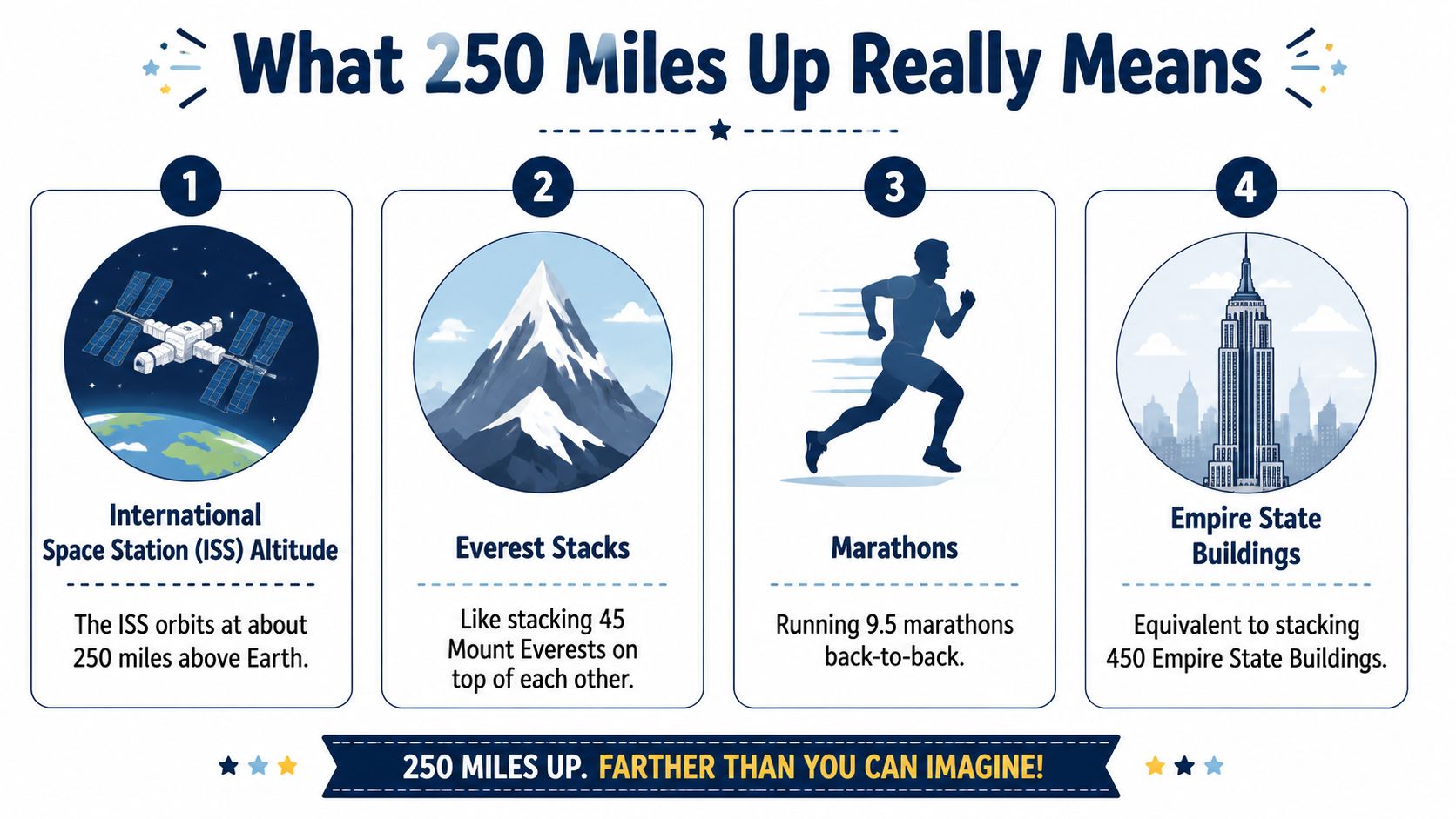
A better way to picture it
Try these simple comparisons with children:
- Aeroplane thinking: A passenger plane flies far lower than the ISS, so astronauts are not just “a bit above the clouds”.
- Balloon thinking: Weather balloons go high, but the station still orbits much higher.
- Satellite thinking: The ISS is nowhere near the very distant satellites that stay much farther out.
If your child asks where the ISS sits in the atmosphere, this child-friendly post on what the exosphere is can help place Earth's layers in order.
Here's a handy visual explainer to keep that sense of scale in mind:
Questions children often ask
| Question | Simple answer |
|---|---|
| Is it as high as a plane? | No. It's much higher. |
| Is it near the Moon? | No. The Moon is far, far farther away. |
| Is 250 miles “close” in space terms? | Yes. In space terms, it's surprisingly close to Earth. |
When children can compare a space fact to something familiar, the idea stops being abstract and starts becoming real.
Why the ISS Stays at That Height
The ISS doesn't stay up because gravity has stopped working. Gravity is still pulling on it. That surprises lots of children, and quite a few adults too.
The trick is motion. The station is moving sideways so fast that while gravity pulls it toward Earth, it keeps missing the ground. Round and round it goes. It's a balancing act.
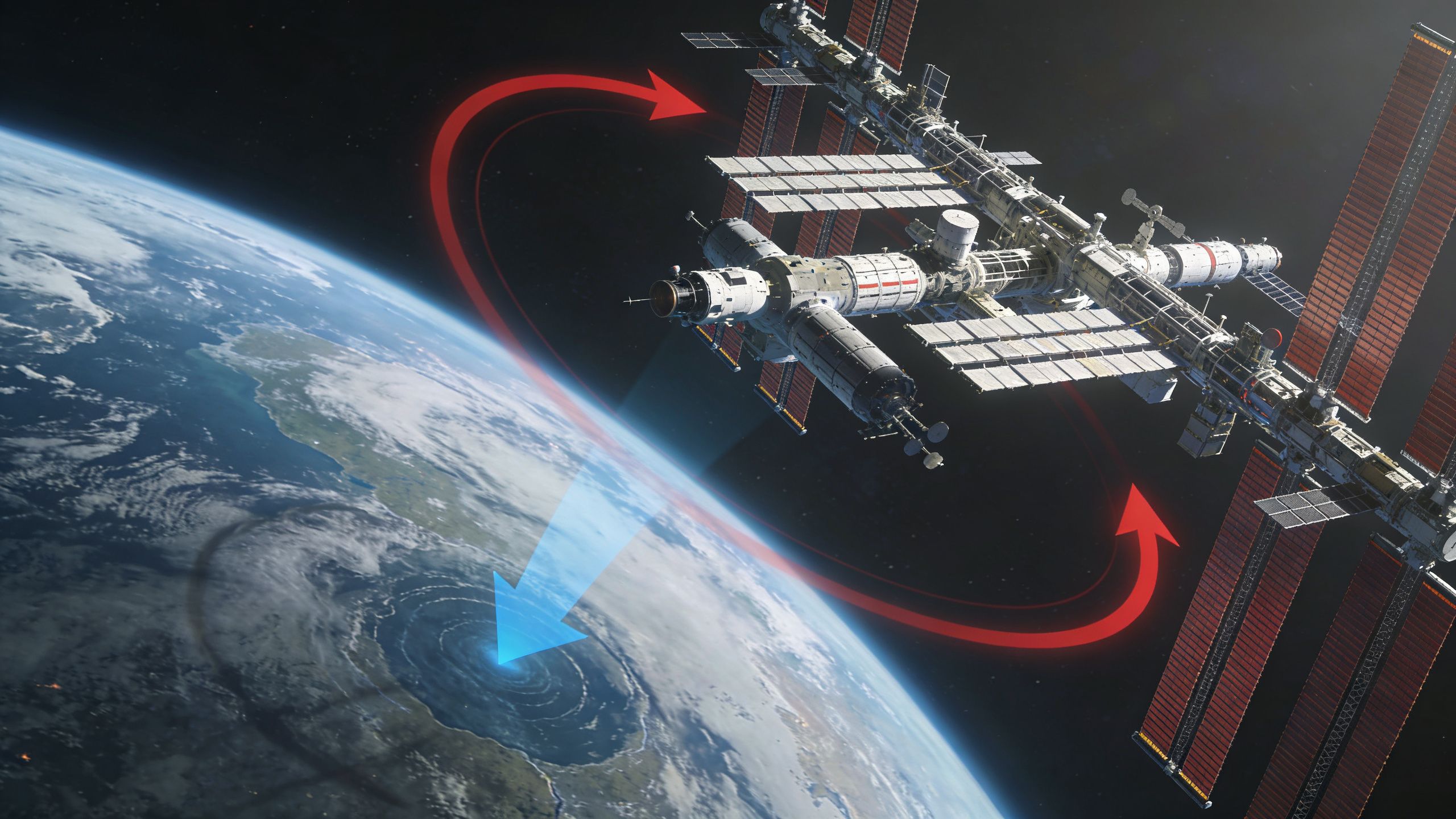
Think of a whirling conker
A good classroom analogy is a conker or ball on a string. When you swing it, there's a pull inward and a movement around the circle. Orbit is not exactly the same, but it helps children feel the idea of motion plus pull.
The ISS also sits at a very useful height. It is high enough to reduce atmospheric drag, but low enough to remain within Earth's protective magnetosphere, which helps make it a good place for science and Earth observation, as described in this overview of ISS altitude and orbit.
Why not higher or lower
If the ISS were lower, the thin upper atmosphere would slow it more strongly.
If it were much higher, different engineering trade-offs would come into play, and it wouldn't be in the same sweet spot for the kind of work it does now.
For children learning the basics of orbit, a simple explainer on how satellites work can make that push-and-pull idea click.
Practical rule: Orbit is not about switching gravity off. It's about moving in the right way while gravity keeps pulling.
That's a lovely “I can explain it” moment for a classroom wall.
Can You See the Space Station from Your Garden
Yes, sometimes you can. And this is often the moment children go from interested to amazed.
The ISS is often visible to the naked eye because it passes over the UK at about 51.64° north latitude. Children in Scotland, Northern England, and across the UK can sometimes spot it during twilight, when the ground is dark but the station is still lit by the Sun, according to the International Space Station entry on Wikipedia.
What does it look like
It usually looks like a bright star moving steadily across the sky. It doesn't flash like many aircraft. It glides.
That makes people say, “Wait, is that really it?” Then somebody runs for a grown-up. Then somebody else says, “I saw it first.” Standard family science procedure.
How to spot it
- Look at twilight: Early evening or early morning often works best.
- Pick a clear view: A garden, playground, or field helps.
- Watch for steady movement: The ISS moves smoothly across the sky.
- Use a tracking tool: Parents can check official sighting tools before heading outside.
A lovely home challenge is to ask children to draw what they think they'll see first, then compare the drawing with the sighting afterwards.
Seeing the ISS turns a fact into an experience. That's when children stop memorising science and start owning it.
Become a Space Ranger with a Classroom Mission
Children understand space better when they do something with their hands. So try this simple orbit mission at home or in class.
First, talk about the station as a real place. The ISS has a pressurised habitable volume of 1,005 cubic metres, which is compared to the inside of a Boeing 747 airliner, and it measures 109 metres end-to-end, longer than the wingspan of an Airbus A380, according to this ISS fact page from The STEM Hub.
Mission one with a bowl and a marble
You need a large bowl and a marble.
- Roll the marble around the inside edge of the bowl.
- Watch how it curves around rather than travelling in a straight line for long.
- Talk about how gravity pulls objects inward.
- Ask children what would happen if the marble went faster or slower.
This model isn't a perfect copy of orbit, but it helps children test ideas. That matters.
Mission questions for deeper thinking
- If you had one day on the ISS, what experiment would you do?
- What would be tricky about sleeping there?
- How would you feel seeing Earth below you?
For tutors and small-group educators organising lesson notes, planning sheets, and pupil follow-up, digital systems can save a lot of faff. Some educators use tools that replace spreadsheets for tutors to keep activities, attendance, and parent communication tidy.
If you want to stretch the learning, ask children to finish these sentence stems:
- I think the ISS stays up because…
- I try to explain orbit by…
- I can compare its height to…
- I can explain why we can sometimes see it from Earth.
That's science, language, and confidence all working together.
Your Adventure into Space Is Just Beginning
So, how high is iss? High enough to feel astonishing, but close enough to matter in a child's world.
That's the magic of this topic. It isn't just a number. It's a real station above a real planet, seen by real families standing in real gardens across the UK. Children can learn the height, understand why it stays there, and even go outside and try to spot it for themselves.
Keep the curiosity going
Parents and teachers don't need to know everything to spark a brilliant conversation. A good question is often enough.
- Ask: What makes something orbit instead of fall?
- Notice: What did the ISS look like in the sky?
- Reflect: Could you explain it to a friend now?
If you enjoy the bigger story of how space missions evolve over time, older readers may like this AI modernization in space missions podcast from Wonderment Apps, which adds useful context around modern mission work.
Learning sticks best when children say, “I get it. I saw it. I can explain it.”
Learning should be experienced, not just delivered.
Ready for more story-led space fun? Explore the Space Ranger Fred universe for adventures that mix reading, humour, and STEM in a way children want to come back to. You can also discover the book page, grab ideas from the freebies and activities page, and, if you'd like interactive storytelling for your pupils, look into Space Ranger Fred school visits that support reading, communication, and confidence through live space-themed sessions.