
Why is the Moon sometimes out in the daytime? And why doesn't its bright edge always seem to point straight at the Sun?
Those are the questions children ask when they look up. They're brilliant questions too, because the Earth, Sun and Moon don't behave like a flat drawing in a workbook. They move in a real, changing 3D pattern, and that's where the fun begins.
Our Amazing Space Neighbourhood
Have you ever looked up and wondered, “Who's moving up there, and why does the sky keep changing?”
Step outside on a bright morning or a chilly evening and you're already part of the story. The Sun is our star. Earth is our home planet. The Moon is our nearby companion, circling Earth while Earth travels around the Sun.
Those three objects explain a surprising amount of ordinary life. Bedtime and breakfast. Summer hats and winter coats. Tides at the seaside. Eclipses that make people stop, point, and stare upward.
Three space characters with very different jobs
Each one has its own job, and the fun starts when their movements overlap.
- The Sun gives light and warmth.
- Earth turns and travels, carrying us with it.
- The Moon does not make its own light. We see sunlight bouncing off it.
All three are moving all the time, and they are moving in space, not across a flat page. That matters. Children often draw the Earth, Sun, and Moon in one neat straight line because many diagrams do. Real space is more like a shifting 3D dance, with changing angles and changing views from where we stand on Earth.
That is why smart kid questions pop up so quickly. Why is the Moon out in daytime? Why does it look different from one night to the next? Why does it seem higher in the sky sometimes?
A quick home demo can help. Use a lamp for the Sun, a ball for Earth, and a smaller ball for the Moon. Let one person hold the “Moon” and walk around the “Earth” while everyone watches which side stays lit. Say this out loud as you do it: “The Sun lights half the Moon all the time. We only see the part facing us.” That one sentence clears up a lot of confusion.
The sky follows patterns. Our view keeps changing.
Here are some excellent “space detective” questions to carry with you:
- Why is the Moon visible in daytime sometimes, but not always?
- Why do days get longer and shorter?
- Why does the Moon change shape?
- Why can the Moon seem low one week and much higher another?
If your family or class is exploring bigger space ideas, this guide to what the solar system is in easy terms makes a handy next stop.
Earths Big Spin and Our Daily Hello to the Sun
Why does morning arrive where you live while another part of Earth is heading into bedtime?
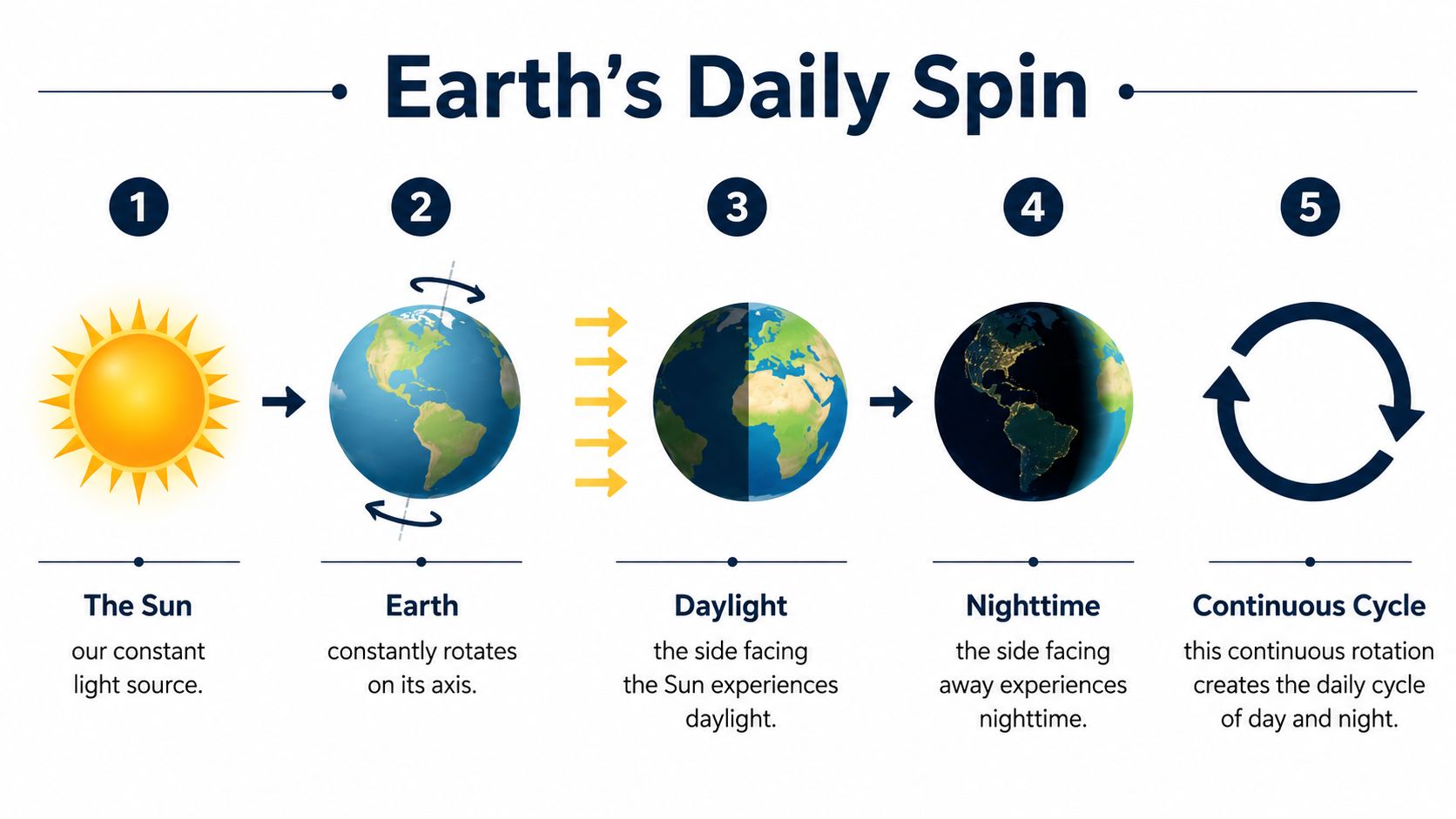
It happens because Earth spins like a giant top. Our planet turns, and your part of the world slowly rotates into sunlight, then out of it again. The Sun appears to move across the sky from our point of view, but the big mover in this daily pattern is Earth.
A simple home demo makes this much easier to see.
Try the torch and ball demo
You can demonstrate this with a ball and a torch.
You'll need:
- A ball such as a football, orange, or rolled-up socks
- A torch to act as the Sun
- A sticker or pen mark for your town
Do this in a dim room.
- Shine the torch steadily at the ball.
- Mark your location on the ball.
- Turn the ball slowly.
- Watch your marked spot move into the light, then across it, then back into darkness.
Now say this line out loud: “The Sun stays shining. Earth turns.”
That sentence helps children separate what they see from what is happening. It also answers a sneaky question many kids ask next. “Is the Sun chasing us?” No. We are turning toward it, then away from it.
What children usually find confusing
One big question is, “If Earth is spinning, why don't we feel it?”
Here is the helpful idea. You, your house, the trees, and the air around you are all moving with Earth together. It feels steady for the same reason a smooth car ride can feel calm when you are inside it. You notice bumps and sudden changes more than steady motion.
Another common muddle is daytime happening everywhere at once. It doesn't. At any moment, one half of Earth faces the Sun and the other half faces away. That is why breakfast is happening in one place while another place is seeing stars.
Practical rule: If your place on Earth faces the Sun, it's daytime there. If it faces away, it's night.
Want to make the demo even more fun? Put a tiny sticker on the ball for your town and ask, “What time of day is it now?” Turn the ball a little. Ask again. Children start predicting sunrise, noon, sunset, and night on their own, which is a great sign that the idea has clicked.
For a strong real-world follow-up, this view of Earth at night from space helps children connect the spinning-planet idea to what astronauts and satellites see.
Our Planets Wobbly Trip and the Four Seasons
Why can it be chilly in January when Earth is still circling the same Sun?
The answer is one of the sneakiest ideas in space science. Earth travels around the Sun with a slight lean, and that lean changes how sunlight reaches different parts of the planet through the year.
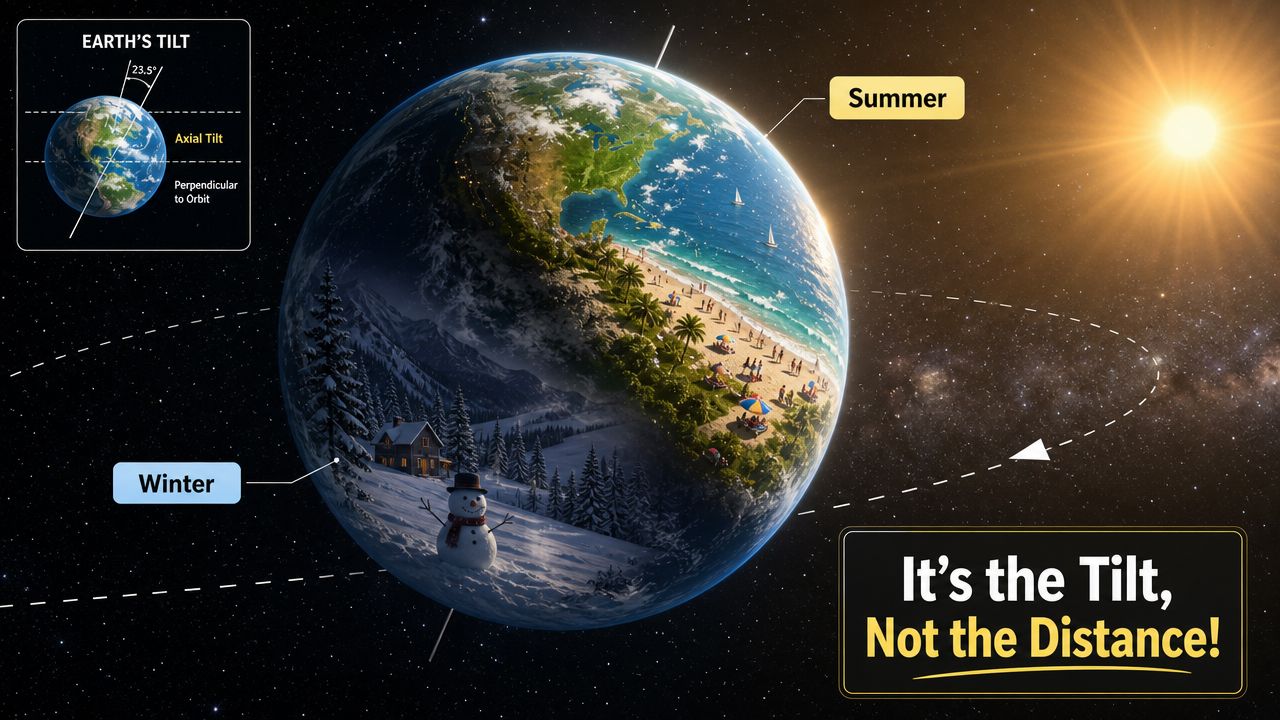
A useful way to picture it is a torch shining on a ball. When the light hits straight on, it is bright and concentrated. When it hits at a slant, the same light spreads out over a bigger area and feels weaker. That is the big season clue.
A pencil and lamp experiment
Try this on a table with a lamp, a pencil, and a ball or orange if you have one.
- Stand the pencil upright to show Earth's axis.
- Tilt the pencil slightly and keep that tilt pointing the same way.
- Move the ball in a slow circle around the lamp.
- Pause halfway round and ask, “Which half is leaning more toward the lamp now?”
Children can usually spot the pattern before the grown-ups say it out loud. A part of Earth leaning toward the Sun gets more direct sunlight and longer days. A part leaning away gets lower-angle sunlight and shorter days.
That is why summer feels so different from winter.
In the UK, this shows up clearly. Summer evenings stay bright for ages, while winter afternoons can fade fast. The Sun takes a higher path across the sky in summer and a lower one in winter, so the light arrives with a different strength and for a different amount of time.
A common question is, “If the tilt stays the same, why do the seasons change at all?” Great question. The tilt keeps pointing in the same direction as Earth travels around the Sun, so different parts of Earth take turns leaning more toward the Sun and then more away from it.
Another kid question pops up here too. “Do all places get the same seasons?” They do not. When it is summer in the Northern Hemisphere, it is winter in the Southern Hemisphere. Australia can be having beach weather while the UK is hunting for gloves.
A quick recap helps the idea stick:
| Season idea | What's really happening |
|---|---|
| Summer | Your part of Earth is tilted more towards the Sun |
| Winter | Your part of Earth is tilted more away from the Sun |
| Spring and autumn | Your part of Earth is between those two stronger extremes |
Want a hands-on follow-up for moon watchers too? This guide to the first quarter Moon is a fun next sky challenge once children start noticing where the Sun and Moon appear through the month.
That is a lovely lightbulb moment. A child can go from “winter is cold because the Sun is farther away” to “winter is cold because the sunlight hits us at a lower angle and for less time.”
The Moons Magic Show of Changing Faces
Why does the Moon seem to change its face from night to night, and why can it sometimes pop up in the daytime too?
The Moon keeps the same round shape all month. What changes is our view of its sunlit half as it travels around Earth. It is a little like watching a ball move around a lamp. The ball stays the same, but the bright part you can see shifts depending on where you stand.
A full cycle of phases takes about a month, so patient sky-watchers can spot a pattern. One week the Moon is a thin crescent. Later it grows to first quarter, then gibbous, then full, and after that it shrinks again.
Biscuit science works very well
If you have sandwich biscuits at home, you have a simple moon-phase model ready to go.
Try making a mini Moon lineup:
- Leave one whole for a full Moon
- Scrape away a little cream for a gibbous Moon
- Make a half for quarter Moon
- Leave a tiny sliver for a crescent
- Use the dark biscuit only for a new Moon
Why does this stick in your memory? Because your hands help your brain. Children can build the phases in order, point to the one they saw last night, and then, with permission from Mission Control, eat the evidence.
A nice follow-up is to watch one phase carefully for several evenings. This guide to the first quarter Moon for young sky-watchers gives children a clear next challenge.
Why is the Moon out during the day?
This is one of the best kid questions in all of sky-watching.
The Moon is often in the daytime sky because it is orbiting Earth all month long, not waiting for darkness to switch on. Sometimes its position puts it up in the sky while the Sun is up too. The daytime Moon can look faint because the bright blue sky makes it harder to notice, but it is still there.
The strange crescent puzzle
Another question pops up fast. Why does the bright crescent not always seem to point straight at where the Sun is?
What your eyes are seeing is the curved sky above you. The lit part of the Moon always faces the Sun, but on our wide dome of sky that direction can look a bit tilted or off to the side. The effect makes more sense when you see a clear diagram from a trusted source, such as this explanation of why a crescent Moon points the way it does from Earth.
Children are often the first to notice this. They look up, spot the odd detail, and ask the question everyone else forgot to ask.
Want to test it yourself? Hold up a ball in a dark room and shine a torch on it from one side. Then walk around the ball. The bright part keeps facing the torch, but from your new position it can look slanted, thinner, or wider. That is the Moon's magic show. No tricks, just light and angles.
Cosmic Hide and Seek with Eclipses
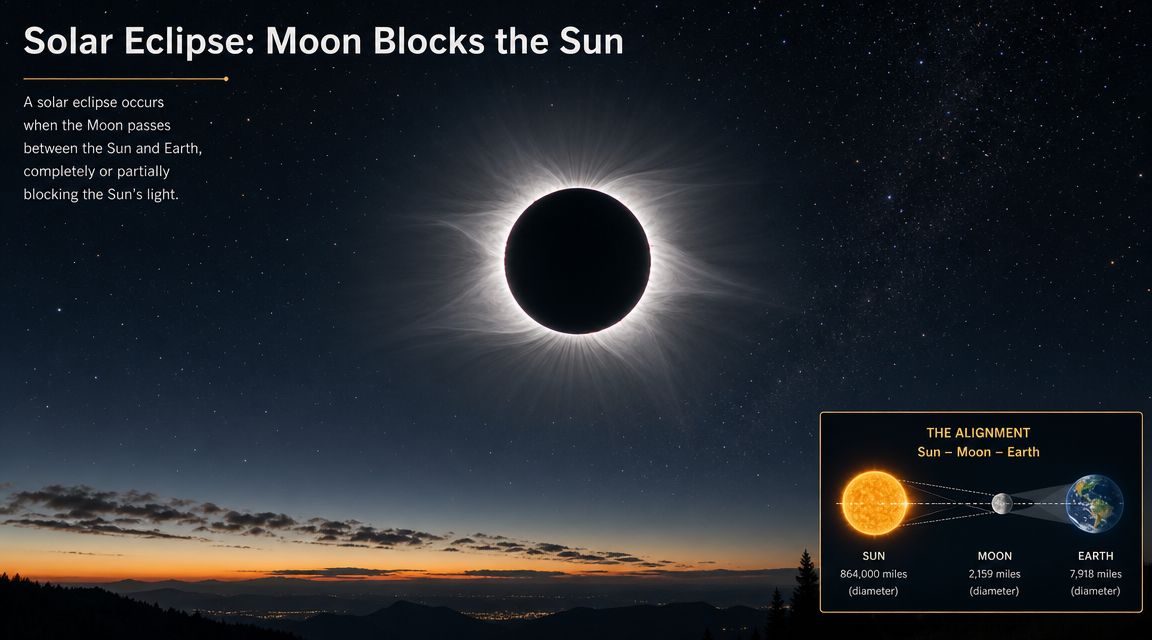
Have you ever wondered why the Moon can sometimes cover the Sun, and other times Earth turns the Moon dark red? Eclipses are what happen when the Sun, Earth, and Moon line up so neatly that one world throws a shadow onto another.
Two kinds of eclipse
A solar eclipse happens when the Moon passes between Earth and the Sun. From our spot on Earth, the Moon can block some or all of the Sun for a short time.
A lunar eclipse happens when Earth moves between the Sun and the Moon. Earth's shadow then falls across the Moon.
Kids often ask a smart follow-up question here. If the Moon goes around Earth every month, why do we not get an eclipse every month? The answer is that the Moon's path is slightly tilted, so most months the shadow misses. The three objects have to line up very closely for an eclipse to happen.
You can show this at home with a quick demo script.
A lamp works like the Sun. A bigger ball works like Earth. A smaller ball works like the Moon.
Say: “Let's make the three space objects line up.”
- For a solar eclipse, hold the small ball between the lamp and the bigger ball.
- For a lunar eclipse, place the bigger ball between the lamp and the small ball.
- Now lift the small ball a little higher or lower and ask, “Did the shadow miss?” That is why eclipses are special.
The size trick that fools our eyes
One reason solar eclipses feel so dramatic is that the Sun and Moon look close to the same size in our sky. They are not the same size at all. The Sun is enormous compared with the Moon, but it is also much farther away, so the two can appear to match from Earth.
That works like holding a small coin near your eye so it covers a distant streetlamp. The coin is tiny compared with the lamp, yet from your viewpoint it can hide it.
A short video can help children picture the lineup:
Safety rule: Never look directly at the Sun, even during an eclipse, unless you are using proper safe solar viewing equipment.
That rule matters every time. Curiosity is wonderful, and protecting your eyes lets you keep exploring the sky for years to come.
Your Space Explorer Mission Recap
You've now got the big picture.
I think about Earth spinning, and I know that gives us day and night.
I try the torch-and-ball demo and test the idea with my own hands.
I can look at the Moon and notice its changing phase.
I can explain that seasons happen because Earth is tilted, not because summer means we've drifted closer to the Sun.
There's another lovely thing to remember. The Moon doesn't always stay in one tidy track across the sky. Earth's tilt and the Moon's tilted orbit can make the Moon appear in very different places, and it can show up almost all over the sky, as described in the Royal Astronomical Society of Canada's explanation of changing lunar angles. That's why it can seem surprisingly high, low, or in an unexpected part of the sky.
If you want to keep the learning going at home or in school, Space Ranger Fred books offer story-led space themes for children. You can also grab printable activities from the freebies and activities page, and teachers can explore interactive sessions through school visits.
The best part of learning space science is this. Children don't need to memorise fancy words first. They can observe, ask, test, and explain. That's real science.
If you'd like more story-led STEM adventures, printable activities, and ways to bring space learning into reading time or the classroom, visit Space Ranger Fred. Learning should be experienced, not just delivered.