
Music games are more than just a bit of fun. They’re playful, hands-on activities that weave together tunes, rhythms, and movement into brilliant learning experiences. They can be as simple as clapping songs or as tech-savvy as a digital app, but the mission is always the same: to teach musical concepts through play.
Along the way, kids pick up incredible skills in coordination, listening, and creativity without even realising it.
How Musical Play Boosts Your Child's Brainpower
Welcome to the universe where music and play collide! It's a place buzzing with rhythm, melody, and pure imagination. But what if I told you that these moments are doing more than just keeping your child entertained? They’re actually powerful tools for growth, helping to build a brilliant brain one beat at a time.
Think of music games for children as a secret key, unlocking your child’s potential in some surprising ways. Following our Menturity™ approach, we see every game as a chance to nurture curiosity, build confidence, and sharpen communication. A simple rhythm game isn't just about clapping in time; it's an adventure in listening, collaborating, and solving problems. When children work together to create a beat, they’re practising vital life skills without even noticing.
The Surprising Link Between Music and STEM
Did you know that music and STEM (Science, Technology, Engineering, and Maths) are best friends? The connection is stronger than you might think. When your child learns to spot a beat, they’re also learning about mathematical patterns and sequences. When they experiment with making sounds—a loud bang versus a soft tap—they're getting a hands-on physics lesson in vibrations and energy.
Music gives a soul to the universe, wings to the mind, flight to the imagination and life to everything. – Plato
This playful approach turns abstract ideas into something children can feel and do. It reframes learning as an exciting mission of discovery, not a chore.
Learning Through Story and Adventure
Here at Space Ranger Fred, we believe the best learning happens through story. Imagine your child isn't just playing a music game; they're composing a soundtrack for an epic space mission. Each note could be a shooting star, and every rhythm a new planet discovered. By framing musical play within a narrative, we ignite their imagination and make the experience unforgettable. This is exactly what we do in our book series, where stories like Space Ranger Fred and the Shoelace Adventure turn everyday challenges into cosmic quests.
By getting stuck into music games, children aren’t just learning notes and rhythms. They are:
- Building Confidence: Nailing a new song or rhythm is a huge confidence booster.
- Improving Communication: Many music games involve teamwork, listening to others, and expressing ideas without words.
- Sparking Curiosity: "What sound does this make?" is the first step on a journey of scientific discovery.
Ready to start your mission? Check out our free activities to find more ways to combine story, play, and learning.
Unlocking the Hidden STEM Connections in Music
Ever wondered what’s really going on when your child is happily tapping out a rhythm or humming a tune? It might look and sound like simple play, but underneath the surface, their brain is on a secret training mission, packed with powerful STEM connections. Music games are a fantastic, almost sneaky, way to introduce big ideas in science, technology, engineering, and maths without it ever feeling like a lesson.
Think of it as musical fun secretly developing their ‘superpowers’. Every note, beat, and melody becomes a hands-on experiment, letting kids explore complex concepts through pure curiosity and play.
From Building Blocks to Musical Phrases
Picture your child building with LEGOs. They grab individual bricks and start fitting them together, creating a spaceship, a castle, or some futuristic city from their imagination. Along the way, they learn that certain pieces connect in specific ways, and that combining them in a sequence creates something new and exciting.
Composing a simple melody follows the exact same logic. Musical notes and phrases are just like those LEGO bricks. By arranging them in order, your child is exploring the very fundamentals of engineering: structure, design, and patterns. They're discovering how individual parts can join to form a cohesive, stable whole—a core engineering principle, learned through the simple joy of making music.
Rhythmic Patterns: The Secret Code to Coding
Learning rhythmic patterns feels a lot like learning the basics of computer coding. When a child claps out a sequence like clap-clap-stomp, they are working with a logical, step-by-step process. This is the bedrock of coding and computational thinking.
Each clap or stomp acts like a line of code—an instruction that has to be performed in the right order to get the result you want. This playful activity teaches them:
- Sequencing: Understanding that order really matters.
- Logic: Recognising cause and effect within a pattern.
- Problem-Solving: Figuring out how to fix the pattern if it goes wrong.
This helps kids develop a logical mindset that’s incredibly useful in a world where technology is everywhere. For a deeper dive, you can explore more about how these concepts fit into the bigger picture of what STEAM education is and why it matters.
This infographic breaks down how music games can boost brainpower, develop essential skills, and strengthen STEM learning.
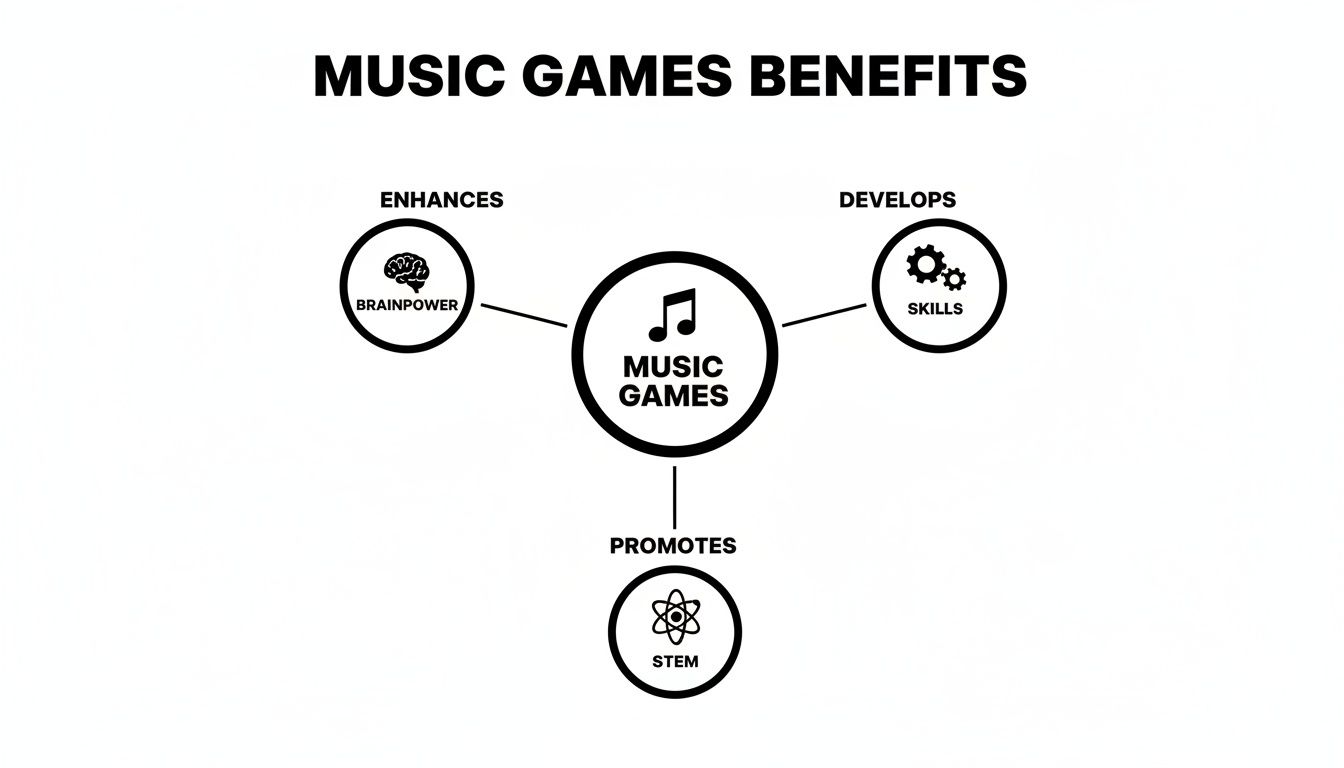
As you can see, the benefits branch out from simple play into crucial areas of development, making music a seriously powerful tool for learning.
A Space Mission into the Physics of Sound
Let’s imagine Space Ranger Fred is on a mission, investigating strange signals on a distant planet. What he’s really doing is exploring the physics of sound! Sound is all about vibrations. When something vibrates, it sends invisible waves through the air straight to our ears.
You can bring this to life with a simple story. Perhaps Fred hears a low hum from a giant, bubbling space geyser—that’s a slow vibration, creating a low pitch. Then, he hears a high-pitched whistle from a tiny, speedy alien creature—that’s a fast vibration, creating a high pitch. The volume, or how loud it all is, depends on the size (amplitude) of those waves.
Try This At Home: Gently stretch a rubber band between your fingers and give it a pluck. Notice the sound and see the vibration. Now stretch it tighter and pluck it again. The pitch gets higher because it's vibrating faster! You've just conducted your own physics experiment.
By turning science into a story, we can show children that physics isn't just a stuffy subject in a textbook; it's a real-world force they can hear, feel, and experiment with. Music becomes a hands-on, adventurous way to understand the science that shapes our universe.
Choosing the Right Music Game for Your Child
So, you're ready to find the perfect music game for your young explorer? With a whole universe of options out there—from apps on a tablet to old-school playground songs—it can be tough to know where to even begin. The secret is to find something that clicks with your child’s personality, fits into your family's rhythm, and, most importantly, feels like pure fun!
This guide is your mission map to the world of music games for children. We'll navigate through three main galaxies: digital games, unplugged adventures, and activities that get everyone up and moving. Each one has its own special powers for building different skills, so let’s figure out which adventure is right for you.
Digital Grooves
Digital music games, whether on an app or an online platform, have become an incredibly popular way for kids to connect with music. It’s a booming area—the global music game market was valued at around USD 2.1 billion in 2023 and is expected to more than double by 2032. A big reason for this is the growing focus on early childhood education, with creators designing games that are as smart as they are fun. You can read more about the growing music game market and see why this space is expanding at light speed.
When you're browsing the app store, look for games that inspire creativity and problem-solving, not just mindlessly tapping along to a beat.
- Benefits: These games are fantastic for introducing tricky musical ideas like notation and composing in a really simple, hands-on way. Plus, they sneakily build digital literacy and hand-eye coordination.
- Simple Game Idea: Find an app that lets your child become a space-age composer by dragging and dropping different sounds and beats to build their own songs.
- Safety First: Always have a quick look at the app’s privacy settings and keep an eye out for in-app purchases or ads. For a deep dive, our guide on how to choose children's educational video games is a brilliant place to start.
Unplugged Adventures
There’s a timeless magic to screen-free games, isn't there? They run on pure imagination and teamwork, using the best instruments you already have—your voice, your body, and everyday objects—to make some musical magic. These are the kinds of games that get everyone talking, listening, and laughing together.
An 'unplugged adventure' can be as simple as making up a silly song about what you did today or creating a story complete with homemade sound effects. It’s all about imaginative, spontaneous play.
An unplugged music game is a fantastic way to tune into your child's creativity. By removing the screen, you open up a space for listening, teamwork, and storytelling to take centre stage.
- Benefits: These games are unbeatable for building social skills, active listening, and raw creativity. They don’t need any special gear and can be played absolutely anywhere.
- Simple Game Idea: Give ‘Sound Story’ a go. You start a story (“Space Ranger Fred landed on a mysterious, rocky planet…”) and your child has to create all the sound effects. They can use their voice or things around the room—tapping a cushion for footsteps or whistling for the wind.
Get Moving Games
For those kids who just can't sit still, games that mix music with movement are the perfect match. These activities connect rhythm and melody directly to the body, helping them develop coordination, balance, and a brilliant sense of timing.
It’s all about feeling the music, not just hearing it. Think dancing to different speeds, acting out musical dynamics (moving quietly for soft music and taking up space for loud music), or a classic game of musical statues. This kind of play is also a great workout for the vestibular system—the body's internal GPS in the inner ear that controls balance. When kids spin, jump, and dance to a beat, they’re giving that system a fun tune-up!
- Benefits: Excellent for gross motor skills, physical confidence, and self-expression. They help children absorb concepts like tempo and dynamics in a physical, gut-level way.
- Simple Game Idea: Put on some music that changes its mood and speed. Challenge your child to move like a slow, heavy giant when the music is low and plodding, then switch to a speedy little alien when it gets fast and high-pitched. It’s a hilarious way to explore musical storytelling with their whole body.
To help you decide, here’s a quick comparison of the different game types.
Choosing Your Perfect Music Game Adventure
| Game Type | Best For | Key Skills Developed | Space Ranger Fred Tip |
|---|---|---|---|
| Digital Grooves | Tech-savvy kids who love interactive play and visual learning. | Digital literacy, hand-eye coordination, music theory (notation, composition). | Look for apps that let your child compose, not just consume. Creative tools are a huge bonus! |
| Unplugged Adventures | Imaginative children, family game nights, and situations needing zero prep. | Social skills, active listening, creativity, communication, storytelling. | Use our characters to inspire a story. What sounds would Zando Centauri make on a mission? |
| Get Moving Games | Energetic kids who learn by doing and need to burn off some steam. | Gross motor skills, coordination, balance, spatial awareness, self-expression. | Create a "Space Ranger Fred" training course with different musical cues for actions like jumping, spinning, and sneaking. |
Ultimately, the best music game is the one your child genuinely enjoys. Don't be afraid to mix and match—maybe an app on a rainy day, a family sound-story in the evening, and a dance party to get the wiggles out before school. Happy playing!
Create Your Own Soundscape Story at Home
Ready for a mission? It’s time to turn your living room into a sound studio and launch an audio adventure! This hands-on project is all about creating a ‘Soundscape Story’ for one of Space Ranger Fred's missions. It’s one of the most imaginative music games for children you can play, transforming a simple story into an amazing, multi-sensory experience.
The best bit? You don’t need any fancy instruments. Your home is already a treasure chest of sounds just waiting to be discovered. This activity is designed to sharpen listening skills, get everyone working as a team, and spark some serious creativity—all while having a brilliant time together.
Your First Mission Briefing
Every great adventure needs a story. Here’s a prompt to get your creative engines firing:
Mission Prompt: Space Ranger Fred's spaceship, the Stardust Cruiser, touches down on Planet Sonus. The air is thick with strange noises: a constant, low whistling wind sweeps across the purple plains, bubbling space geysers erupt with a gentle plop-fizz, and tiny, metallic creatures scuttle past with a rhythmic click-clack.
Your challenge is to bring this scene to life using only sounds you can make around your home. How will you recreate the unique atmosphere of Planet Sonus?
Step 1: Assemble Your Sound Toolkit
Now, this is where the fun really starts. Send the family on a sound hunt around the house. The goal is to experiment and think outside the box about what different objects can do. Don’t be afraid to try silly things; that's usually where the best ideas come from!
Here are a few ideas to get you started:
- For the Whistling Wind: Try blowing gently over the top of a bottle, swishing a handful of rice in a box, or even just making a "whoosh" sound with your mouth.
- For the Bubbling Geysers: How about blowing bubbles into a glass of water with a straw? Or maybe slowly pouring lentils from one container to another?
- For the Clicking Creatures: What could you use? Tapping two spoons together, clicking a pen, or shaking a box of paperclips could all work perfectly.
Step 2: Rehearse and Record Your Soundscape
Once you've gathered your sound-making objects, give each family member a specific sound to create. Have the storyteller read the mission prompt aloud, and when they mention a sound, the assigned person makes it. Practise a few times until your timing is just right. You're not just making noise; you're conducting a tiny orchestra!
This picture shows a family having a brilliant time finding sounds with things they found in the kitchen.

Their focus and teamwork are turning simple objects into an exciting, collaborative story.
For an extra layer of fun, try recording your soundscape on a phone. You can play it back during your next storytime, turning a simple tale into an epic audio adventure. Kids absolutely love hearing their own productions. To help your child create their own unique musical experiences, consider an activity like the Melody Magic Remix activity.
This whole process is a fantastic exercise in active listening, communication, and creative problem-solving. It's not about getting it perfect—it's about experimenting, laughing, and building a story together. For more story ideas and missions, head over to the Space Ranger Fred freebies and activities page.
Bringing Musical STEM into Your Classroom
For all you brilliant teachers, librarians, and homeschool heroes out there, this is your launchpad. We're about to explore how you can weave musical STEM into your learning environment, and I promise, it's easier and more fun than you might think.
Integrating music games for children into your lessons isn't about adding another complicated task to your plate. It's actually a wonderfully simple way to connect big ideas across different subjects, all while getting your students to work together and think creatively.
Let's dive into a practical, curriculum-aligned mini-lesson called 'The Rhythm of the Planets'. This activity brilliantly connects music, astronomy, and maths, turning your classroom into a mini solar system of sound. It’s a perfect example of how we at Space Ranger Fred believe learning should be: hands-on, collaborative, and playful.
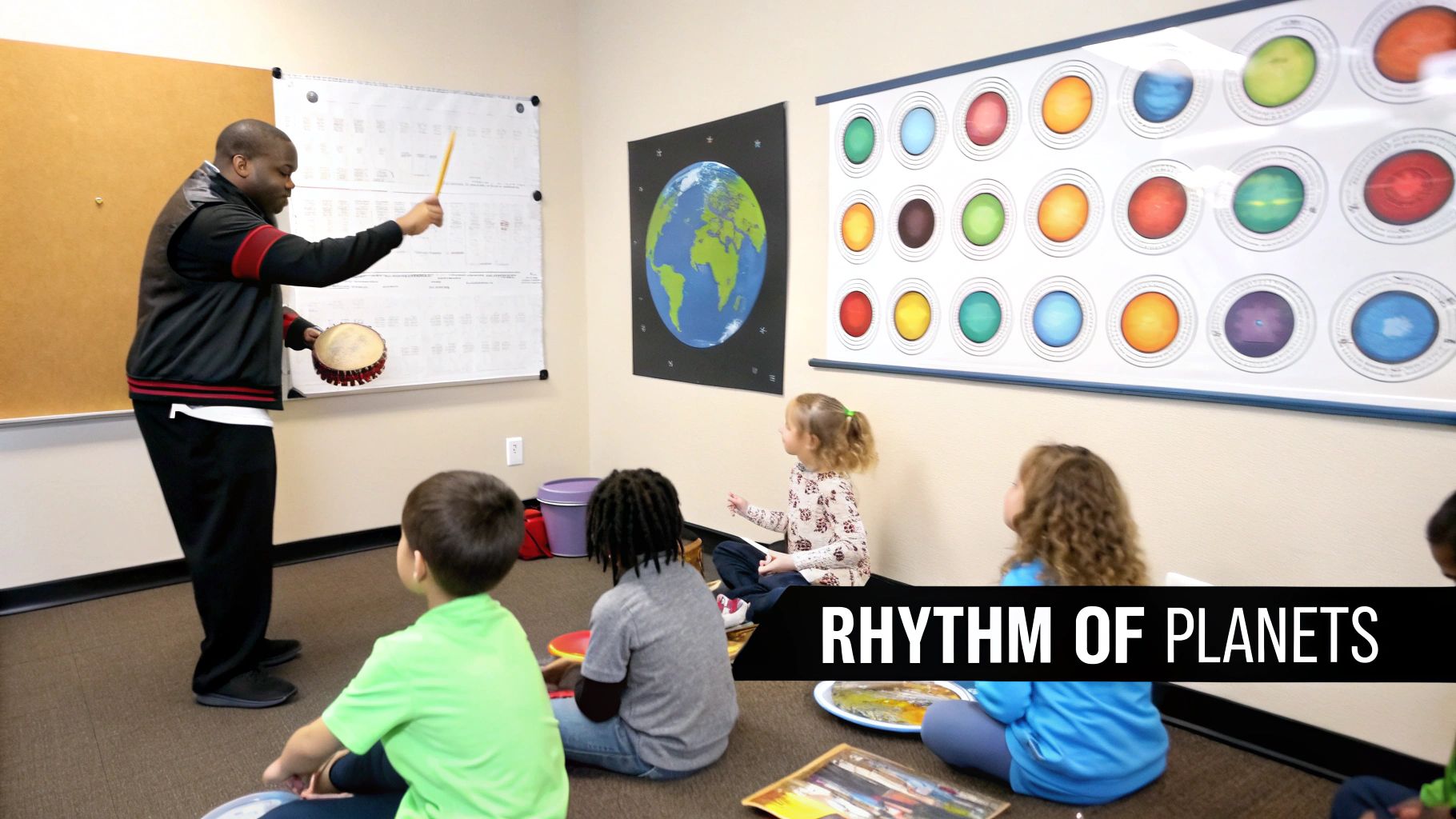
This kind of hands-on approach helps children embody abstract concepts, making what they learn far more memorable and meaningful.
Mini-Lesson Plan: The Rhythm of the Planets
In this activity, students team up to create unique rhythmic patterns for each planet in our solar system. The mission? To translate scientific facts into musical expression, sharpening both their analytical and creative skills at the same time.
Learning Objectives:
- Understand that different planets have unique characteristics (like size or orbital speed).
- Translate abstract data into rhythmic patterns.
- Practise collaboration, communication, and active listening.
- Develop a basic grasp of tempo, rhythm, and dynamics.
Materials Needed:
- Simple percussion instruments (shakers, drums, tambourines, wood blocks).
- Body percussion (clapping, stomping, snapping works just as well!).
- Pictures or interesting facts about the planets in our solar system.
Step-by-Step Mission Guide
Ready for blast-off? Here’s a simple guide to lead your students on their cosmic musical journey.
Mission Briefing: Kick things off by chatting about the planets. Ask questions to get them thinking, like, "Which planet is the biggest?" or "Which one spins the fastest?" If you want to get everyone extra inspired, you could even explore our blog post on the wonders of space exploration to set the scene.
Form Your Crews: Split the class into small groups, assigning one or two planets to each 'crew'. One crew might tackle Mercury and Venus, while another takes on the gas giants, Jupiter and Saturn.
Compose Your Planet Anthem: Now for the fun part. Challenge each group to create a simple rhythm representing their planet. Think about it: a slow, heavy, four-beat pattern (BOOM… boom… boom… boom…) would be perfect for massive Jupiter. Meanwhile, a fast, light, and skittish rhythm (ti-ti-tak-tak-ti-ti-tak) could capture speedy little Mercury perfectly. Encourage them to use instruments or just their hands and feet.
Perform for Mission Control: Bring everyone back together and have each crew perform their planetary rhythm. The rest of the class can then guess which planet the rhythm represents based on its tempo and feel. This is a great way to build presentation skills and lock in the learning.
This activity isn't just about making noise; it's about making connections. Children learn that music is a language that can describe the world—and even the universe—around them. It’s a powerful lesson in communication and abstract thinking.
How to Adapt the Mission
One of the best things about this activity is how flexible it is. You can easily tweak the mission parameters to suit different ages and abilities.
- For Younger Explorers (Ages 6-8): Keep it simple. Focus on two contrasting planets, like tiny Mercury and giant Jupiter. Stick to body percussion and guide them in creating a fast beat versus a slow one.
- For Older Astronauts (Ages 9-12): Add a layer of complexity. Challenge them to incorporate dynamics (loud vs. soft) to represent a planet's stormy weather or quiet atmosphere. You could even have them combine their individual planet rhythms to create a full "Solar System Symphony."
By bringing music games for children into your classroom, you're not just teaching—you're creating a dynamic and engaging experience. This mission does more than teach facts about space; it fosters teamwork, builds confidence, and shows kids that STEM can be an incredibly creative adventure.
How to Choose Quality Music Games and Apps
Diving into the universe of apps and games can feel like a mission in itself. With so many out there, how do you pick the best music games for children? Think of this guide as your co-pilot, here to help you find high-quality, safe, and genuinely brilliant games your young explorer will actually love.
The secret is to look for games that inspire creativity and real learning, not just flashy distractions. It’s a bit like packing for a Space Ranger Fred mission: you need tools that are useful, reliable, and can adapt to new challenges. A great music game should do the same, growing right alongside your child as their skills take off.
Look for Genuine Educational Value
The best educational games are the ones that disguise learning as pure fun. When you’re looking at an app, ask yourself: what is my child really doing? Are they actively creating, solving problems, and tinkering with musical ideas? Or are they just passively tapping along to a pre-set tune?
You’ll want to prioritise games that encourage creation over simple repetition. Games that let kids compose their own melodies, experiment with different instrument sounds, or solve rhythm puzzles are far more powerful for building lasting skills and confidence. This hands-on approach is at the heart of what makes gamification in education so effective.
This focus on playful, educational content is a growing priority for families. In the UK, the market for educational toys is expanding quickly, with STEM toys becoming the fastest-growing segment. It shows a clear shift towards products that cleverly blend entertainment with cognitive development. You can discover more about this growing trend in educational toys.
Your Quality Checklist
To make your search a bit easier, here's a simple checklist to keep in mind. Consider it your pre-flight check before you download a new app or buy a game.
- Is it age-appropriate? A good game offers challenges that are achievable but not too easy, just like a well-designed mission for Space Ranger Fred.
- Does it grow with your child? Look for adjustable difficulty levels or different ways to play that can keep them hooked as they learn.
- Is it safe? Check for sneaky hidden costs, in-app purchases, or distracting third-party ads. A quality educational app should be a safe space for curiosity.
- Does it foster creativity? The best games provide tools, not just rules. They give children the freedom to experiment and express their own musical ideas.
By choosing games built on a foundation of creative, child-led exploration, you're not just providing entertainment. You're giving them a launchpad for a lifelong love of learning, music, and problem-solving.
Finding the right music game is really about finding the right adventure. With these tips, you can confidently choose experiences that will help your child’s skills and imagination soar to new heights.
Start Your Family's Musical Adventure Today
And there you have it. You’re all set to press play on a brand-new universe of learning and fun. We’ve journeyed through just how music games for children are so much more than a noisy afternoon—they’re brilliant tools for building up confidence, sparking real curiosity, and secretly sharpening those all-important STEM skills.
From composing your own cosmic soundtracks in the living room to turning the classroom into a solar system of sound, the mission is clear. When you mix music and play together, you create an unstoppable force for learning.
Your Adventure Starts Now
Whether you fire up a digital app, dive into an unplugged story, or throw a full-blown dance party in the kitchen, you’re giving your child a fantastic gift. You’re showing them that learning isn’t just something stuck in a textbook; it's something you do, feel, and try. It’s all about asking questions, not being afraid to make a few mistakes, and having a good laugh along the way. That’s the Menturity™ approach in action—growing curious, confident thinkers through hands-on adventure.
Every song, rhythm, and silly sound is another step on a journey of discovery. By jumping into musical play, you are helping your child build a brain that is resilient, creative, and ready for any challenge the universe throws at them.
The real secret is to keep things playful and let your child take the lead. After all, the best learning happens when it doesn't feel like learning at all. For those days when you fancy a break from the tunes, you can keep the fun going with other activities like funny board games for families that also get everyone connecting and laughing together.
Ultimately, it’s these shared moments of creativity that build the strongest family bonds and make the best memories.
Your family’s musical mission is ready for launch. Where will your imagination take you first? The adventure is only just getting started, and the whole universe is waiting to hear what you create.
The story doesn't end here! The Space Ranger Fred universe is full of exciting missions and cosmic adventures. Dive into one of our books for more story inspiration or blast off into your next hands-on project with our free activities and missions. Come and explore with us.