
Meta title: Master Drawing a Cartoon Dog Face
Meta description: Learn how to draw a cartoon dog face with simple shapes, fun expression tips, and creative classroom ideas for children, parents, and teachers.
A blank page. A child with a pencil. A grown-up nearby wondering, “How do I make this fun without making it complicated?”
A cartoon dog face is a brilliant place to start. It feels friendly. It uses simple shapes. It gives children quick wins.
It also sneaks in real learning. Circles, ovals, symmetry, expression, observation, storytelling. That is a lot of good stuff from one cheerful dog nose.
If your young artist loves space adventures, even better. A cartoon dog can become a brave sidekick, a moon rover pup, or the captain of a biscuit-powered rocket. Drawing stops feeling like practice and starts feeling like a mission.
Your Creative Mission Briefing What You Need
You do not need a giant art cupboard or fancy equipment to draw a good cartoon dog face. You need a few reliable tools and a willing imagination.
I like to treat this part like packing for launch. Every item has a job. Every job helps the drawing feel easier.
Your mission supplies
- Paper: A4 paper is a lovely size because there is enough room for a big head shape, floppy ears, and plenty of edits.
- HB pencil: This is an effective starting tool. It makes light lines that are easy to adjust.
- Rubber: Not for mistakes. For course corrections. That sounds better, doesn’t it?
- Black fineliner or dark pencil: Useful when the sketch is ready and you want clear outlines.
- Colours: Coloured pencils, crayons, or felt tips all work. Choose what the child already likes using.
Some children freeze because they think they must get it right first time. That is usually the first wobble. A cartoon dog face works best when children know they can sketch lightly and change things.
Tip: Tell children the first pencil lines are “planning lines”. That small phrase often removes the fear of getting it wrong.
Why simple tools help
A basic pencil slows the process down in a good way. Children look more carefully. They notice where the eyes sit. They compare one ear with the other. They think before adding detail.
Learning lives there.
A fineliner comes later, not first. If children outline too early, they often feel stuck with wonky shapes. Keep the bold lines for the final stage.
A small mindset shift
I often tell pupils this. We are not trying to draw the perfect dog. We are trying to draw a dog with personality.
That changes everything.
One dog may have giant ears and tiny eyes. Another may have a huge nose and a grin like it has stolen a sandwich from mission control. Both can work beautifully.
The Secret Code Simple Shapes for Drawing
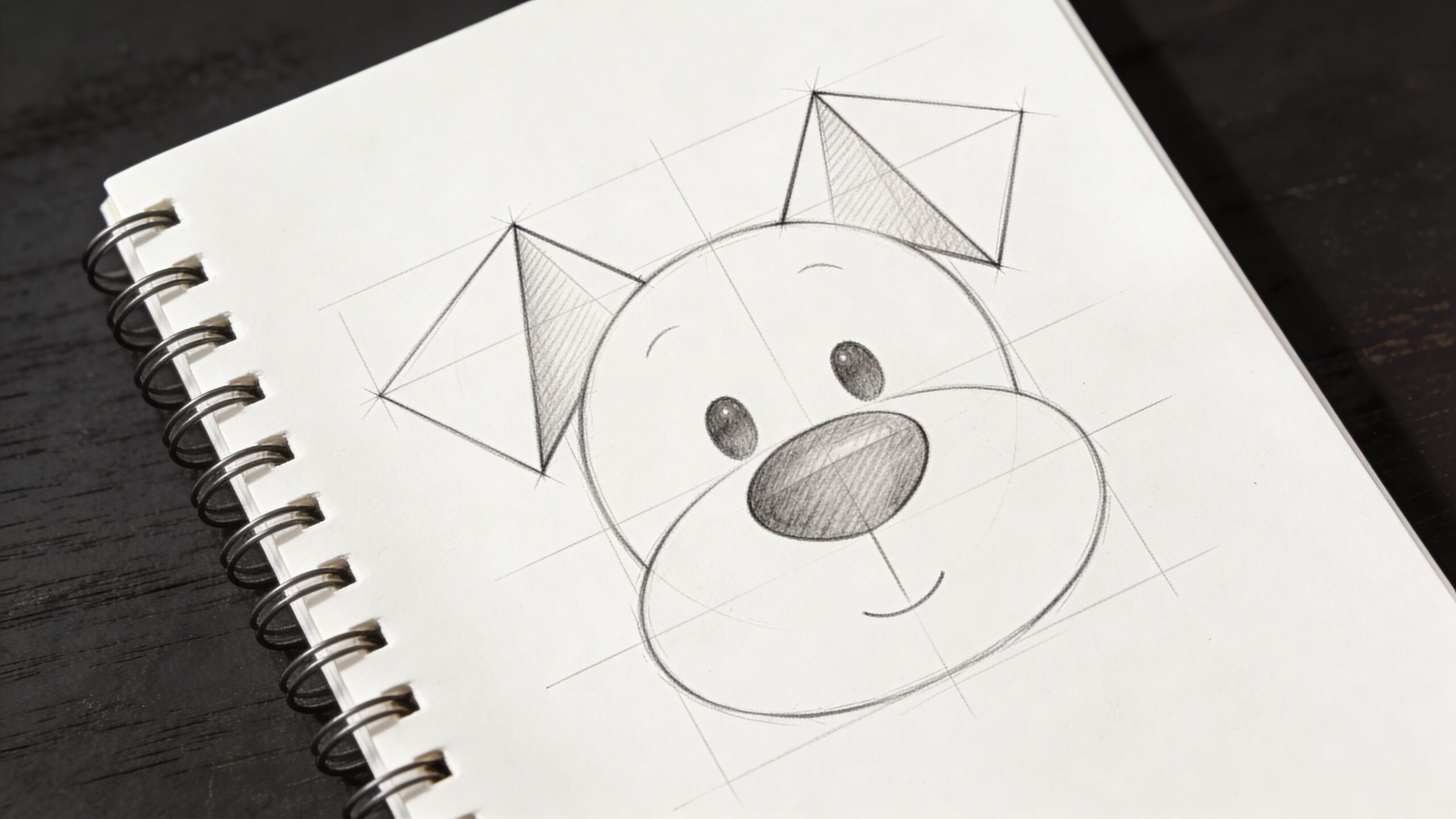
Artists use a quiet little trick all the time. They build pictures from shapes.
A cartoon dog face may look like a finished character, but underneath it is usually a collection of circles, ovals, curves, and triangles. That is useful for children because shapes are familiar. They already know them from maths, toys, and classroom displays.
The head is not a mystery
Start with the biggest shape first. Usually that is the head.
A rounded oval works well because it feels soft and friendly. If the oval is slightly wider, the dog can look younger and cuter. If it is taller, the dog can look more elegant or thoughtful.
Then add the smaller shapes:
- Eyes: Two circles or rounded ovals
- Ears: Long ovals, droopy loops, or pointed triangles
- Nose: A small triangle or rounded blob shape
- Muzzle: A curved oval or soft rounded snout
- Mouth: A simple curve can do plenty of work
Children often think drawing means doing everything at once. It does not. Big shape first. Medium shapes next. Small details last.
The STEM bit hiding in the fun
Drawing connects with simple STEM thinking.
Designers and animators also break complicated things into manageable parts. They simplify. They test proportions. They adjust structure before they worry about polish.
A child drawing a dog face is doing early design thinking.
Here is a simple way to explain it:
| Part of drawing | Shape idea | What children practise |
|---|---|---|
| Head | Oval or circle | Scale and placement |
| Eyes | Circles | Spacing and symmetry |
| Ears | Ovals or triangles | Variation and comparison |
| Nose | Triangle | Position and balance |
| Mouth | Curved line | Expression and control |
Where children usually get confused
The most common confusion is not the nose. It is the spacing.
Children may draw one eye much higher than the other. Or they put features too close to the edge of the face. That is normal. It means they are still learning how shapes relate to each other.
Try this language:
- “Find the centre first.”
- “Leave room for ears.”
- “Make the eyes into a team, not strangers.”
Key takeaway: A strong cartoon dog face begins with structure. The funny details come after the shapes are working together.
Once children see the secret code, they stop saying, “I can’t draw.” They start saying, “I can build it.”
Building Your First Cartoon Dog Sidekick
The fun starts here. The page stops being paper and becomes a character.
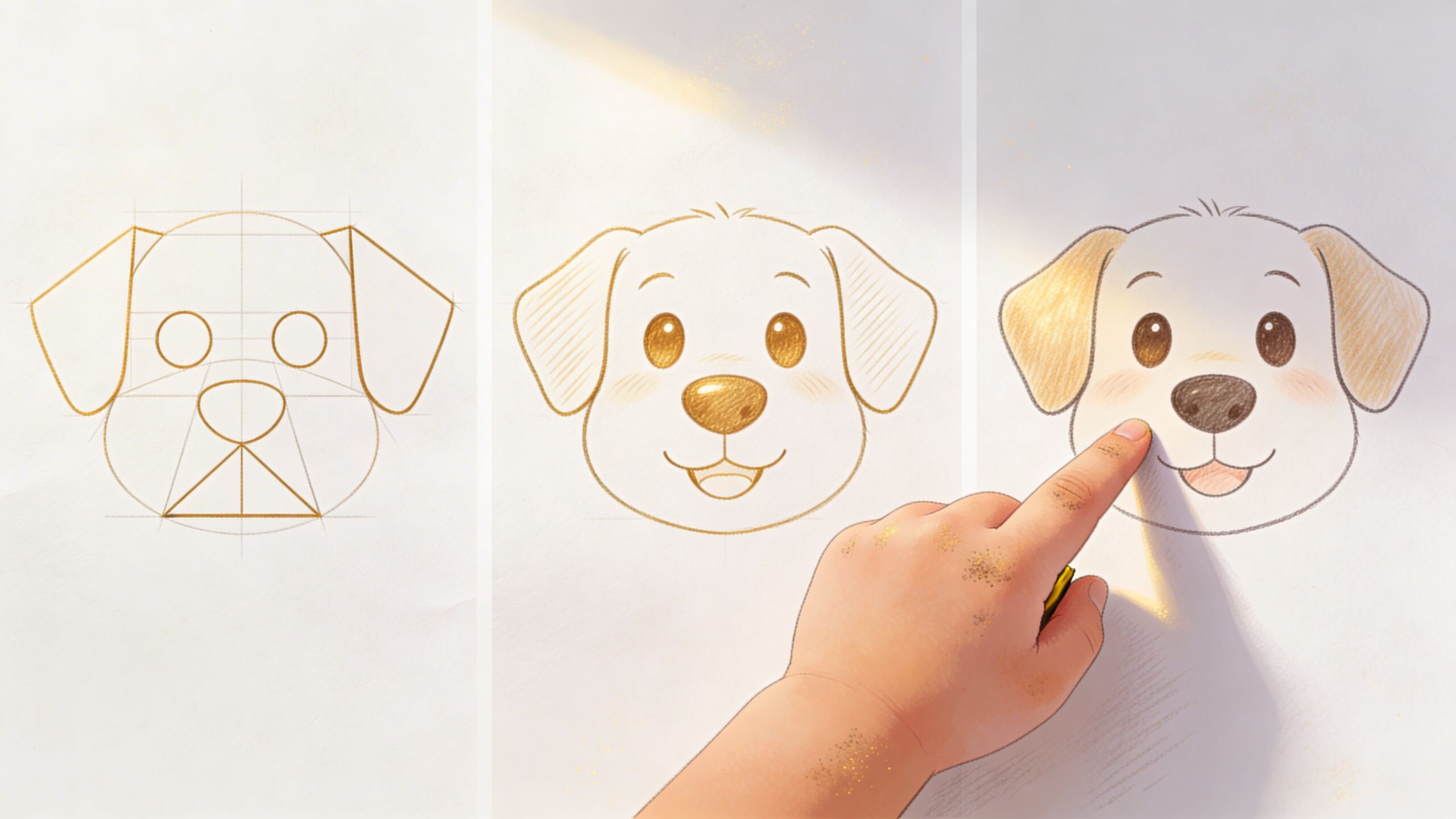
In many UK primary classrooms, children begin with a central oval for the head and then add horizontal and vertical guidelines. According to this guide to drawing cartoon dogs, that approach helps over 92% of pupils in Years 3 to 5 place the eyes correctly and avoid common asymmetry errors.
Start with the head and guide rails
Ask the child to draw one large oval in the centre of the page. Not tiny. Give the dog room to breathe.
Then add a light vertical line down the middle and a horizontal line across the upper part of the face. These lines are like map coordinates. They help place the features before the details arrive.
If a child says, “It looks weird already,” that is often a good sign. Sketches usually look odd halfway through. Cakes look odd before icing too.
Add the eyes with intention
Place the eyes along the horizontal guide. Keep them friendly and simple.
Round eyes feel gentle. Slightly larger eyes feel playful. Leave a bit of space between them so the face does not feel squashed.
Children often push the eyes too high or too low. If that happens, ask them to compare the left and right side rather than rubbing everything out at once.
A useful question is, “Do these eyes look like they belong to the same dog?”
Give your dog a nose and muzzle
The nose usually sits lower down the centre line. A small triangle works well for a classic cartoon dog face.
Under the nose, add a rounded muzzle. This can be one soft shape or two little cheek bumps. Then draw a mouth line underneath. A gentle smile is enough.
Do not chase perfection here. A slightly crooked grin can make the character more charming.
Ears do half the storytelling
Now for my favourite bit. The ears.
Floppy ears make the dog look soft, loyal, and ready to follow you to Jupiter for snacks. Pointy ears can make the dog look alert and brave. Tiny ears can make the head feel larger and more comic.
Let the ears connect clearly to the top sides of the head. If they float in space, the child can lightly redraw them so they feel anchored.
Bring the lines to life
Once the full sketch is in place, go over the final lines more boldly. Keep the planning lines faint or rub them away first.
Children get a wonderful moment of realisation. “Oh. It is a dog.”
Tip: If the drawing feels stiff, ask the child to tilt the eyebrows, widen one side of the smile, or make one ear flop more than the other.
A moving picture can help some learners see the process more clearly:
A quick rescue table for common wobbles
| If this happens | Try this |
|---|---|
| Eyes look uneven | Compare them to the centre line before erasing |
| Nose feels too high | Move it slightly lower into the lower half of the face |
| Ears look disconnected | Extend their base into the head shape |
| Face feels flat | Add eyebrows, cheeks, or a curved mouth |
The best part is this. Children can now say, I can draw a character. Not a random scribble. A character.
That matters.
A Universe of Expressions Bringing Your Dog to Life
A cartoon dog face becomes memorable when it shows a feeling.
This is the moment where a plain drawing turns into someone. Happy. Worried. Sleepy. Mischievous. Proud because it found the last biscuit on the spaceship.
Animators know how powerful this is. In children’s animation, creators often make the eyes about 25% of the head’s diameter to boost the cuteness factor, a technique linked with audience engagement of up to 89% in UK A/B tests, as noted in this cartoon dog tutorial for children’s animation.
Tiny changes do a big job
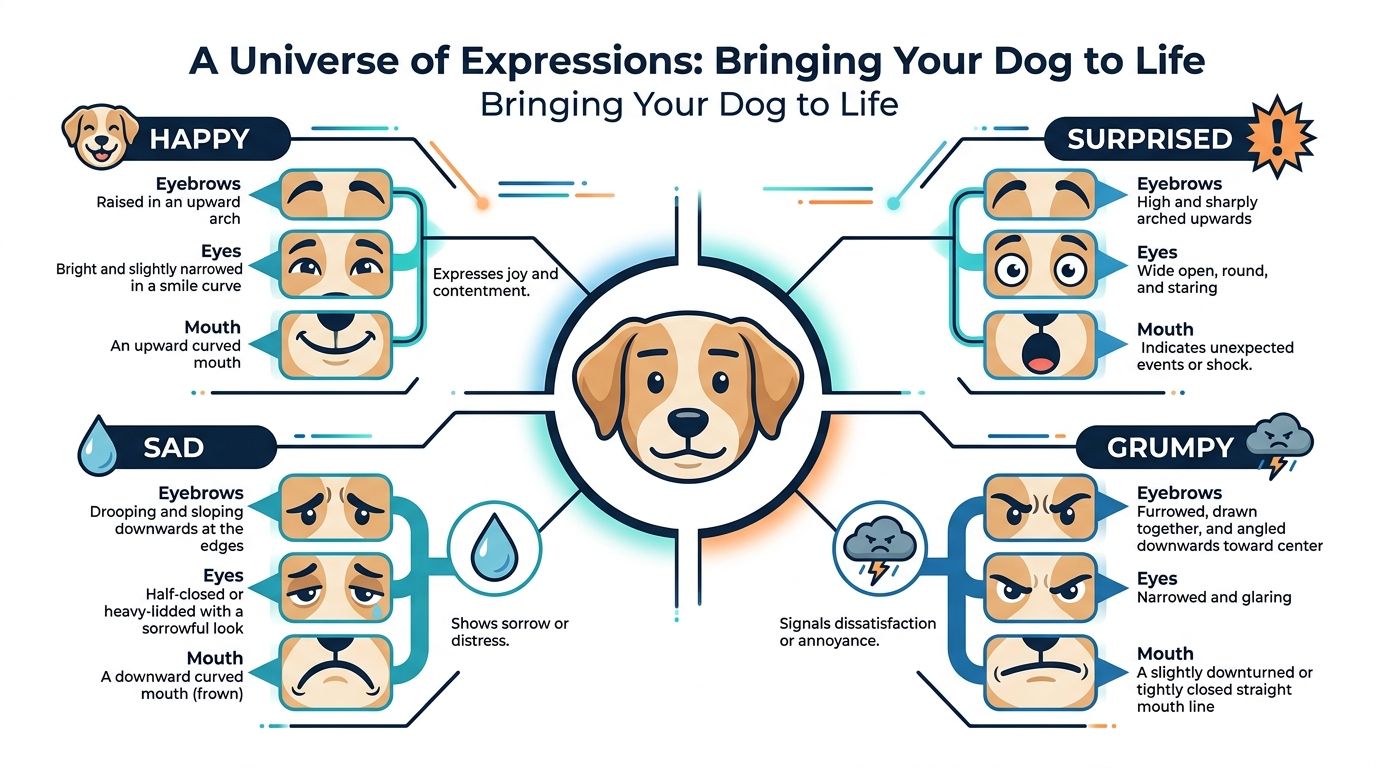
You do not need to redraw the head to change the mood.
Try changing just three things:
- Eyebrows: Raised eyebrows can make the dog look curious or delighted.
- Eyes: Wide eyes suggest surprise. Half-closed eyes can look sleepy or sly.
- Mouth: A curve up feels cheerful. A curve down feels disappointed.
A child often discovers this fastest by drawing the same dog four times and changing only one feature set at a time.
A quick emotion guide
| Feeling | Eyes | Eyebrows | Mouth |
|---|---|---|---|
| Happy | Open and bright | Slightly raised | Curved up |
| Sad | Softer or drooping | Tilted upward in the middle | Curved down |
| Surprised | Wide open | Raised high | Small O shape |
| Grumpy | Narrower | Angled down | Slight downturn |
This is useful beyond drawing. Children begin to read expressions. They notice how faces communicate without words.
That makes art a lovely doorway into emotional literacy.
Let the dog tell a story
I once asked a child to draw “a dog that has just heard a strange noise on Mars”. The first version looked fine, but flat. Then we lifted the brows, widened the eyes, and made the mouth an O.
Suddenly the dog looked alert.
That is the magic. A few lines. A whole story.
If you want more classroom-style inspiration for exploring expressive faces, that activity format can help children connect art and feelings in a very practical way.
Key takeaway: Expression is not extra decoration. It is the part that gives the character a voice.
And once children have a character with a voice, they often want a story to go with it. That is a perfect moment to browse the Space Ranger Fred book page for more adventure-filled reading that keeps imagination and learning travelling together.
Exploring Different Breeds and Styles
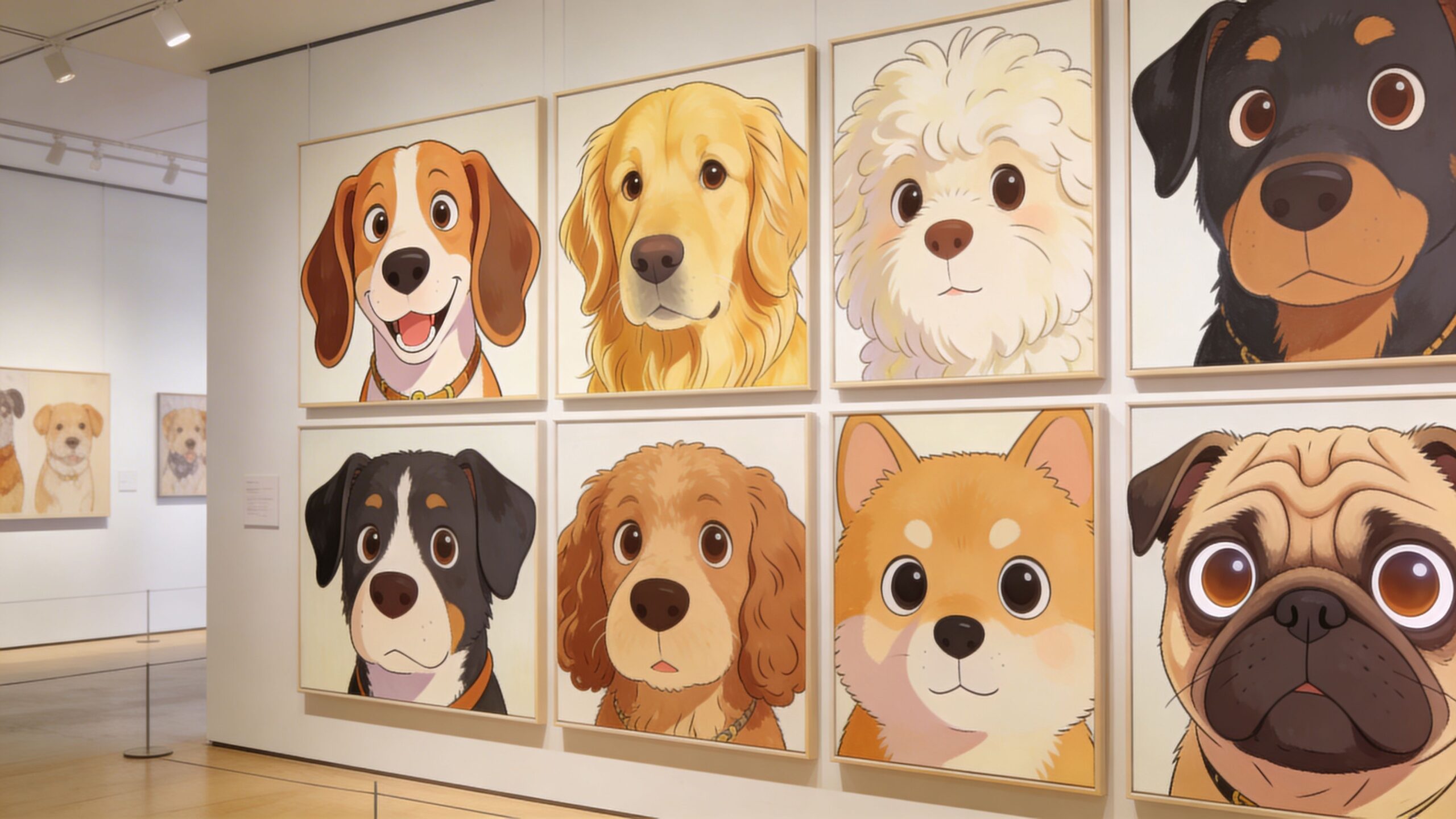
Once children can draw one solid cartoon dog face, they can start changing the design, allowing creativity to stretch its legs.
Not every dog has the same ears, snout, fur, or attitude. Some look brave. Some look cuddly. Some look as if they run the spaceship and everyone else is helping.
With 57% of UK households owning a pet, and popular breeds such as Labradors and Cocker Spaniels featuring strongly in family life, there is clear demand for more varied art resources. Yet less than 5% of online cartoon dog assets reflect these common UK breeds, according to this dog cartoon face search reference.
Small tweaks that change the whole dog
You can keep the same basic head shape and alter only a few parts.
- Long droopy ears: Great for a gentle hound or spaniel look
- Short pointy ears: Better for a terrier or alert guard-dog feel
- Wide muzzle: Feels strong and friendly
- Narrow muzzle: Can look elegant or curious
- Fluffy cheek lines: Suggest a softer coat
- Smooth outline: Feels sleek and simple
That means children are not starting from scratch each time. They are remixing a pattern.
Real dogs and invented dogs
Some children love drawing breeds they know from home or from the park. Others want to invent a moon-dog with comet fur and radar ears.
Both are worth encouraging.
A real breed helps children observe. An invented breed helps them design.
For visual inspiration, even looking at stylised wall art such as this Greyhound art print can spark useful conversations about shape, posture, and how artists simplify animal features.
A handy comparison game
Ask children to draw three versions of the same dog:
| Version | Change only this | Result |
|---|---|---|
| Dog one | Ears | Different breed feel |
| Dog two | Muzzle | Different age or personality |
| Dog three | Fur lines | Different texture and style |
This kind of comparison builds confidence quickly. It also teaches that style is a choice.
For more inspiration on turning animals into strong characters, this article on animal cartoons characters is a useful next read.
Classroom Adventures and Home Activities
A cartoon dog face is not just a finished picture. It is a starting point.
That matters for teachers, parents, and librarians because one drawing activity can lead to writing, speaking, design, and simple STEM thinking. It can also fill a real gap.
While 78% of UK primary schools use colouring for creative development, there is still a shortage of curriculum-aligned STEM resources. Searches for “cartoon dog colouring STEM UK” have risen 45% year-on-year, yet very few resources are available, according to this dog face outline resource reference.
Three low-prep ideas that travel well
You do not need complicated planning for this.
Story cards
Children draw a cartoon dog face, cut it out, and glue it onto a folded card. Inside, they write:
- Name
- Special skill
- Favourite planet snack
- Biggest fear
This supports descriptive writing and character building.
Expression detective
Place several dog faces on a table or display board. Give children emotion words such as happy, nervous, proud, grumpy, or puzzled.
They match the word to the face and explain why.
That “why” is the gold. It prompts observation and speaking.
Design a mission badge
Children place the dog face inside a badge or shield. Then they add symbols around it, such as stars, rockets, paw prints, moons, or tools.
This sneaks in shape selection, spacing, and visual planning.
Why this works so well
Colouring and drawing can feel calm, but they are not passive. Children make decisions all the way through.
They choose shape, proportion, expression, colour, and story. They also practise control with pencils and pens. For many children, that feels more inviting than a blank writing page.
Tip: If a child does not want to write a full story, ask for one sentence only. “My dog is worried because the moon biscuits are missing.” That is enough to get the engine started.
A useful extension for rainy afternoons
Printable activities can stretch this kind of lesson beautifully. If you want ready-made ideas to build on today’s drawing, the cartoon colouring pages collection offers a natural follow-on for home corners, library tables, or art rotations.
You can also turn finished dog faces into:
- Puppets for a mini performance
- Bookmarks for reading corners
- Comic panels with speech bubbles
- Class display pieces showing a “crew” of different dog characters
The key is simple. Let the drawing keep going.
Your Drawing's Next Adventure From Paper to Pixel
A child’s cartoon dog face may begin as pencil on paper, but that is not where the journey has to stop.
Many creative jobs start like this. Someone sketches an idea. They test shapes. They refine a character. Later, that character might appear in a book, an animation, a game, a classroom poster, or a sticker sheet on a lunchbox that mysteriously returns home covered in crumbs.
How a simple sketch grows
The path is often surprisingly straightforward:
- First sketch: Loose pencil drawing
- Refined version: Cleaner shapes and stronger outline
- Digital version: Scanned or redrawn on a screen
- Character sheet: Different expressions and poses
- Story use: Added to scenes, games, books, or activities
Children do not need to master these skills now. They only need to realise that their drawing has potential.
That idea can be powerful. It tells them, I think. I try. I can. I can explain.
Careers hiding inside this activity
A child making design choices today might one day enjoy work in:
| Creative area | What they often do |
|---|---|
| Animation | Turn drawings into moving characters |
| Illustration | Create pictures for books and posters |
| Game art | Design characters and worlds |
| Graphic design | Build clear visual ideas for audiences |
Even if none of those become a career, the habits matter. Observation. problem-solving. revision. communication. imagination.
Those are not “art” skills. They are life skills.
Keep the mission going
If a child wants to move their drawing from pencil to digital tools, a gentle next step is trying resources that introduce creative software in a child-friendly way. This guide to an online drawing program for kids is a sensible place to continue.
And if you are the adult reading this, you do not need to be “good at art” to help. You only need to be encouraging, curious, and willing to say, “Show me how your dog got that expression.”
That question invites explanation. Explanation builds confidence.
A cartoon dog face may be simple. The learning tucked inside it is anything but.
If your child, class, or library group is ready for more story-led creativity, have a look at Space Ranger Fred. You can explore the books for fun reading with STEM flavour, find playful activities that keep children making and imagining, and discover school visits that support confidence, reading, communication, and curiosity through interactive storytelling. Learning should be experienced, not just delivered.