
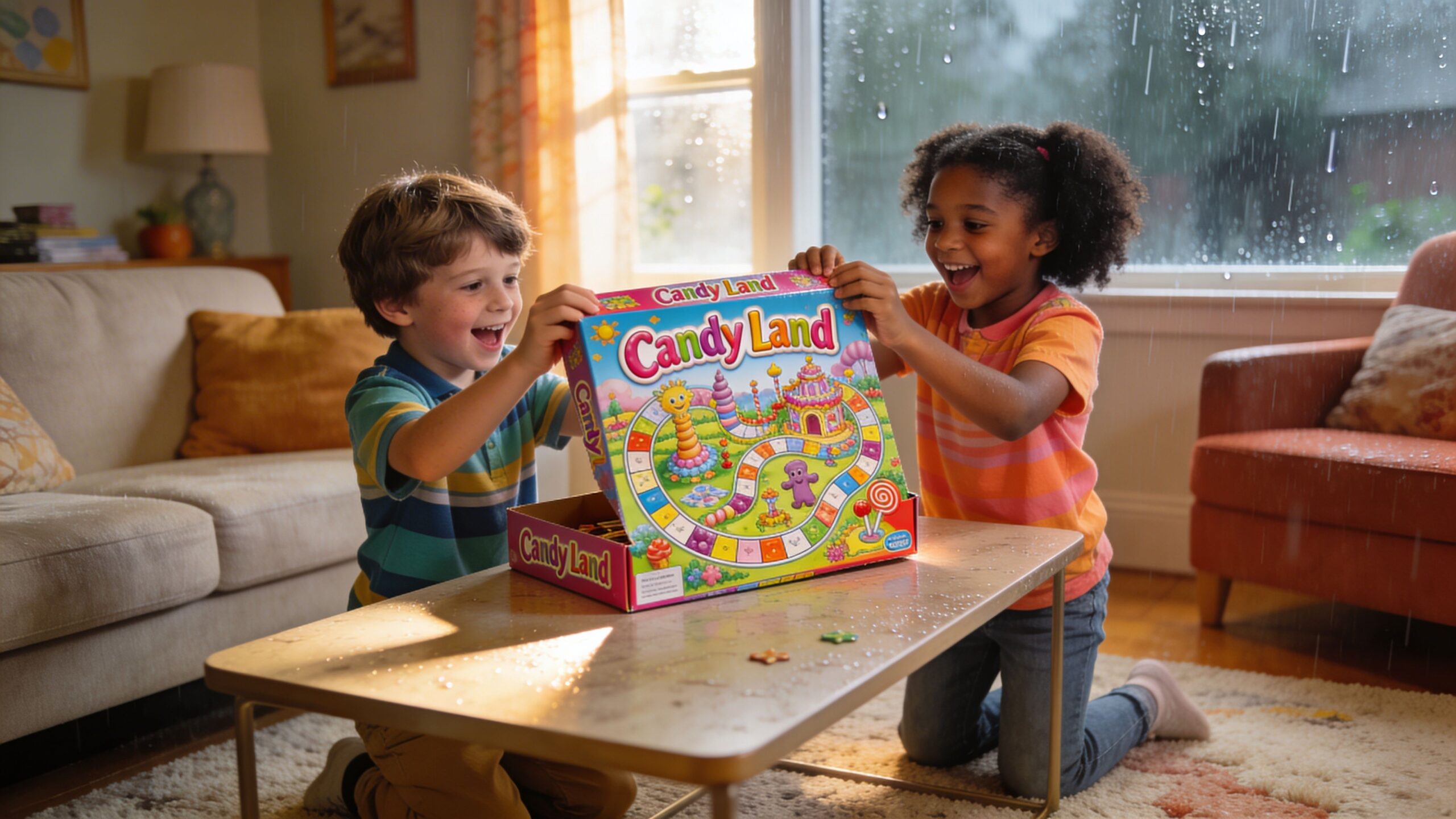
Rainy afternoon. Shoes by the radiator. One child upside down on the sofa, another asking for a game for the fifth time in ten minutes.
That’s often when candyland board games make their grand return from the cupboard.
Parents, teachers, and librarians know the scene well. A bright board. A simple path. A handful of cards. No long instructions. No dramatic setup. Just straight into play. And in a world full of apps, alerts, and flashing screens, that simplicity can feel oddly refreshing.
Remember That Sugary-Sweet Rainbow Path?
There’s a reason this game sticks in people’s minds.
The board looks like a sweet shop collided with a storybook. Children don’t need to decode pages of rules. They can begin almost at once. That matters, especially when you’ve got a tired class after lunch or a child at home who wants fun now, not after a ten-minute explanation.
Why adults keep coming back to it
For grown-ups, the attraction is often practical. You can set it up quickly. Younger children can join in. Older siblings can help. Grandparents usually understand it without needing a rule refresher.
That’s why classic games often sit alongside newer picks in family and classroom collections. If you're weighing up simple first games, this guide to board games for 4 year olds is a useful companion because it shows how families choose games that are easy to learn but still inviting.
Why children still say yes
Children rarely analyse game mechanics. They respond to feeling.
They like the colours. They like the tiny moments of suspense. They like moving their piece and seeing progress. Even when the play is based on luck, it still feels like a journey. That sense of movement matters more than many adults expect.
A simple game can still be a meaningful one if it helps a child join in, stay engaged, and feel successful.
Some readers get stuck on one question. Is a game still valuable if it doesn’t ask children to plan complicated moves?
Yes. Just not for every stage, and not for every purpose.
Candyland board games work well as a starting point. They introduce the idea that games have rules, turns, waiting, setbacks, and little celebrations. That’s a lot for one cheerful box. The clever part is knowing what it’s good at, and what it isn’t.
A game doesn’t need to do everything to do something worthwhile.
The Sweet Story Behind Candyland Board Games
The story behind Candy Land is far gentler, and more moving, than many people realise.
It wasn’t born from a trend meeting or a toy company trying to chase the next big thing. It was created by Eleanor Abbott during the 1940s polio epidemic. She designed it for children in hospital, including children who were very young or physically limited, which is why the game needed to be easy to understand and possible to play without reading.
Built for access from the beginning
That design choice explains almost everything about the game.
The path is linear. The colours do the heavy lifting. The rules are light. Children don’t need to read text-heavy cards or make strategic calculations. They recognise, match, and move.
According to the background recorded on the Candy Land history page, the game launched in the UK in 1949, its board used a path of 134 coloured spaces, and by the early 2000s cumulative UK sales had exceeded 5 million units. The same source notes that it influenced UK NHS paediatric programmes in the 1950s and that over 70% of UK primary schools stocked it in a 2020 BookTrust survey.
That’s a remarkable legacy for a game with such simple mechanics.
Why teachers kept it on the shelf
Teachers didn’t keep using it by accident.
They used it because it solved real classroom problems:
- Low barrier to entry. Children could join in quickly.
- Minimal reading demand. Useful for very young children and mixed-ability groups.
- Clear turn structure. Helpful when teaching routines and expectations.
- Visual appeal. The board itself invited participation.
In other words, the game was never only about sweets and bright colours. It was about inclusion, participation, and early confidence.
Classroom reminder: the easiest game to explain is often the one that gets played most.
There’s also something lovely about its endurance. In a nursery corner or library play area, Candy Land can feel like a bridge between generations. Adults remember it. Children discover it. That shared familiarity gives the game a social life beyond the board itself.
A classic with a real educational place
For early years settings, its strengths are still easy to spot.
A child practises recognising colours. They learn that another player goes first sometimes. They discover that following a sequence helps the game make sense. They also get used to the idea that fun can include waiting.
Those may sound like tiny lessons. They’re not.
For many children, especially at the beginning of their game-playing life, those are the first building blocks of group learning. Candyland board games have stayed relevant because they support those basics without making a fuss about it.
What Are We Really Learning from Lollipops and Gumdrops?
Adults sometimes look at Candy Land and think, “This is all luck.”
They aren’t wrong. But they aren’t seeing the whole picture either.
A young child doesn’t experience the game as a debate about mechanics. They experience it as practice. Every turn asks them to notice, wait, match, move, and cope.
The skills hiding inside a simple turn
Here’s what often happens during one ordinary go:
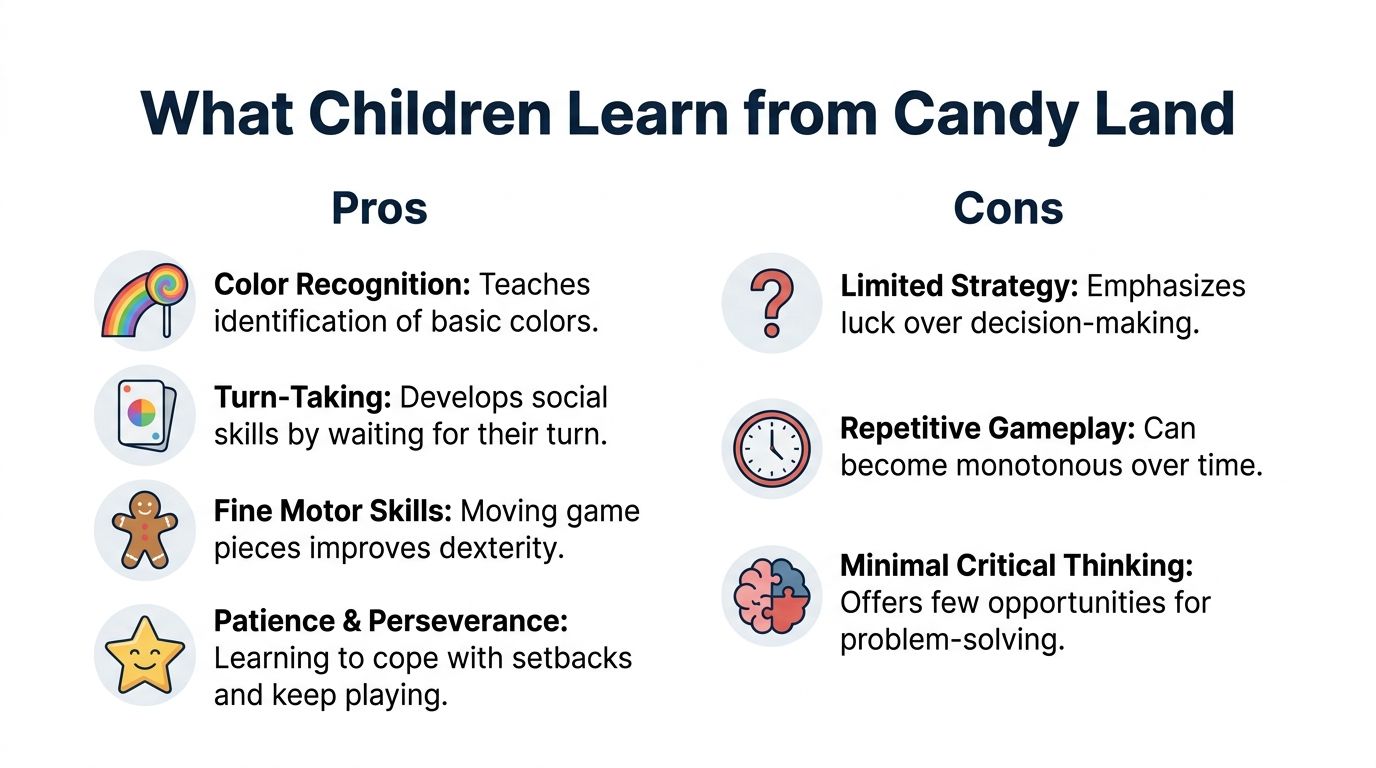
- Colour recognition. A child sees a card, names the colour, and matches it to the board.
- Rule following. They learn that the card decides the move, even if they wish it didn’t.
- Turn-taking. They wait while someone else has their go.
- Fine motor control. They pick up and place a small piece carefully.
- Emotional regulation. They keep going after an unlucky draw.
Those are real learning moments. They just don’t look flashy.
Where the game starts to show its limits
As children grow, though, many adults notice a shift.
The child who was once delighted by “move to red” begins asking better questions. Could I choose another route? What happens if I try a different plan? Why did that happen? How can I solve it?
That’s where luck-based play can begin to feel thin.
The source provided for this topic reports that the UK children’s board game market grew 8% in 2025, while the edutainment segment grew 22%, and it also states that a 2024 British Educational Research Journal study found strategy games boost executive function 25% more than luck-based games like Candy Land, which mainly focuses on preschool colour-matching rather than problem-solving, as cited in this Candyland discussion.
That helps explain why many families and schools start with classics, then add games and activities that demand more thinking.
A useful way to see it
A simple comparison helps.
| Focus | Candy Land style play | Strategy-rich play |
|---|---|---|
| Main demand | Recognise and respond | Plan and decide |
| Best for | Early game habits | Growing problem-solvers |
| Emotional lesson | Handling chance | Handling consequences of choices |
| Thinking pattern | Follow the path | Build the path mentally |
Neither side is “bad”. They serve different stages.
Best use: treat Candy Land as a foundation, not the final destination.
If you like the idea of children learning by doing, this piece on discovery learning is worth reading. It helps explain why children remember ideas better when they explore, test, and talk through them.
So yes, Candyland board games can teach. They just teach the first layer. Once a child is ready for more challenge, the next step is to adapt the play or offer richer kinds of adventures.
Giving the Classic Game a STEM-Powered Boost
Here's where things get fun.
You don’t need to throw the game away. You can upgrade it.
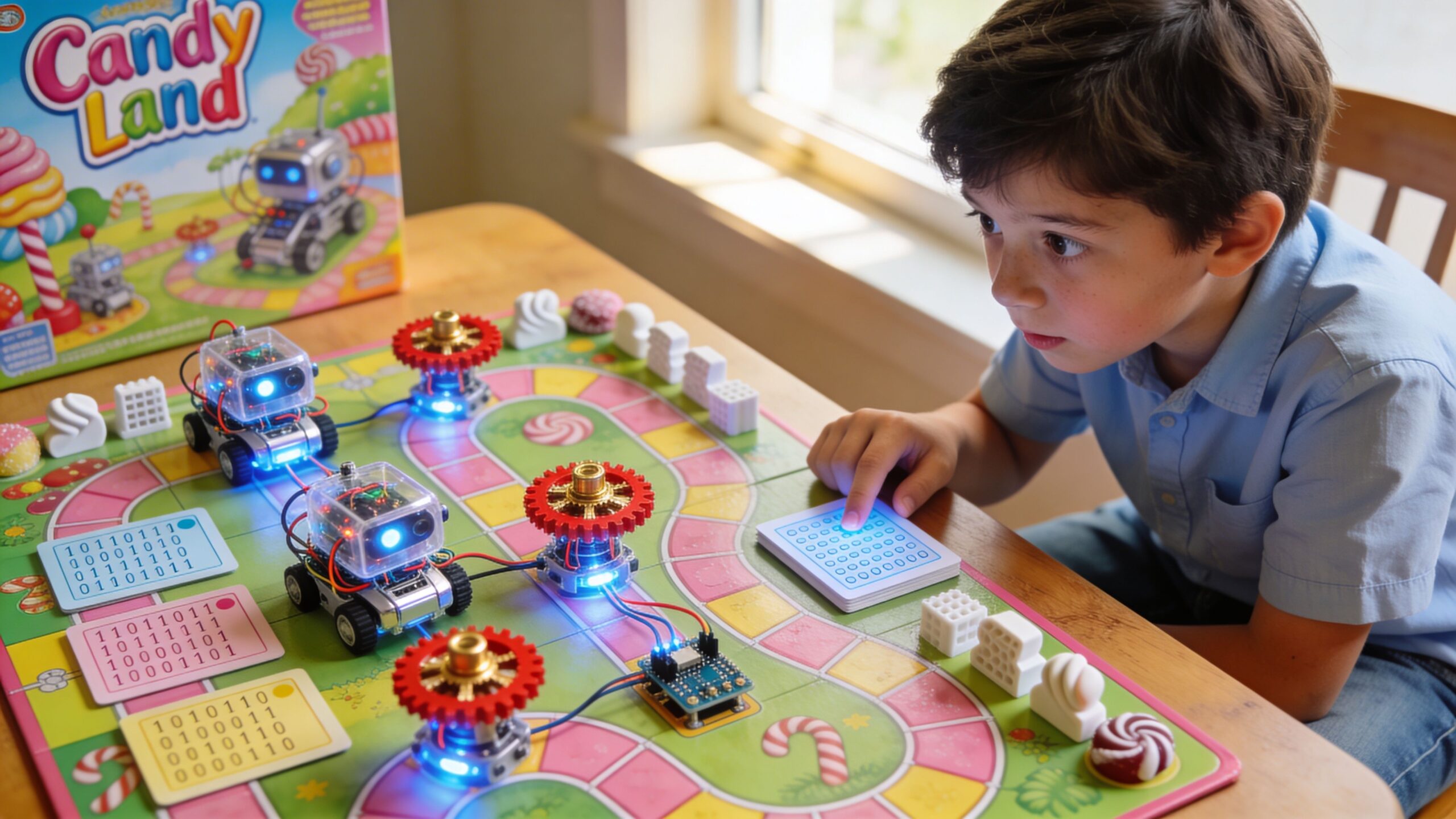
A familiar board is a brilliant base for playful learning because children already understand the structure. That means you can add small challenges without overloading them. The board stays friendly. The thinking gets sharper.
Easy classroom and home tweaks
Start with one change, not five.
Try these ideas:
Add a die for counting practice
Keep the coloured path, but roll a die before moving. Children count aloud as they go. If you want a little extra challenge, ask, “You rolled two and then one more. How many altogether?”Swap some cards for question cards
Make a small set of homemade cards. A correct answer lets the child move. Keep the prompts short.
Examples:- Name a planet
- Find something in the room shaped like a circle
- What happens when ice gets warm?
- Say a number that comes after six
Turn colours into mission zones
Red could be rocket launch. Blue could be deep space. Green could be alien garden. Yellow could be solar light station. Suddenly the board becomes a story map.Use “why” cards for older children
Instead of only asking for facts, ask for explanations.
Example prompts:- Why do we need to sleep?
- Why do shadows change?
- Why might a rocket need careful planning?
Why this works better than a worksheet
A worksheet says, “Answer this.”
A game says, “Let’s see what happens next.”
That difference matters. Children often give more energy to learning when there’s a path, a piece, and a bit of suspense involved. The board becomes a reason to keep trying.
Children often persist for longer when the task feels like part of a mission rather than a test.
A sample STEM version
Here’s one simple setup for a mixed-age group.
| Board colour | Challenge type | Example |
|---|---|---|
| Red | Maths | Count backwards from five |
| Blue | Space knowledge | Name something you’d see in the night sky |
| Green | Nature | Name a plant, animal, or insect |
| Yellow | Reasoning | What could you use to build a bridge for a toy car? |
Notice what’s happening. The board still gives security. The questions add curiosity.
You can also make the game more physical:
- Hop to your colour instead of only moving a piece
- Build a block tower before taking a turn
- Act out a science word such as float, spin, or melt
That kind of movement helps children who learn best when hands and bodies are involved. If you want a broader look at this playful approach, this article on what STEM learning is gives a clear overview in family-friendly language.
Keep the magic, add the thinking
The trick is not to overcomplicate the game.
If every turn becomes a mini exam, children will spot it immediately. Keep the tasks light. Keep the pace moving. Let some turns stay simple and lucky. The goal isn’t to replace the charm. It’s to stretch it.
Candyland board games work best in this role when adults treat them as a springboard. The sweets stay. The adventure grows.
When Your Explorer Is Ready for the Next Mission
At some point, many children change the way they play.
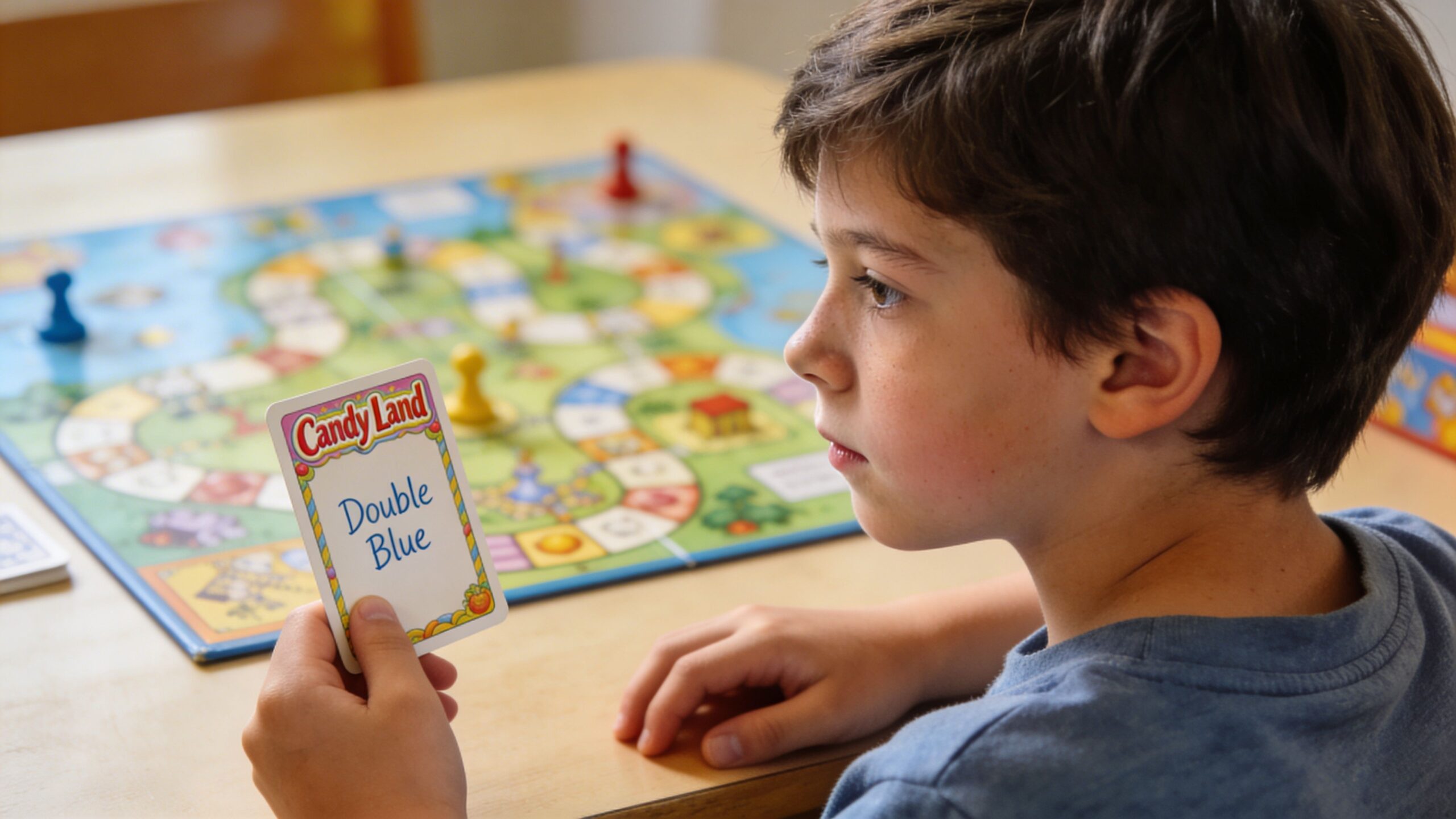
They stop being satisfied with “what colour did I get?” and start asking for a reason, a puzzle, or a choice. That’s an important moment. It usually means they’re ready for richer challenges, not just longer games.
You’ll often notice the signs before they say it outright.
Clues that a child wants more
A child may be ready for the next step when they:
- Ask more questions about how things work
- Invent extra rules because the original game feels too simple
- Prefer stories with mysteries, quests, or problems to solve
- Want agency instead of only following a path
That doesn’t mean the classic has failed. It means it has done its job.
From following a path to making decisions
Early games teach structure. Later experiences should invite thinking.
That could mean a board game with meaningful decisions. It could mean a reading activity with clues to interpret. It might be a story-led challenge where children imagine, predict, test, and explain.
This is often the point where adults start looking beyond toddler and preschool staples. If your child is outgrowing luck-based play, a guide to the best board games for 10 year old kids can help you compare games that offer more strategy, cooperation, and problem-solving.
When a child starts changing the game on purpose, they’re often asking for a deeper one.
A simple graduation path
You don’t need a dramatic switch. Think of it more like stepping stones.
First step
Use Candy Land for shared play, rules, and confidence.
Next step
Adapt it with questions, counting, or mini missions.
Then
Introduce stories, puzzles, and activities where children explain their thinking.
That final part matters a lot. We want children to move through a pattern of growth:
- I think
- I try
- I can
- I can explain
That’s where confidence becomes real learning.
For teachers and librarians, this progression is especially useful. A child who once needed highly structured, low-reading play may soon be ready for group tasks that involve prediction, discussion, and curiosity-led discovery. For parents, it can turn “I’m bored” into something much better. A mission. A challenge. A reason to keep reading.
So the question isn’t whether candyland board games still belong in a child’s learning life. They do. The better question is whether we notice when the child is ready to go further.
Making Sure Everyone Can Join the Adventure
A good game should open the door, not close it.
That matters even more in schools, libraries, and mixed-age family settings where children come with different needs, strengths, and ways of engaging. Inclusive play isn’t a bonus extra. It’s part of good teaching.
The need is plain. UK Department for Education statistics show 1.57 million pupils, or 17.8% of the total, had SEN in 2024/25, and the same source highlights the need for better classic-game adaptations such as tactile cards for visually impaired children or simplified paths for children with motor challenges in this discussion of Candyland adaptations.
Simple adaptations that help straight away
You do not need specialist equipment to make a game more accessible.
Try practical adjustments such as:
- Tactile markers on coloured spaces. Add felt, foam, or textured stickers so children can feel the difference between sections.
- Larger playing pieces. Easier to grip for children with motor difficulties.
- Shortened paths. Reduce the number of spaces if the full board is tiring or frustrating.
- Visual turn cues. Use a “my turn” card or token to make the sequence clearer.
- Choice of response. Let a child point, touch, say, or use symbols rather than insisting on one communication style.
Matching the adaptation to the child
Different needs call for different changes.
| Need | Helpful adaptation | Why it supports play |
|---|---|---|
| Visual impairment | Tactile cards or textured board spaces | Makes information easier to access through touch |
| Motor challenge | Bigger pieces and a shorter route | Reduces physical strain |
| Attention difficulty | Fewer cards in play and clearer turn signals | Keeps the task manageable |
| Communication difference | Picture prompts or yes-no choices | Lowers language pressure |
Practical rule: adapt the game first, not the child.
That one shift in thinking changes the atmosphere immediately.
Inclusive play is also about pace
Adults sometimes focus only on equipment. Pace matters too.
Some children need more processing time. Some benefit from seeing one move modelled before trying their own. Some may enjoy the social part but need fewer turns to stay successful. You can honour all of that without making the game feel unusual.
For movement-based learners, this article on kinesthetic learning offers useful ideas for making learning more active and accessible.
The goal is simple. Every child should feel, “I belong at this table. I know what to do. I can take part.” Once that happens, the game stops being just a pastime. It becomes a shared adventure.
Your Mission Learning Should Be an Adventure
Candyland board games have earned their place.
They’re welcoming. They’re easy to start. They give children a first taste of rules, patience, and playful persistence. For many families and classrooms, that’s exactly what makes them useful.
But a first step isn’t the whole journey.
Children grow. Their questions get bigger. Their imaginations stretch further than the board. They want to solve, wonder, test, explain, and laugh while they do it. That’s where adults can do something powerful. We can take a familiar activity and gently turn it into something richer.
What the classic game still does well
It still helps children learn to:
- Join in with others
- Follow a sequence
- Cope with setbacks
- Stay curious inside a simple structure
Those are sturdy foundations.
What comes next matters most
The most exciting learning often begins when we build on those basics.
A child moves from matching colours to asking questions. From waiting for a turn to making a plan. From following a path to understanding why a path works at all. That’s the heart of the learning journey:
I think. I try. I can. I can explain.
If you’d like more playful ways to keep that journey going, explore the Space Ranger Fred book page, try the freebies and activities, or dip into another family learning read such as this blog post on reading and discovery.
Learning should feel like an invitation to explore, not a worksheet in disguise.
If your young explorer is ready for stories, laughter, and hands-on learning, take a look at Space Ranger Fred. The books bring reading and simple STEM ideas together in one lively adventure. Schools can also book interactive visits that support confidence, communication, and curiosity through storytelling children remember.