
Meta title: Giant Dinosaur Toy Buying Guide for Parents
Meta description: Discover how to choose a giant dinosaur toy safely and turn it into a fun STEM learning tool with practical tips for parents and teachers.
A giant dinosaur toy often starts as a simple request.
One child wants “the biggest T. rex ever”. A teacher needs something that grabs a whole class in seconds. A librarian wants a display piece that turns quiet browsing into excited questions about fossils, bones, and the age of the Earth.
That’s when adults usually pause. Is this going to be brilliant, enormous fun, or just one more giant thing to trip over before tea?
The good news is that a well-chosen giant dinosaur toy can do much more than roar from the corner of a room. It can help children explore scale, storytelling, classification, design, and careful observation. In other words, it can be play with a purpose.
Welcome to the Land of Giants
One minute the bedroom floor is tidy enough to see the carpet. The next, it’s a prehistoric nature reserve. There’s a Triceratops near the sock drawer, a Brachiosaurus by the bed, and a Tyrannosaurus rex guarding the door like an overexcited museum curator.
Then comes the question.
“Can I have a giant one?”
For many parents and teachers, that word giant is where excitement meets practical worry. Will it fit? Will it last? Will it be safe? And perhaps the biggest question of all. Will the novelty wear off by Tuesday?
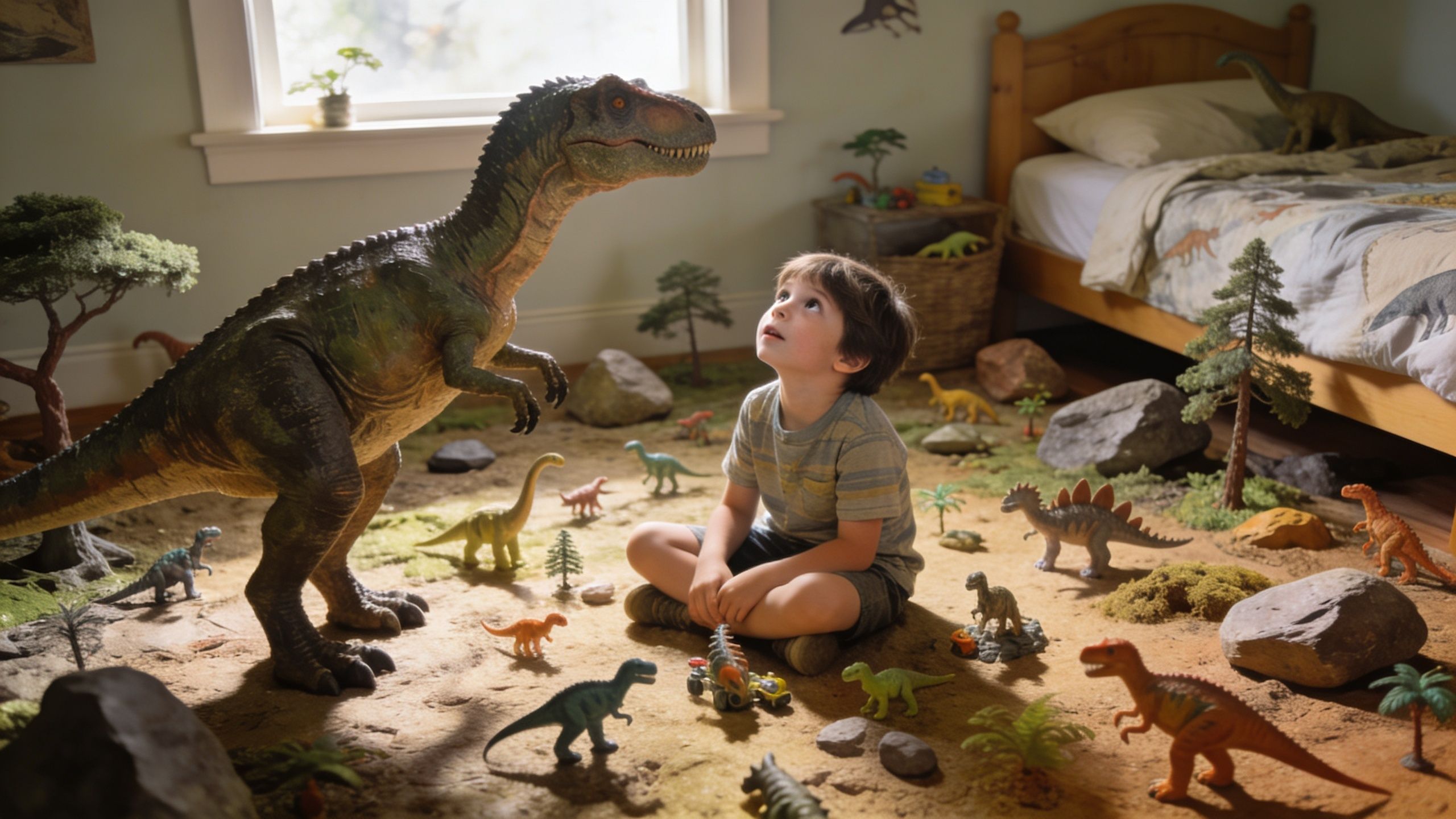
Children don’t usually ask for a giant dinosaur toy because they’re thinking about storage. They ask because big things feel important. A large dinosaur toy turns ordinary play into an event. It gives their ideas more room. A rescue mission feels bigger. A habitat project feels more real. A made-up story suddenly has weight, shape, and stompy feet.
That matters in homes, classrooms, and libraries. When a child can touch, move, compare, and talk about something oversized, curiosity tends to wake up quickly.
A big toy can slow a child down in a good way. They notice details, invent stories, and explain what they think is happening.
Adults sometimes see a giant dinosaur toy as one purchase. Children often see a whole world. One day it’s a jungle explorer. The next day it’s a fossil clue. By Friday, it may have become the star patient in a pretend veterinary surgery for Cretaceous creatures.
That’s why it helps to think beyond the roar. The right dinosaur can become a tool for learning through experience, not just a large lump of plastic in the sitting room.
Why Big Dinos Make a Big Impression
A child stands a giant dinosaur toy beside the sofa and suddenly the room changes size. The sofa becomes a cliff. The rug becomes a swamp. A simple question, “Could this dinosaur fit through the doorway?”, turns play into an investigation.
That shift matters because children aged 6 to 12 are still building a feel for scale, distance, and proportion. Large toys make those abstract ideas easier to hold onto. Instead of hearing that a dinosaur was enormous, they can measure its tail against a cushion, compare its height with a table, and test where it can or cannot “walk”.
A small figure suits collecting. A giant one invites inquiry.
Size helps children grasp difficult ideas
Dinosaurs can feel slippery as a topic. They belong to a past no child has seen, and their bodies were often far larger than anything in everyday life. A giant toy gives children a bridge between fact and imagination.
With a larger model, children can:
- Compare length and height with familiar objects around the home or classroom
- Spot visible features such as claws, teeth, plates, tails, and neck shape
- Explain what they notice by pointing as they talk
- Test ideas through play, such as which dinosaur could hide, reach, balance, or chase
That kind of talk is early STEM learning in plain clothes. A child who says, “This one needs more space to turn round,” is working with spatial reasoning. A child who says, “These legs look stronger, so maybe it runs differently,” is beginning to connect structure with function.
Space Ranger Fred uses this exact spark in later dino-missions, where one big toy can become a measuring tool, a habitat clue, and a story prompt all at once. The excitement comes first. The learning follows naturally.
Big dinosaurs invite language, reasoning, and confidence
Large toys slow children down in a helpful way. They notice details because there is more to notice. They explain more because the toy gives them something concrete to point at. For a child who finds open-ended discussion tricky, that can be a relief.
“Look at this tail.”
“It would knock the trees down.”
“It needs a bigger nest.”
Those short comments may sound simple, but they are doing serious work. Children are observing, predicting, and building vocabulary. They are also practising the skill adults want later in science lessons: saying what they think and giving a reason.
This is one reason oversized toys often stay interesting longer than expected. The toy itself does not have to “do” much. The child does the mental work.
The wow factor has real learning value
Adults sometimes worry that a dramatic toy is only about spectacle. In practice, wonder is often the starting point for careful thinking. A giant dinosaur catches attention the way a museum skeleton does. Once children are impressed, they start asking better questions.
Why is one neck so long?
Why are those feet wide?
Why would this body shape suit forests, plains, or water?
That curiosity is useful at home, in classrooms, and in clubs. It gives adults an easy way to guide play into structured learning without making it feel forced. If you want a helpful comparison of how size and material shape play in another monster-themed toy category, the POPvault King Ghidorah plush guide shows how scale changes collecting, display, and imaginative use.
Practical rule: If a giant dinosaur toy gets a child to compare, classify, measure, predict, or tell a story with evidence, it is supporting learning as well as play.
The strongest giant dinosaur toys leave a big impression because they do two jobs at once. They feel thrilling to a child, and they give adults a clear route into science, maths, and communication. That balance is what makes them memorable.
Your Prehistoric Procurement Guide
A giant dinosaur toy can feel like a brilliant idea right up until it arrives and you realise it is too flimsy for classroom play, too awkward for the bedroom floor, or harder to clean than a muddy welly. Buying well means looking past the roar and checking how the toy will behave in real life.
A simple way to do that is to test four things. Material, durability, size, and safety.
Material shapes the whole experience
Material is not a small detail. It decides how a dinosaur feels in the hands, how long it lasts, and what kind of learning it supports.
Soft figures usually suit children who want to carry the dinosaur from room to room, set up rescue scenes, or curl around it during story play. Buildable models create a different kind of excitement. They slow children down in a good way. Instead of only pretending, they also assemble, compare parts, and notice structure. That links neatly to STEM habits, especially if you want to turn play into a Space Ranger Fred style mission where the child becomes a junior field engineer charting bones, balance, and body design.
Material also changes the adult experience. Some toys wipe clean in seconds. Others are better kept for calmer sessions at a table.
If you’re comparing toy formats across fandoms, not just dinosaurs, POPvault’s King Ghidorah plush guide is a useful example of how material and scale affect display, cuddly play, and collecting choices.
Durability should match the kind of play you expect
A toy can look impressive in the box and struggle once the game begins. The better question is not “Does it look strong?” but “What will children do with it?”
A floor-play dinosaur needs to cope with dragging, lifting, squeezing, and the occasional crash landing into the sofa. A build-and-display dinosaur needs joints and slots that stay firm after repeated use. In a classroom or club, durability also includes cleaning. If a surface holds dust, marks easily, or traps sticky fingerprints, it becomes work for the adult and a distraction for the group.
A quick test helps here. Picture the toy in three scenes. A child carrying it one-handed. Two children arguing over whose turn it is. An adult clearing up once play is done. If the toy seems awkward in all three scenes, keep looking.
“Giant” means different things in different rooms
Buyers often encounter a common pitfall. 'Giant' does not have one standard size. It can mean “large enough to dominate a shelf” or “large enough to become part of the room”.
Before you buy, measure the actual play space. Then measure the storage space too. A dinosaur that feels thrilling on a product page can become a tripping hazard beside a bed, or a classroom obstacle near a book corner.
Size changes more than storage. It changes the kind of activity the toy invites. A large floor dinosaur encourages body-based play such as stepping, circling, measuring, and comparing lengths. That can be excellent for informal maths and science. A very large toy, though, needs clear placement so children can move around it safely and adults can supervise without constantly repositioning it.
If you enjoy combining prehistoric themes with vehicles, tracks, or role-play zones, this post on ways dinosaurs and train toys can work together in play offers ideas without needing a full room redesign.
Safety: The checkpoint adults should do first
Children notice teeth, tails, and claws. Adults need to notice markings, stability, and the play environment.
For UK homes and schools, check for UKCA marking and read the age guidance carefully. Then look at the toy as if you were setting up a mini museum exhibit. Will it stand securely on the floor surface you have? Are there projecting parts at eye level for younger children? Does the toy fit the room without narrowing walkways or crowding other activities?
That sounds serious because it is. Good safety checks do not reduce the fun. They protect it.
Use this quick buying filter:
Check the marking
UKCA should be visible and easy to find.Check the base and balance
A large toy needs stable placement on the surface where it will be used.Check the room, not just the toy
Busy corners, smooth floors, and narrow paths matter as much as the dinosaur itself.Check the age fit
The best choice matches the child’s stage, grip strength, and patience level.Check whether it supports the kind of learning you want
Some toys are best for dramatic storytelling. Others suit measuring, building, sorting, and simple investigations.
That last point is easy to miss. A giant dinosaur toy can be a thrilling present, but it can also become a tool for structured STEM play if you choose with purpose. That is the sweet spot. The child gets the giant prehistoric adventure. You get a toy that can support observation, problem-solving, and the kind of practical missions Space Ranger Fred would happily send a rookie explorer to complete.
Matching the Dino to the Child
A child opens a giant dinosaur toy on Saturday morning. By lunchtime, one child has turned it into a jungle rescue with Space Ranger Fred. Another has lined up rulers, notebooks, and smaller dinos to compare claws, tails, and teeth. Same toy category. Very different match.
That is why size alone never tells you enough. The better question is how the child likes to learn through play right now.
Ages 6 to 8 often want touch, movement, and simple missions
Many younger children want a dinosaur they can carry, hug, pose, and recruit into a fast-changing story. Soft materials and a shape that is easy to grip usually suit this stage well, especially for children who still play with their whole body and may drop, drag, or tumble the toy during an expedition across the living room.
Adults sometimes worry that "educational" means formal. At this age, it usually means something simpler. The toy should invite action. Can the child move it without frustration? Can they place it in a cardboard cave, a blanket swamp, or a toy-space base and keep the story going?
That kind of hands-on play builds early STEM habits more than it first appears. A child testing whether the dinosaur fits through a fort entrance is working on size and spatial reasoning. A child deciding what the creature eats is sorting and classifying. Space Ranger Fred would call those first field missions.
If you support younger children more broadly, our guide on toddler development gives helpful context on sensory learning, confidence, and growing independence.
Ages 9 to 12 often want detail, logic, and a challenge
Older children often enjoy the story too, but many start asking sharper questions. What species is it meant to be? Which features are accurate? How long is the tail compared with the body? Could they build a habitat, label body parts, or create a fact sheet for a "museum display" at home?
For this age group, a giant dinosaur toy works best when it gives them something to investigate. A buildable model, a highly detailed figure, or a dinosaur with clear anatomical features can hold attention longer because the child has more to examine, compare, and explain.
You can spot the difference in play style quickly. Some children want to make the dinosaur chase a rover. Others want to measure the rover tracks and record findings like junior palaeontologists. Both are good. The match matters.
Choose for the child’s play pattern
A useful shortcut is to ask which of these sounds most like your child:
- Story builder. Loves characters, rescues, adventures, and dramatic scenes.
- Collector and classifier. Notices species names, features, and categories.
- Builder and problem-solver. Enjoys assembly, habitats, diagrams, and how things fit together.
- Young investigator. Likes measuring, comparing, recording, and asking "why".
Many children overlap across two or three of these. That is often the sweet spot. A giant dinosaur toy can begin as pretend play and then grow into structured STEM tasks, especially if you frame it as a Space Ranger Fred mission instead of a lesson.
Value comes from repeated use. A well-matched toy keeps opening new doors. One week it is a rescue target on an alien planet. The next it is the centrepiece for measuring length, sorting herbivores and carnivores, or sketching body features in a notebook.
If you want more age-based ideas in the same spirit, see our guide to the best educational toys for 6-year-olds.
Dino-Missions STEM Activities with Space Ranger Fred
Saturday morning can shift quickly. One minute your child is stomping a giant dinosaur toy across the carpet. Ten minutes later, they are measuring its tail, testing whether it floats, and dictating a rescue report to Mission Control.
That shift matters. A big dinosaur already grabs attention. The primary opportunity is to give that attention a job. With the Space Ranger Fred story frame, play feels like an adventure, but the learning underneath is organised and purposeful.
Adults often want practical ideas, not vague advice. A simple mission structure works well because each activity has one clear goal, one easy prompt, and one small result your child can notice. If you enjoy pairing play with wider science habits, Ocodile's guide on STEM toys is a useful companion read.
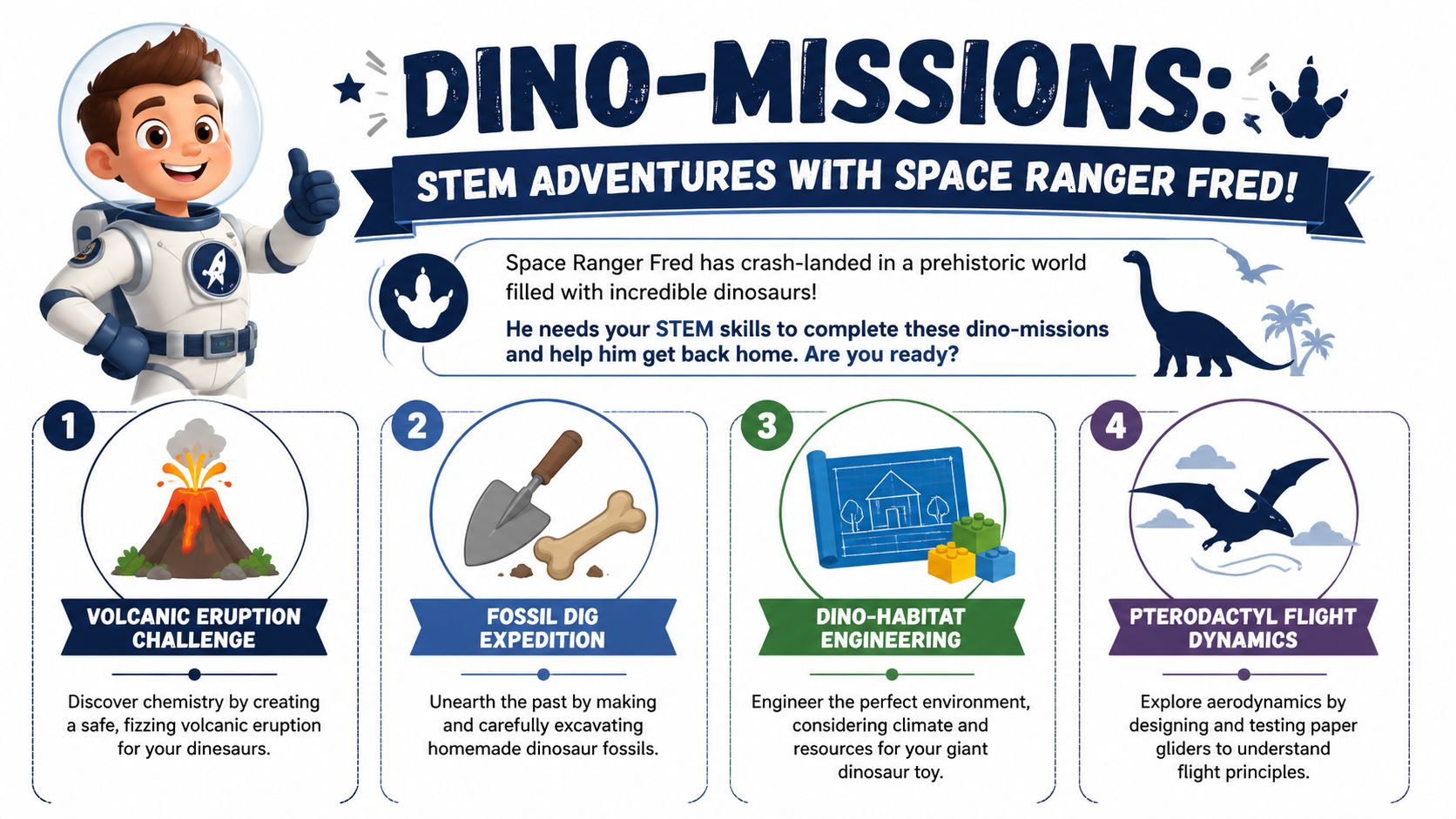
A helpful way to present these is to say, “Space Ranger Fred has sent four dino-missions.” Children hear a story. You get a structure that builds observation, maths, science, and communication step by step.
Mission one for measuring and comparing
Start with the easiest scientific habit. Notice size carefully.
Give your child a tape measure or ruler and a notebook. Measure the dinosaur’s length, height, foot, or tail. Then compare those numbers with familiar objects in the room. A sofa, a school bag, a shoe, or a cereal box all work well because children can see the comparison, not just hear it.
Ask:
- What in this room is bigger
- What is smaller
- What is about the same size
This helps a child move from “It’s huge” to “Its tail is longer than my pillow but shorter than the table.” That is real mathematical thinking in simple clothes.
Mission two for observation and classification
Next, switch from measuring to noticing features.
If you have several dinosaur toys, line them up. If you have one giant dinosaur toy, add pictures from library books or printed cards. Then ask your child to group them by visible traits. Scientists sort living things by shared features. Young children can begin with the same habit in a very concrete way.
Try these categories:
- Horned or not
- Long neck or short neck
- Plant-eater or meat-eater
- Two legs or four
The useful part comes after the sorting. Ask your child to explain one decision aloud.
Try this sentence frame: I think this dinosaur belongs in this group because I noticed…
That sentence frame works like stabilisers on a bicycle. It gives enough support for a child to keep going until explanation starts to feel natural.
Here’s a short video to spark more science ideas for children:
Mission three for prediction and testing
Now bring in a simple experiment.
If the toy’s material is suitable for water play, ask one clear question. Will it float? Before the test, invite your child to make a prediction in words. This part can feel small, but it teaches a big lesson. Science starts before the splash.
Use this routine:
- I think
- I try
- I can explain
Children do not need the “right” answer first time. They need practice noticing what happened and adjusting their idea. That is the heart of scientific thinking. For more activities built around that same pattern, see these fun science experiments and activities for kids.
If you want to make this mission feel even more like Space Ranger Fred, call the bowl or tray a landing pool and ask your child to record whether the dinosaur is “water-safe for alien rivers.”
Mission four for writing and imagination
Finish with a field report.
The giant dinosaur toy stops being only a prop and becomes a reason to read, speak, draw, and write. Ask your child to create a mission log for Space Ranger Fred. Younger children can dictate while you write. Older children can add labels, captions, warnings, or a full page report.
They can include:
- the dinosaur’s name
- where it was discovered
- what it eats
- how to keep it safe
- what problem it caused on its first day in town
This works especially well because it blends fact with story. A child who resists “Write a description of a dinosaur” will often happily produce “Urgent report: giant Spinosaurus spotted near the school gates.” The learning goal stays the same, but the route feels far more inviting.
If you are using these missions at home or in a classroom, it helps to print a short checklist before you begin. Give each mission a box to tick for measure, sort, test, and report. That small bit of structure keeps the activity from drifting and fits nicely with the practical safety-first approach in this guide, especially when you are already checking toy suitability against UK standards elsewhere in the article.
Caring for Your Colossal Creature
Once the giant dinosaur toy arrives, the next challenge emerges. Where does this prehistoric lodger live?
A good storage plan makes the toy easier to enjoy. It also helps children learn that looking after their belongings is part of play, not an annoying extra.
Cleaning without drama
Different materials need different care.
For soft vinyl toys, a gentle wipe with a damp cloth usually does the job. Dry the toy properly before putting it back on a shelf or into a storage corner. For buildable card models, keep cleaning dry and light. Dusting is better than anything wet.
A simple routine helps:
- After messy play wipe or dust the toy
- After bath or water play dry it fully if the material allows water use
- After classroom use check for loose parts or bent sections
- After display time move it before dust gathers in all the dramatic creases
Create a home, not a pile
Children are far more likely to tidy up when the storage idea feels like part of the story.
Try one of these:
- A dino den in a bedroom corner with books nearby
- A prehistoric park in the classroom role-play area
- A fossil station with labels, paper, and measuring tools
- A mission bay where the toy waits for the next science challenge
If the storage space has a name, children remember to use it.
Think like mission control
A giant toy shouldn’t become a hallway ambush.
Choose a place that keeps walkways clear and gives the dinosaur a stable resting spot. If the toy is especially large, teach children a simple rule. Carry it carefully, park it properly, and check that nobody is behind the tail before turning.
That final one sounds obvious. It becomes less obvious when a Brachiosaurus is being flown through the lounge like a rescue helicopter.
Your Ultimate Giant Dinosaur Toy Checklist
A giant dinosaur toy often wins a child over in seconds. The smarter question for the adult is what happens in week two, after the first roar, the first parade round the sofa, and the first trip to the “mission bay.” A strong choice keeps working after the novelty fades. It still invites building, measuring, sorting, explaining, and storytelling.
That matters even more if you want play to do two jobs at once. It should feel thrilling for the child and useful for learning. Space Ranger Fred’s dino-missions work well here because the toy becomes more than a prop. It becomes a science tool, a story starter, and sometimes even a test subject for simple STEM challenges.
Printable Giant Dinosaur Toy Buyer's Checklist
Print this list or save it on your phone before you buy. It helps you check the toy like a careful explorer rather than a rushed shopper.
| Check Area | What to Look For | Why It Matters |
|---|---|---|
| Safety marking | Clear UKCA marking | Shows the product is marked for the UK market, which is a practical first safety check |
| Stability | A shape and footprint that stays steady during active play | Helps prevent toppling in homes, classrooms, and reading corners |
| Material | A material that suits the kind of play you want, such as soft wipe-clean surfaces or buildable board pieces | Material shapes the play experience and the clean-up routine |
| Age fit | Features that match the child’s stage, patience, and motor skills | Better fit usually means more confident, satisfying play |
| Durability | Strong joints, surfaces, and parts that cope with frequent handling | Useful for shared play and repeat use |
| Size | A toy large enough to feel exciting, but still practical for your space | Giant should feel impressive without becoming awkward to store |
| Educational potential | Chances to measure, compare, classify, build, or retell facts | Turns a toy into a hands-on STEM resource |
| Clean-up | A realistic cleaning and storage routine for the material | Toys that are easy to maintain get used more often |
| Open-ended play | Plenty of room for missions, small-world scenes, and invented stories | Supports imagination, language, and flexible thinking |
| Reuse value | More than one way to play over time | Keeps interest going long after the unboxing moment |
A useful extra check is whether the toy invites children to explain what they are doing. That is often the difference between busy play and learning-rich play. If a child can say, “This dinosaur is longer than the book,” or “I sorted the herbivores first,” they are practising early scientific thinking without it feeling like a lesson.
A final thought before you buy
For a classroom, library, or family home, ask one plain question.
Will this toy help a child think, try, and explain?
If yes, you are choosing more than a large animal model. You are choosing something children can investigate with a ruler, use in a Space Ranger Fred rescue mission, compare with other creatures, and return to for fresh challenges. That is what makes a giant dinosaur toy worth bringing home.