
Meta title: What's the Time Mr Wolf Game Guide
Meta description: Learn how to play what's the time mr wolf game with classroom tips, inclusive adaptations, STEM ideas, and free printable mission fun.
You need a game. Right now. The children are wiggly, the hall is booked for only a short slot, and someone has already asked, “What are we doing?” in the tone that means they may combust if the answer isn't fun.
That's where the what's the time mr wolf game saves the day. Or, if you prefer the proper dramatic version, it saves the galaxy.
A Classic Playground Game Gets a Cosmic Upgrade
Some games survive because they are easy. This one survives because it is easy, exciting, and just unpredictable enough to make children squeal and adults secretly want a turn.
In schools, parks, and playgrounds across Britain, this game has been a dependable favourite for generations. Its earliest documented UK origin goes back to 1899, when it appeared in a London-published book as “Pray, Mr. Fox, what time is it?” according to the historical record summarised here. That gives it serious old-school playground credentials.
And yet it still works beautifully now.
Why children love it
The pattern is simple. Ask a question. Hear an answer. Take steps. Wait for the surprise.
Children quickly understand the rhythm, but they never quite know when the chase will begin. That little flutter of suspense is the magic ingredient. It turns a basic movement game into a tiny adventure.
Classroom truth: children rarely complain about practising counting when they get to shout, move, and run afterwards.
Why adults keep returning to it
Parents and teachers like it because there is almost nothing to prepare. No complicated kit. No elaborate setup. Just space, clear boundaries, and a group ready to play.
It also sneaks learning into the fun:
- Counting aloud helps children match number words to movement
- Time language makes clock vocabulary feel less abstract
- Turn-taking gives everyone a chance to follow and lead
- Listening carefully matters because one wrong move can wake the wolf
If you want more lively ideas that blend movement and imagination, have a rummage through these space activities for kids.
The cosmic version
My favourite way to frame it is this. The wolf is not just a wolf. The wolf is an alien commander guarding the snack vault on Planet Dinnertime. The other players are cadets crossing the crater field one careful step at a time.
Now the children are not just walking forward. They are calculating distance, listening for signals, and making mission decisions.
That shift matters. When a game becomes a story, children don't just join in. They inhabit it.
Your First Mission The Rules of Engagement
If you've never run the what's the time mr wolf game before, don't worry. The rules are gloriously straightforward. The trick is not complexity. The trick is clarity.
Set the field
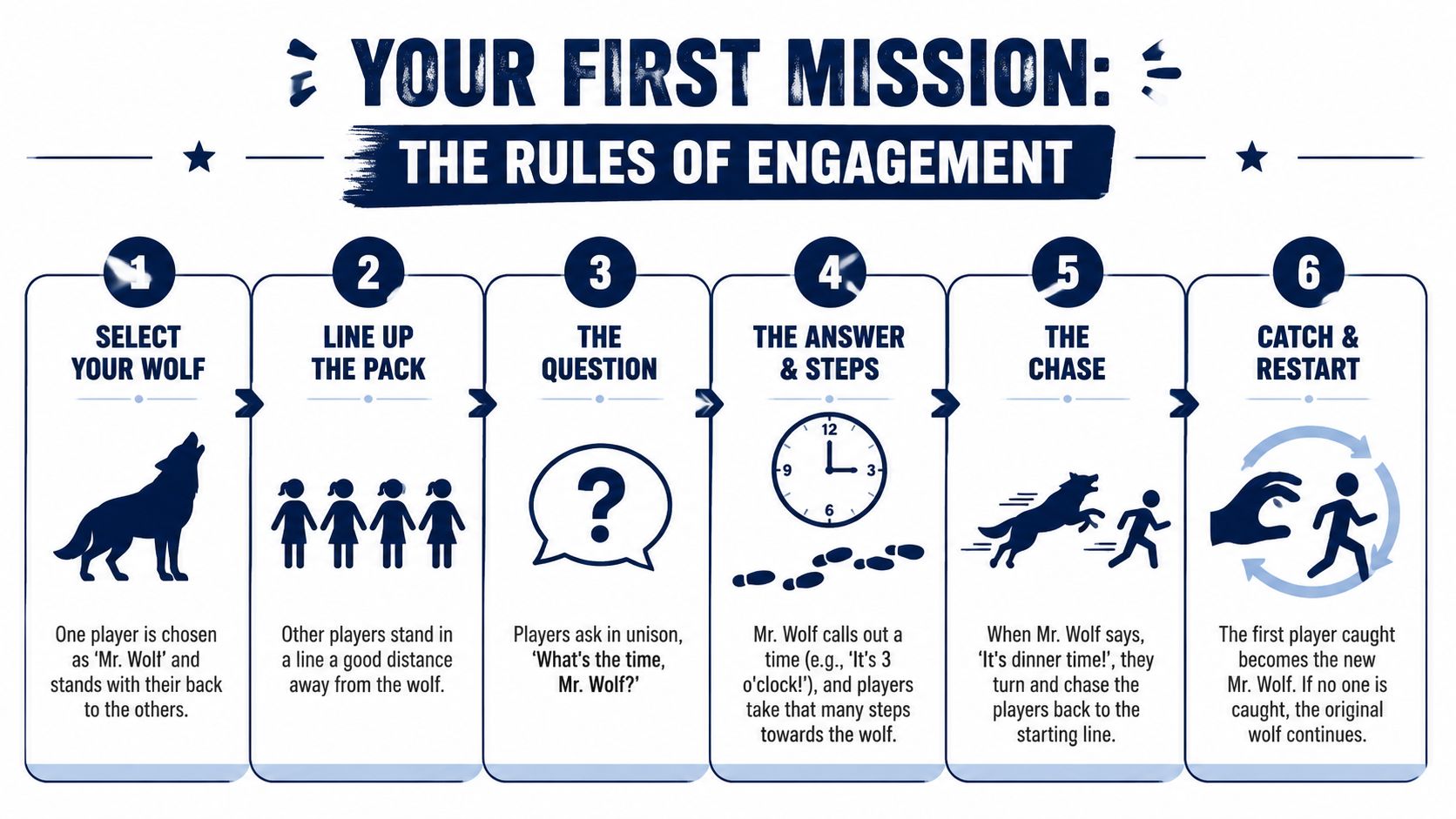
Choose one child to be the wolf. That child stands at one end of the space with their back to the group.
The rest of the players line up at the opposite end. Scouts UK suggests a 15 to 20 metre playing field in its activity method, which also notes an 85% engagement success rate in group settings, and advises that the wolf should call “Dinner time!” when players have crossed about 70% of the field for the best balance of fun and fairness in the chase, as described in the Scouts activity guide.
That sounds technical, but really it means this. Don't trigger the chase too early, and don't wait until the children are practically standing on the wolf's shoelaces.
Run the mission
Here's the flow that works best:
Choose the wolf
One player stands facing away from everyone else.Line up the group
Everyone else waits at the starting line.Ask the question together
“What's the time, Mr Wolf?”Wolf answers with a time
“It's three o'clock.”Players take matching steps
Three steps forward. Count them aloud.At any point, the wolf may call dinner time
Then the wolf turns and chases everyone back to the start.
If the wolf tags someone, that player usually becomes the next wolf.
The bit children argue about
It is nearly always the steps.
One child takes tiny mouse steps. Another takes giant moon-landing strides. A third invents something that looks like interpretive dance. Peace wobbles.
So make this clear before you begin:
- Use normal walking steps so everyone moves fairly
- Count out loud together to keep the group in sync
- Stay behind the line until the answer is given
- Run only to the safe zone once dinner time is called
Practical rule: do three short practice rounds before the real game. Children learn the rhythm quickly, and you avoid most of the “But I thought…” debates.
For another game that burns energy without needing much equipment, this popping bubbles game is a cheerful backup.
A simple script for nervous adults
If you're leading younger children, use this script:
“Cadets, stand on the launch line. Ask together. Listen carefully. Count your steps. If the wolf says dinner time, zoom back to base.”
That's it. Clear, brisk, and wonderfully effective.
Creative Twists for Every Space Cadet
Once children know the standard version, you can start tinkering. This makes the game especially useful. You can make it gentler, sillier, more educational, or more inclusive without losing its spark.

For younger children
Very young players often love the structure but struggle with the chase. So soften it.
Try these swaps:
Animal step version
Instead of standard walking, children take bunny hops, penguin waddles, or giant stomps.Freeze version
When “dinner time” is called, children freeze instead of run.Colour clock version
The wolf calls a colour and children step only if they can point to something that colour first.
This keeps the rhythm of the game while lowering the stress.
For older children who need more challenge
Once children are secure with o'clock times, add extra thinking.
You might use:
- half past
- quarter past
- quarter to
- matching analogue and digital times with cards
- prediction questions such as “How many steps will get us closest without reaching the wolf?”
That last one is especially fun because children start estimating distance, not just obeying instructions.
For inclusive play
This matters. A lot.
With 1.8 million pupils in the UK identified as having SEND in 2024/25, adapting games is essential, and many standard guides still don't offer enough support, which is why options such as visual timers, cooperative goals, and alternatives to chasing can make the game more accessible, as discussed in this SEND-focused gap summary.
Some children find sudden chasing thrilling. Others find it overwhelming. Both reactions are valid.
Use adaptations like these:
Visual prompt cards
Hold up clock images as well as saying the timeRole choice
Let children choose caller, counter, timekeeper, or line leaderCooperative ending
Replace chasing with “Can the team reach the rocket base before the alarm?”Quieter calls
Let the wolf ring a bell, lift a card, or use a soft voicePredictable pattern rounds
Use a fixed sequence before introducing surprise
Some children join more confidently when they know exactly what comes next.
Game variations for every mission
| Variation Name | Best For | Key Rule Change |
|---|---|---|
| Bunny Steps Wolf | Younger children | Players hop or waddle instead of taking standard steps |
| Freeze on Dinner | Children who dislike chasing | “Dinner time” means freeze, not run |
| Clock Match Mission | Classroom numeracy | Players match spoken times to cards or drawn clocks |
| Team to the Stars | Inclusive groups | Everyone works together to reach base before the final call |
| Space Ranger Version | Story-led play | The wolf becomes an alien guard and players are cadets |
If you want another party-friendly classic to remix, these pass the parcel ideas pair nicely with a themed games session.
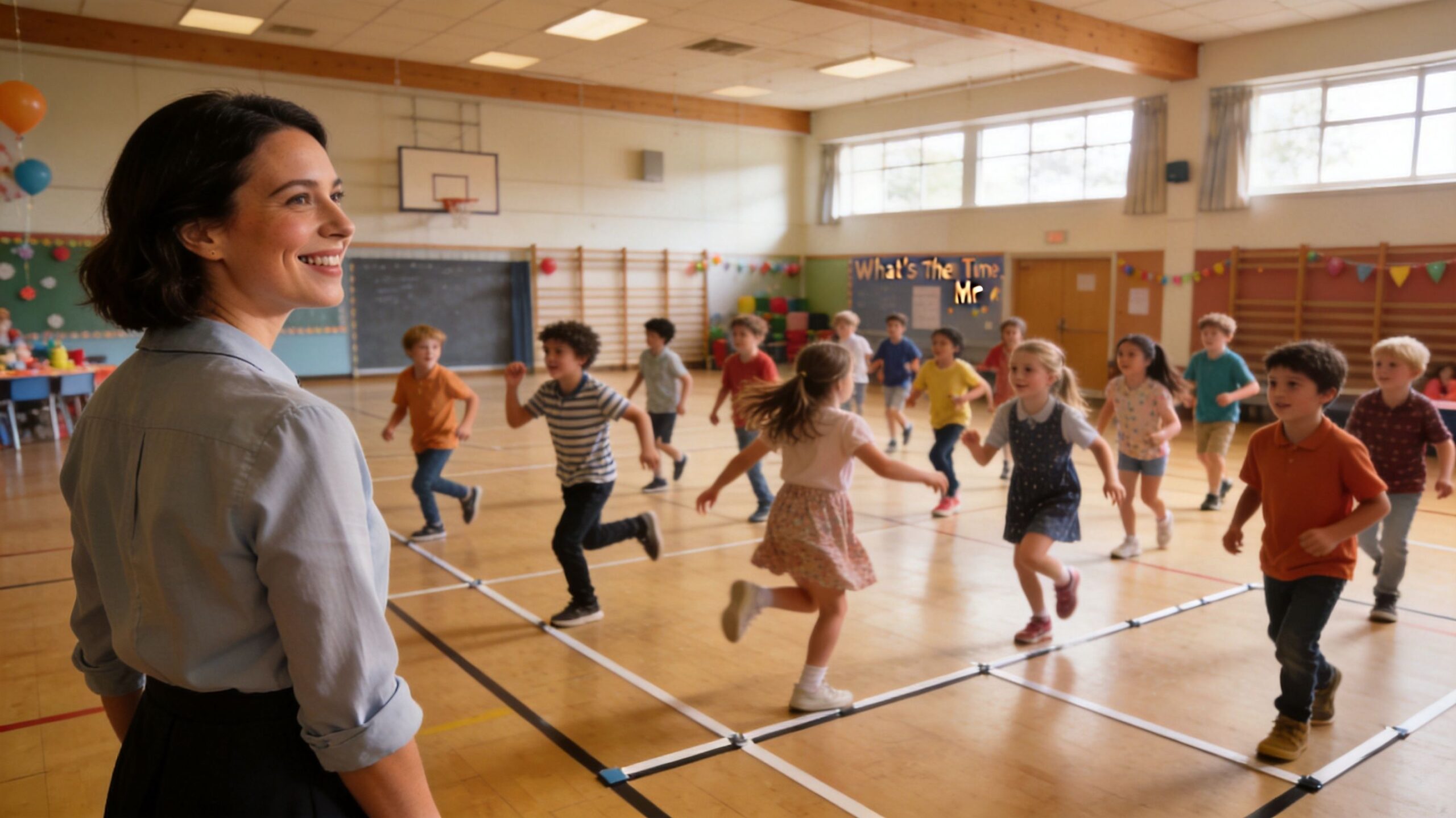
A quick visual example can help children grasp the energy of the game before you begin:
Mission Control Adapting for Classrooms and Parties
A small group can play this game almost instantly. A large group needs a little more orchestration. Happily, the game scales far better than many adults expect.
The biggest proof is wonderfully British. The largest recorded game involved 494 participants in Edinburgh, UK, showing just how adaptable this simple playground classic can be for big events, according to Guinness World Records.
How to manage bigger groups
You don't need hundreds of children to borrow the logic of a large event. Even with one class, these choices help:
Mark clear boundaries
Cones, chalk, or floor spots stop drifting and squashingSplit into waves
If the group is very large, run two smaller games side by sideAssign helper roles
One child counts, one watches the line, one checks fair stepsUse a visible safe zone
Children run better when they know exactly where “home” is
Why it works in schools
Teachers often need activities that do more than fill ten minutes. This one earns its place.
It supports:
- numeracy, because children hear and act on time language
- physical development, because they walk, stop, turn, and run
- listening skills, because one missed word changes everything
- social confidence, because taking part feels manageable even for reluctant joiners
It also fits beautifully into story-led learning. A bare instruction like “take four steps” can feel flat. A mission command like “advance four moon steps towards the crater gate” somehow feels urgent and hilarious at once.
Teacher move: give every child a job, even if they are not the wolf. Counters, callers, line judges, and clock holders stay involved.
For parties, libraries, and family events
Party organisers and librarians often need games with quick explanation and strong group appeal. This one is ideal because children can join halfway through and understand the pattern fast.
If you're indoors, reduce the running distance and switch from full chase to fast walking or freeze mode. If you're outdoors, use the extra space and let the drama build properly.
The result is organised chaos. Which, in my profession, is often the gold standard.
Download Your Free Mission Briefing
A printable pack turns this game into mission control.
For some children, hearing “three o'clock” is enough. For others, seeing the clock, saying the time, and then stepping it out makes the idea click. That is where a Space Ranger Fred style mission pack earns its space badge. It gives children something to hold, point to, and talk about, which is especially helpful in classrooms and mixed-age groups.
What to include in your pack
Keep it simple and usable. A good mission briefing pack usually includes:
Clock cards
Mix analogue and digital times so children can match what they see to what they hearCharacter masks
A wolf, alien, or space captain mask adds instant story energyMission certificate
A small finish-line reward can matter a lot to children who need a clear sense of successAdult prompt sheet
Short instructions help teachers, helpers, and family members run the game the same way
You can also adapt the pack for different learners. Add larger print, colour cues, fewer choices on each card, or a now and next board for children who benefit from extra structure. That small tweak can turn a busy playground game into a calm, predictable mission.
How to use it well
Use the printables as part of the action, not as a worksheet pile waiting on a table.
A simple sequence works well:
- Show one clock card
- Say the time aloud
- Let the group repeat it
- Take the matching number of steps
- Ask one quick reflection question
That routine works like a launch sequence. Children hear, see, say, move, and then explain. Each stage reinforces the one before it.
Try questions such as:
- What time did Commander Wolf say?
- How many steps matched that time?
- Was the clock face analogue or digital?
- Can you teach the next cadet how you knew?
That final question is the secret engine. It turns passive listening into real understanding, and it gives quieter children a chance to shine as mission experts.
Frequently Asked Mission Questions
Is it safe for all ages
It can be, if you choose the version sensibly. Young children often do better with walking, freezing, or a short chase to a very clear safe zone.
Check the surface first. Wet grass, cluttered halls, and mystery school shoes with untied laces are the natural enemies of smooth mission planning.
What if children get upset about being caught
Keep the emotional temperature low. Being tagged should mean a new role, not public failure.
You can say, “Brilliant, now you're the next wolf,” or “Excellent, you're on command duty.” A change of language can change the whole mood.
What if children cheat with giant steps
Don't enter a courtroom drama about it. Demonstrate one normal step, let everyone copy, and restart cheerfully.
If you know a group loves arguing, appoint a step captain. Children often accept a ruling faster from a peer role than from an adult repeating themselves.
What does the game actually teach
Quite a lot, very discreetly.
- Time vocabulary through repeated hearing and matching
- Counting practice through movement
- Self-control through waiting and listening
- Spatial awareness through distance and direction
- Communication through group responses and turn-taking
Can it work without a competitive chase
Absolutely. Replace the chase with a team goal. The whole group tries to reach the rocket base before the final signal.
That version is often calmer, more inclusive, and still full of excitement.
What should I remember most
Keep the rules clear. Keep the space safe. Keep the tone playful.
If children leave saying, “Can we do that again?” you've probably got it right.
If you'd like more story-led learning fun, explore the Space Ranger Fred books for adventures that mix reading, humour, and STEM in a child-friendly way. Schools and libraries can also book interactive visits through Space Ranger Fred to support confidence, communication, reading engagement, and lively science-flavoured storytelling. Learning should be experienced, not just delivered.