Ever watched a child build a magnificent fort out of cushions and blankets? They aren't following a blueprint. They’re figuring out which cushions can bear weight and how to stop the roof from caving in, all through trial and error. This is the heart of discovery learning.
It’s a hands-on, active approach where children become little detectives on a mission. They explore, ask questions, and piece together the answers for themselves, uncovering new ideas along the way.
What Is Discovery Learning All About?
Discovery learning completely flips traditional teaching on its head. Instead of pupils sitting quietly and soaking up facts, they’re encouraged to get their hands messy, experiment with ideas, and solve problems. Think of it as being a science explorer rather than just reading a science textbook.
The whole approach is about nurturing a child's natural curiosity. When they figure something out on their own—whether it’s why a paper aeroplane flies better with folded wings or what happens when you mix blue and yellow paint—that knowledge sticks. They own that discovery, which makes learning feel genuinely exciting and rewarding.
This concept map shows how being active, hands-on, and a great problem-solver are central to discovery learning.
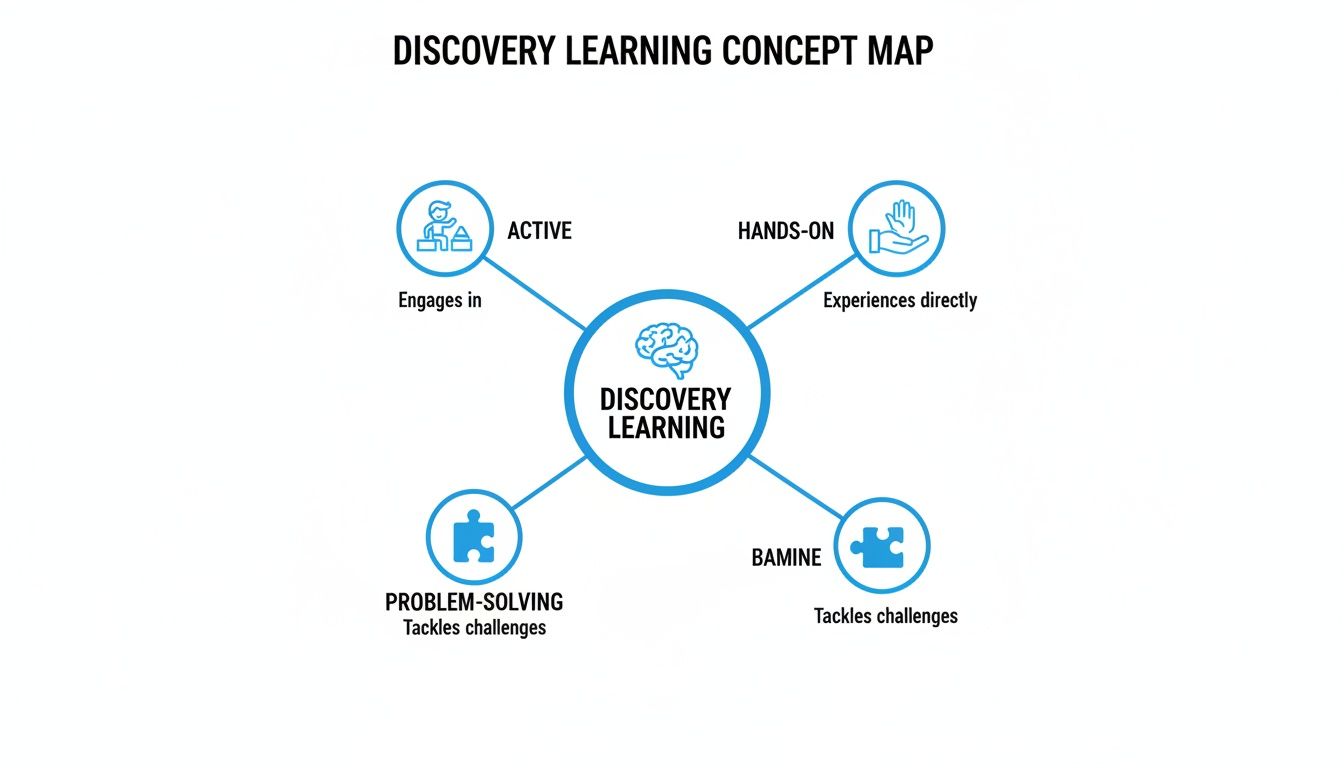
The map helps visualise how this method encourages children to actively engage with challenges, using their own two hands to find solutions. It's all about doing, not just listening.
A Different Kind Of Learning
The biggest difference between discovery learning and more traditional methods comes down to the roles of the child and the adult. In discovery learning, the child is the active explorer. The parent or teacher acts more like a guide, setting up interesting challenges and asking thoughtful questions to help them along their journey.
This is a world away from the traditional model where the teacher is the expert delivering information for the child to absorb.
This shift has a huge impact. To give you an idea, a recent study found that 75% of primary teachers saw higher student motivation when using discovery-led methods, with children showing 40% more enthusiasm for their projects.
It’s an approach that works brilliantly for small-group collaboration, especially with average primary school pupil-to-teacher ratios at 18.1 in England. Discovery learning is also closely related to other hands-on approaches, which you can read about in our guide to what is kinesthetic learning.
Discovery Learning vs Traditional Learning At A Glance
To make the distinction crystal clear, here’s a simple table comparing the two approaches. It really highlights how discovery learning empowers the child to take charge of their own educational adventure.
| Feature | Discovery Learning | Traditional Learning |
|---|---|---|
| Learner's Role | Active explorer, problem-solver | Passive recipient of information |
| Teacher's Role | Facilitator, guide | Expert, instructor |
| Learning Process | Hands-on, inquiry-based, experimental | Rote memorisation, listening, direct instruction |
| Pace of Learning | Self-paced, driven by curiosity | Teacher-paced, follows a set curriculum |
| Motivation Source | Intrinsic (curiosity, sense of achievement) | Extrinsic (grades, rewards) |
| Focus | Understanding the 'why' and 'how' | Memorising the 'what' |
| Activities | Experiments, building projects, group problem-solving | Lectures, reading textbooks, completing worksheets |
As you can see, the focus shifts from simply knowing facts to truly understanding concepts. It’s about building a foundation of curiosity and critical thinking that will serve them well beyond the classroom.
Why Discovery Learning Builds Essential Life Skills
The real magic of discovery learning isn’t just about grasping a new science concept; it’s about building the skills children need for life. When a child figures something out on their own, they’re doing so much more than just finding an answer. They're learning how to think, how to adapt, and how to keep going when things get tricky.
Think about a kid trying to build the ultimate paper aeroplane. Through endless trial and error, they learn that a folded nose makes it fly faster, or that wider wings help it glide. This isn't just a lesson in aerodynamics; it's a mini-masterclass in critical thinking and problem-solving. They have to analyse what went wrong, dream up new ideas, and test them out.
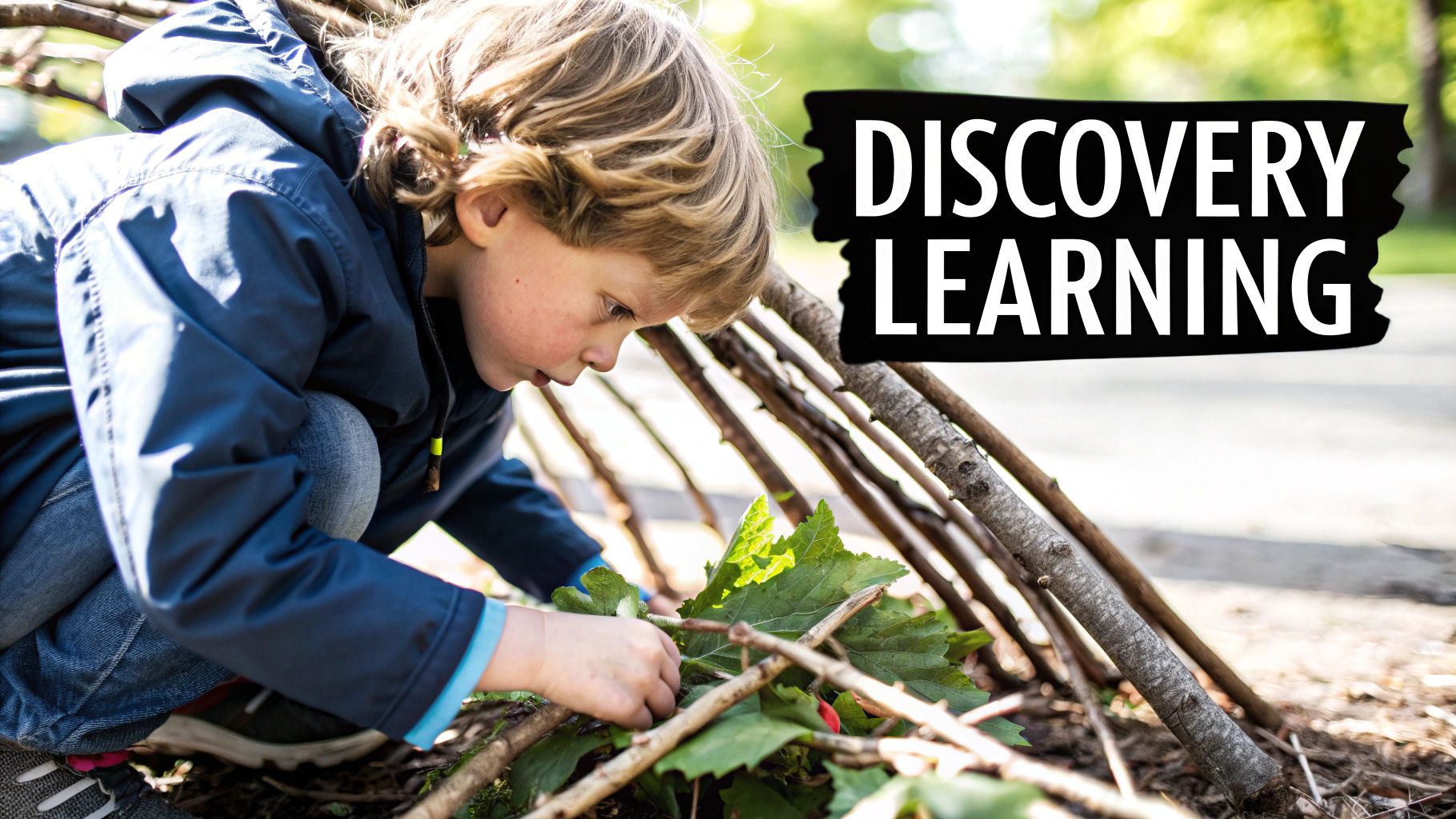
This hands-on process creates powerful, long-lasting memories. Knowledge that's personally uncovered sticks around far longer than facts simply memorised from a textbook.
Nurturing Curiosity and Confidence
Every time a child has that "Aha!" moment, something wonderful happens. They experience a jolt of intrinsic motivation—the pure, simple joy of figuring things out for themselves. That feeling is incredibly rewarding, and it's what encourages them to keep asking questions and exploring new challenges.
Discovery learning teaches children that it's okay not to know the answer right away. The real fun is in the journey of finding out, turning mistakes into opportunities and challenges into adventures.
This approach helps build a resilient and creative mindset. Kids who are comfortable with experimenting and adapting are far better equipped to face unfamiliar situations in every part of their lives. A simple kitchen experiment or a bug hunt in the garden is actually a training ground for lifelong problem-solving.
The Key Benefits for Young Explorers
So, what are the core life skills that discovery learning really helps to develop? It builds a foundation that supports them well beyond their school years.
- Boosts Critical Thinking: Children learn to analyse problems, weigh up evidence, and make logical connections on their own.
- Encourages Resilience: When an experiment doesn't work, they learn to try again, tweaking their approach and building perseverance.
- Fosters Creativity: Without a strict set of instructions, children are free to imagine, invent, and find totally unique solutions.
- Develops Intrinsic Motivation: The satisfaction of solving a puzzle or making a discovery fuels a genuine love for learning that comes from within.
By giving children the space to explore, we empower them to become confident, capable, and endlessly curious individuals. If you’re looking for fun ways to get started, check out the Space Ranger Fred activities page for lots of exciting discovery missions.
How To Bring Discovery Learning Into The Classroom
Ready to turn your classroom into a hub of exploration? Weaving discovery learning into your lessons is probably easier than you think. The real secret is shifting your role from an instructor to more of a ‘Mission Commander’—someone who provides the initial briefing, offers the right tools, and asks fantastic questions to nudge your crew forward.
Instead of just handing out answers, you’re creating an environment where pupils can find them for themselves. This means celebrating mistakes as valuable data and cheering on teamwork every step of the way. It’s all about building an atmosphere of trust and curiosity where every child feels confident enough to explore.
In the UK, this approach gives children the chance to 'co-create' their own education. Recent research highlights just how powerful discovery through inquiry can be for building relationships. In fact, 84% of teachers involved in co-creation projects reported stronger trust between students and staff. This method is also a natural fit for EdTech; things like animations have been shown to improve outcomes for pupils with lower prior knowledge when used in a discovery setting.
A Sample Mission To The Moon
Let's imagine a sample lesson: designing a settlement on the Moon. Instead of starting with a lecture on lunar conditions, you set the scene and pose a big, exciting challenge.
The Mission Briefing:
"Space Explorers, your mission, should you choose to accept it, is to design a base for the first humans to live on the Moon! You’ll need to figure out how they will get air to breathe, what they will eat, and how they’ll travel across the lunar surface."
The Discovery Process:
- Team Up: First, pupils form small astronaut crews. Getting these team dynamics right is crucial, and you might find our guide on classroom engagement strategies helpful for building great teamwork.
- Brainstorm & Design: Each crew gets to work tackling a problem. One team might design a lunar rover from cardboard and straws, another could research plants that might grow in a sealed biodome, and a third could be planning a sustainable food supply.
- Experiment & Adapt: The rover team might quickly realise their wheels are too flimsy. Instead of telling them the answer, you can ask, "What other shapes or materials might make it stronger?" They discover the best solution through good old-fashioned trial and error.
As Mission Commander, your job is to ask probing questions like, "What have you discovered so far?" or "What do you think might happen if you try that?" This helps guide their thinking without ever taking away their sense of ownership.
Cross-Curricular Discovery Adventures
The great thing about discovery learning is that it can be woven into almost any subject, creating a rich, interconnected experience that makes learning feel relevant and exciting.
- Science: Challenge pupils to build a simple circuit to light up a "star." They'll uncover the principles of electricity for themselves.
- History: Turn them into mini-archaeologists. Give them mock artefacts (think old photos, maps, or diary entries) and ask them to piece together the story of a local historical event.
- Maths: Forget worksheets and set up a classroom shop. Pupils can price items, manage a budget, and calculate change, learning practical financial skills as they go.
To take it a step further, especially in science, exploring various digital tools and platforms designed for STEM education can provide some brilliant resources. By framing lessons as missions and challenges, you ignite your pupils' natural curiosity and turn your classroom into a real launchpad for adventure.
Turning Your Home Into A Launchpad For Discovery
You don’t need a fancy science lab to kickstart a discovery learning adventure. In fact, your home is already the perfect launchpad! With a bit of imagination, everyday objects and routines can be transformed into exciting missions that spark curiosity and build confidence. It’s all about shifting your perspective and seeing the learning potential in the world around you.
The key isn’t having all the answers; it’s about asking brilliant questions. By encouraging your child to wonder, predict, and investigate, you empower them to become the hero of their own learning story. This approach turns ordinary moments into extraordinary explorations.
Your At-Home Mission Briefing
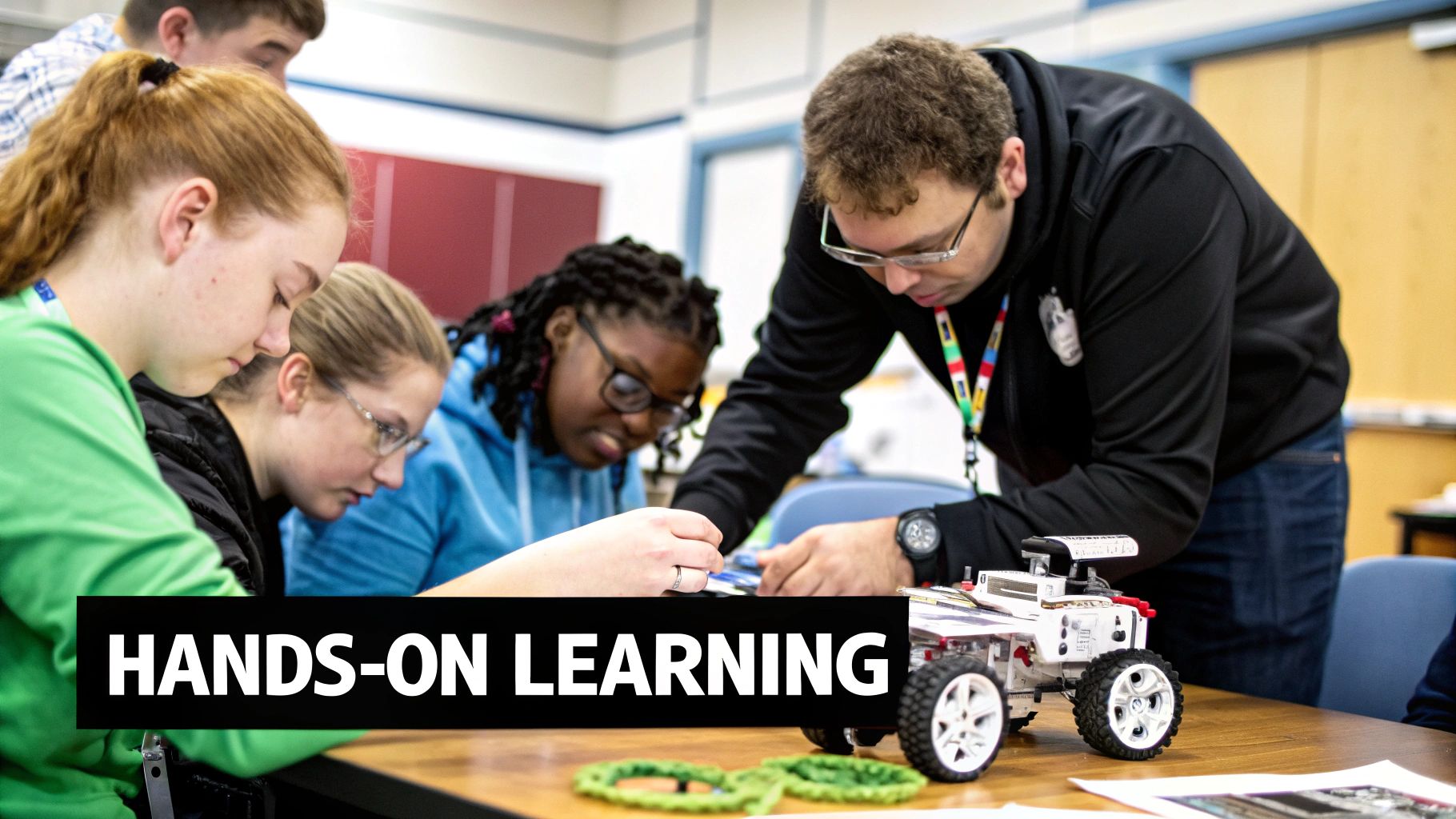
Ready to get started? Here are a few simple, playful missions you can try at home. These ideas require minimal setup but offer maximum opportunity for hands-on discovery.
- Kitchen Science Lab: Baking a cake becomes a chemistry experiment. Ask, "What do you think the baking powder does?" or "Why does the mixture get bubbly?" Let them measure, mix, and observe the magical transformations.
- Garden Safari: Head outside with a magnifying glass and a notebook. Your mission: identify as many different insects, leaves, and flowers as you can. Encourage them to draw what they see and wonder about the roles these tiny creatures play.
- Cardboard Spaceship Challenge: Gather empty boxes, tape, and anything else you can find. The challenge is to build a spaceship sturdy enough for an imaginary journey to Mars. This is a brilliant way to explore basic engineering and design principles.
The goal here is to let your child lead the way. If you're looking for more structured projects, our guide to the best science kits for kids has some fantastic ideas that still leave plenty of room for discovery.
How To Be The Best Mission Guide
Your role as a parent or homeschooler is to be a supportive guide, not an instructor with all the solutions. This can be tricky, as our instinct is often to help by providing direct answers. Resisting that urge is one of the most powerful things you can do.
The most important part of discovery learning at home is fostering a mindset where questions are more valuable than answers, and trying is more important than succeeding on the first attempt.
Instead of just giving the answer, try using gentle prompts to guide their thinking. These open-ended questions encourage children to develop their own problem-solving skills and build resilience when things don’t go as planned.
Your Guiding Question Toolkit:
- "What do you think might happen if we…?"
- "That’s an interesting idea! How could we test it?"
- "What did you notice when you did that?"
- "What could we try differently next time?"
By using these prompts, you’re telling your child that their ideas matter and that you trust them to figure things out. This is how you turn your home into a place where curiosity thrives, building a foundation for a lifelong love of learning—just like the adventures in the Space Ranger Fred book series.
How Stories and Characters Inspire Discovery
Stories are one of the most powerful tools we have for sparking a child's curiosity. They pull us into new worlds, introduce us to brave heroes, and throw exciting problems our way that we get to solve right alongside the characters. This is where discovery learning and storytelling connect so beautifully, turning what could be a passive reading experience into an active, imaginative adventure.
The Space Ranger Fred universe is built on this very idea. Fred and his crew don’t just follow a set of instructions; they’re constantly up against the unknown. Their adventures are a perfect model of the discovery mindset in action, showing children that learning is an exciting quest filled with challenges, teamwork, and brilliant ‘aha!’ moments.

This blend of story and hands-on thinking feels more important than ever. Animated stories like Space Ranger Fred’s are a natural fit for how kids are learning today, especially with the growth of the global animation market and the increasing use of educational apps by UK students. The media they engage with can be a fantastic bridge for education, especially when it’s designed to be interactive and engaging.
Learning Through Adventure
Just imagine Fred and his robot sidekick, C.H.I.P., trying to navigate a dense asteroid field. There’s no map to follow. They have to rely on observation to spot patterns in the floating rocks, use teamwork to call out dangers, and lean on experimentation to find the safest path through. They might try a zigzag pattern first, realise it’s too slow, and then try to use the gravitational pull of a larger asteroid to slingshot past.
This little scene isn't just a story; it's a perfect demonstration of the discovery learning process. The crew hits a problem, brainstorms solutions, tests them out, and learns from the results. It makes the idea of trial and error feel exciting rather than something to be scared of.
By following characters who embrace challenges with a positive attitude, children learn that it’s okay not to have the answer straight away. The real fun is in the journey of figuring things out.
Building Resilience One Story at a Time
The adventures of the Space Ranger Fred crew also model resilience in a big way. When a mission doesn't go to plan, they don't just give up. Instead, they regroup, share ideas, and try a different approach. This teaches children a vital life skill: perseverance.
- Problem-Solving: Watching characters think through a challenge encourages children to try similar strategies in their own lives.
- Positive Attitude: Fred’s relentless optimism shows that setbacks are just part of the adventure, not failures to be feared.
- Curiosity as a Superpower: The crew’s endless questions encourage young readers to start asking their own "what if?" and "why?" questions.
By wrapping STEM concepts inside these exciting narratives, we show children that learning isn't just about facts and figures. It’s about exploration, creativity, and the genuine thrill of discovery. And if you really want to capture young imaginations, it's well worth exploring how to boost classroom enthusiasm with storytelling videos, as they can take the power of a great story to a whole new level.
Space Ranger Fred is the perfect companion for any child ready to launch their own discovery-led STEM mission.
Common Questions About Discovery Learning
As you get ready to launch your own discovery-led adventures, it’s completely normal to have a few questions buzzing around. It’s a different way of thinking about learning, for sure, but it’s often more intuitive than it sounds. Here are some of the most common queries we hear from parents and teachers, with clear, practical answers to help you feel confident and excited.
Is Discovery Learning Just Unstructured Playtime?
Not at all! This is probably the biggest misconception out there. While it often feels as joyful as play, effective discovery learning is carefully guided. It’s not a free-for-all; a better way to think of it is ‘structured freedom’.
The adult’s role here is to be a thoughtful mission planner. You set up an interesting challenge, provide the right tools, and then ask great questions to steer the exploration towards a learning goal. It’s like creating a treasure map for your child—they get the thrill of the hunt, but you’ve helped design a path that leads to a wonderful discovery.
How Do I Know If My Child Is Actually Learning?
This is a great question. Assessment in discovery learning looks very different from a traditional test. Instead of judging them on a final score, you can learn so much by simply observing their process and talking to them about it.
Genuine understanding really shines through in their actions and explanations. You can look for a few key signs:
- Deeper Questions: Are they moving beyond "what is this?" to "what would happen if I…?"
- Trying New Strategies: When they hit a wall, do they try a different approach or just give up?
- Explaining Their Thinking: Afterwards, ask them to describe their journey. Can they explain what they did, why they did it, and what they found out along the way?
Their ability to talk through their process is a fantastic indicator of real learning. The focus is on the how and why, not just the what.
What Should I Do If My Child Gets Frustrated?
First off, know that frustration is a natural, and even important, part of the learning process. It’s a sign that your child is tackling something genuinely challenging, and overcoming it is what builds resilience. The key is to create a supportive environment where mistakes are seen as valuable clues, not failures.
When frustration hits, your job is to be the calm, encouraging co-pilot. You can help by:
- Breaking the problem down into smaller, more manageable steps.
- Asking, "What's just one tiny thing we could try differently?"
- Praising their effort and perseverance, not just the final outcome.
Remember, the Space Ranger Fred crew often faces setbacks on their missions. Their stories show children that getting stuck is normal and that working together can help you overcome any obstacle. Seeing heroes persevere makes it easier for them to do the same.
This approach helps children develop a healthy relationship with challenges, teaching them that persistence pays off. By reframing frustration as part of the adventure, you empower them to become confident and resilient problem-solvers for life.
The entire Space Ranger Fred universe is designed to inspire this kind of curious, hands-on exploration. From books that model problem-solving to activities that get kids creating, we’re here to make STEM learning an unforgettable adventure.
Ready to launch your next mission? Explore the world of Space Ranger Fred today.